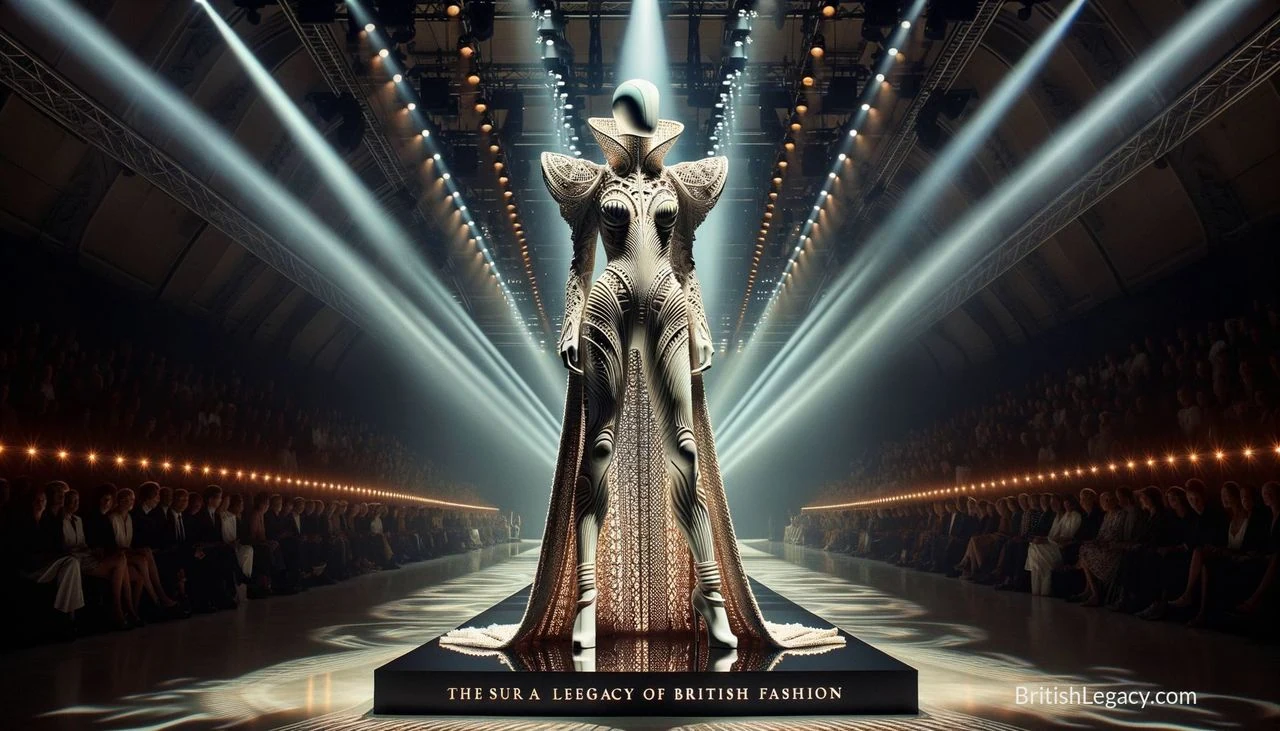
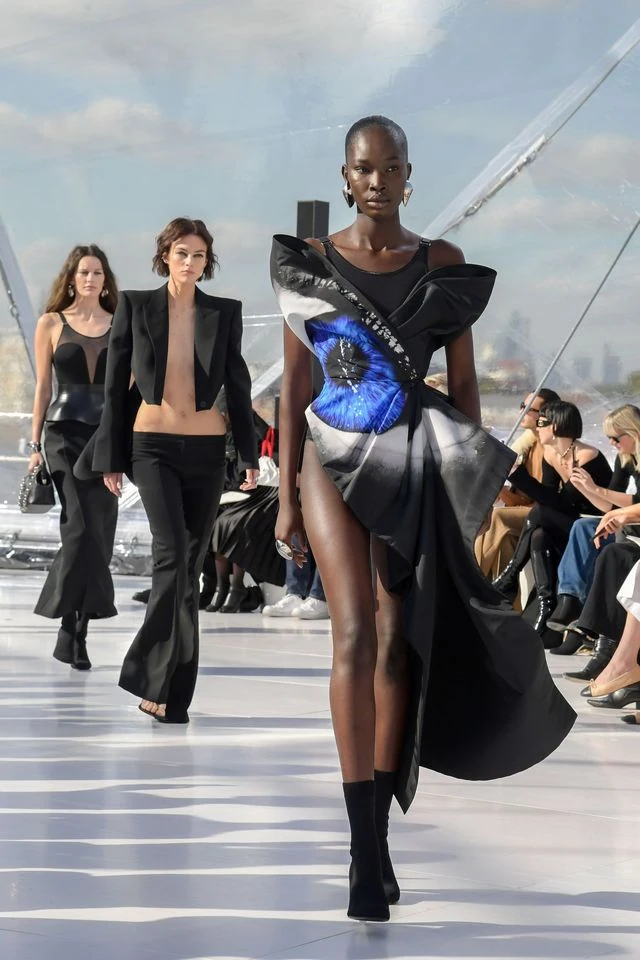
Alexander McQueen built his reputation on a striking combination: the disciplined cut of a tailor and the disruptive imagination of a showman. He trained on Savile Row, but his collections did not treat clothing as a quiet exercise in finish. They brought history, nature and conflict onto the catwalk, often through silhouettes and staging that audiences could not ignore. From his London beginnings to his work at Givenchy and the international growth of his own label, McQueen made British fashion’s tailoring traditions part of a far more confrontational story.
Learning the work of the tailor
Lee Alexander McQueen was born in Lewisham, London, on 17 March 1969, the youngest of six children. His father, Ronald, worked as a taxi driver and his mother, Joyce, was a social science teacher. He attended Carpenters Road Primary School and Rokeby School. Interested in clothes from childhood, he made dresses for his sisters and later recalled drawing a dress on the wall at home when he was three.
McQueen left school at 16 in 1985 with one O-level, in art, and studied tailoring at Newham College. He then began a two-year apprenticeship in coat-making at Anderson & Sheppard on Savile Row, followed by a short period as a pattern cutter at Gieves & Hawkes. He worked briefly for theatrical costumiers Angels and Bermans, making costumes for productions including Les Misérables, and later worked for designers Koji Tatsuno and John McKitterick. A period in Milan included work in Romeo Gigli’s studio.
In 1990, McQueen approached Bobby Hillson, head of the fashion MA course at Central Saint Martins, seeking a job teaching pattern cutting. His portfolio persuaded Hillson to admit him to the course despite his lack of formal qualifications. He borrowed money from his aunt to pay the fees. His graduation collection, Jack the Ripper Stalks His Victims, was presented at London Fashion Week in March 1992 and bought in its entirety by fashion editor Isabella Blow. Blow became a mentor and promoter, using her contacts to support his early career.
A London label and an uncompromising point of view
McQueen started his own label in 1992, using his middle name, Alexander. His first post-graduation collection, Taxi Driver, appeared in 1993. It introduced the “bumster”, a dramatically low-rise trouser that became one of his recognisable designs. The following year, his first professional runway show, Nihilism, used deliberately bruised-looking styling and revealing clothes. Early collections made controversy part of the conversation around his work, but they were also grounded in command of pattern, cut and construction.
Highland Rape, shown for autumn/winter 1995, took its inspiration from the Highland Clearances. Its torn and distressed garments provoked criticism from viewers who read the collection as a depiction of violence against women. McQueen said it referred to England’s treatment of Scotland and rejected that interpretation. The dispute showed how his historical references could be forceful and contested, rather than decorative. The collections that followed, including The Hunger and Dante, widened his profile; he received his first British Designer of the Year award in 1996.
He used the catwalk as a space for constructed images and live action. For No. 13, the spring/summer 1999 collection, McQueen drew on the Arts and Crafts movement and its interest in handwork. Double-amputee model Aimee Mullins walked on intricately carved ash prosthetic legs. The show ended with Shalom Harlow in a white dress, spray-painted by two industrial robotic arms. Later, Voss (spring/summer 2001) placed its audience opposite a dark glass box that initially reflected the spectators before revealing a tableau inside. These were not simply presentations of clothes: the setting, reveal and final image were integral to the collection’s effect.
Givenchy, Gucci and a growing international stage
In 1996, McQueen became head designer at Givenchy, succeeding John Galliano. The appointment placed a British-trained designer at the head of a Paris couture house. His first collection for the label received a mixed response, and McQueen later criticised it himself. His relationship with the house remained strained; he left in 2001, saying that it had begun to constrain his creativity. Alongside the Givenchy work, his own collections continued to develop. Shows including It’s a Jungle Out There and No. 13 demonstrated how he could turn a critical response or an idea about nature and industry into a distinct runway language.
In 2000, the Gucci Group acquired 51 per cent of McQueen’s company, with McQueen remaining creative director of his label. The partnership helped the business expand, including the opening of boutiques in cities around the world and the development of new product lines. It also gave his label a wider commercial reach without ending the elaborate staging of its shows. For It’s Only a Game in spring 2005, models formed a human chess game; The Widows of Culloden in autumn 2006 ended with a life-sized illusion of Kate Moss in rippling fabric.
McQueen also designed for musicians. He created costumes for David Bowie’s 1997 tour and worked with Björk on designs connected with her music. His interest in natural forms and imagined futures came together in Plato’s Atlantis, presented in Paris in October 2009. The collection envisaged human beings adapting to a flooded world and used digital prints, intricate construction and distinctive armadillo shoes. It was his last fully realised mainline collection.
Recognition, loss and the work after his death
McQueen received four British Designer of the Year awards between 1996 and 2003. He was named International Designer of the Year by the Council of Fashion Designers of America in 2003 and appointed a Commander of the Order of the British Empire that year for services to fashion. His achievements encompassed both the exacting construction of garments and the ability to make a collection’s ideas legible through its setting, styling and movement.
McQueen died in London on 11 February 2010, aged 40. His final autumn/winter collection was unfinished; his design team completed the pieces and presented them in a small series of shows. Sarah Burton, his longtime collaborator, became creative director of the Alexander McQueen label in May 2010. The company continued after his death, and the brand remains active. The original article also notes that Burton designed the wedding dress worn by Catherine, Duchess of Cambridge.
His work has also been presented in major retrospective exhibitions. Alexander McQueen: Savage Beauty opened at New York’s Metropolitan Museum of Art in 2011 and was shown at London’s Victoria and Albert Museum in 2015. A later exhibition, Lee Alexander McQueen: Mind, Mythos, Muse, opened in 2022. Such displays place his clothes in conversation with the wider histories and visual references that informed them, while preserving the detail of the garments themselves.
Why Alexander McQueen deserves a place in British Legacy
McQueen’s place in British Legacy rests on a particular meeting of skills and ambition. His formation as a designer was shaped by British tailoring: he trained at Newham College and served an apprenticeship on Savile Row before developing his own label. That knowledge of cut and construction did not confine him to convention. He used it to make clothes that could carry difficult historical references, create unfamiliar silhouettes and hold their own within elaborate theatrical presentations. The combination made his work recognisable without reducing it to spectacle alone.
His influence also shows how British fashion could travel. A designer who came through London training and London Fashion Week became head designer at Givenchy, built an international label through the Gucci partnership, and brought his work to audiences through exhibitions in London, New York and elsewhere. The benefit to British fashion was not simply publicity: McQueen demonstrated that technical craft and experimental ideas could command attention on an international stage. His career is also a reminder that fashion design can operate across disciplines, bringing tailoring into contact with performance, history, music and technology. The garments, shows and exhibitions remain a substantial record of that achievement.
Sources
Alexander McQueen — supplied Wikipedia revision
Adapted in part from Alexander McQueen by Wikipedia contributors, under CC BY-SA 4.0. Text has been edited and combined with the existing article; this adapted text is shared under the same licence. Contributor history.