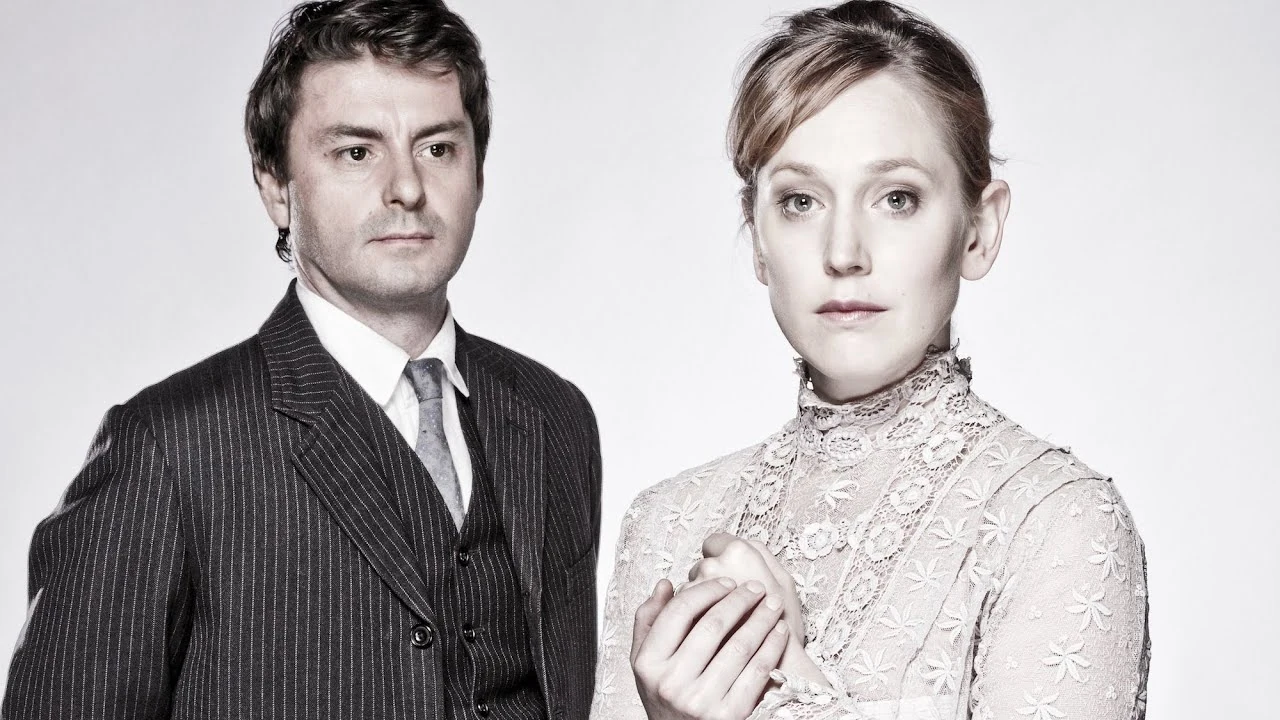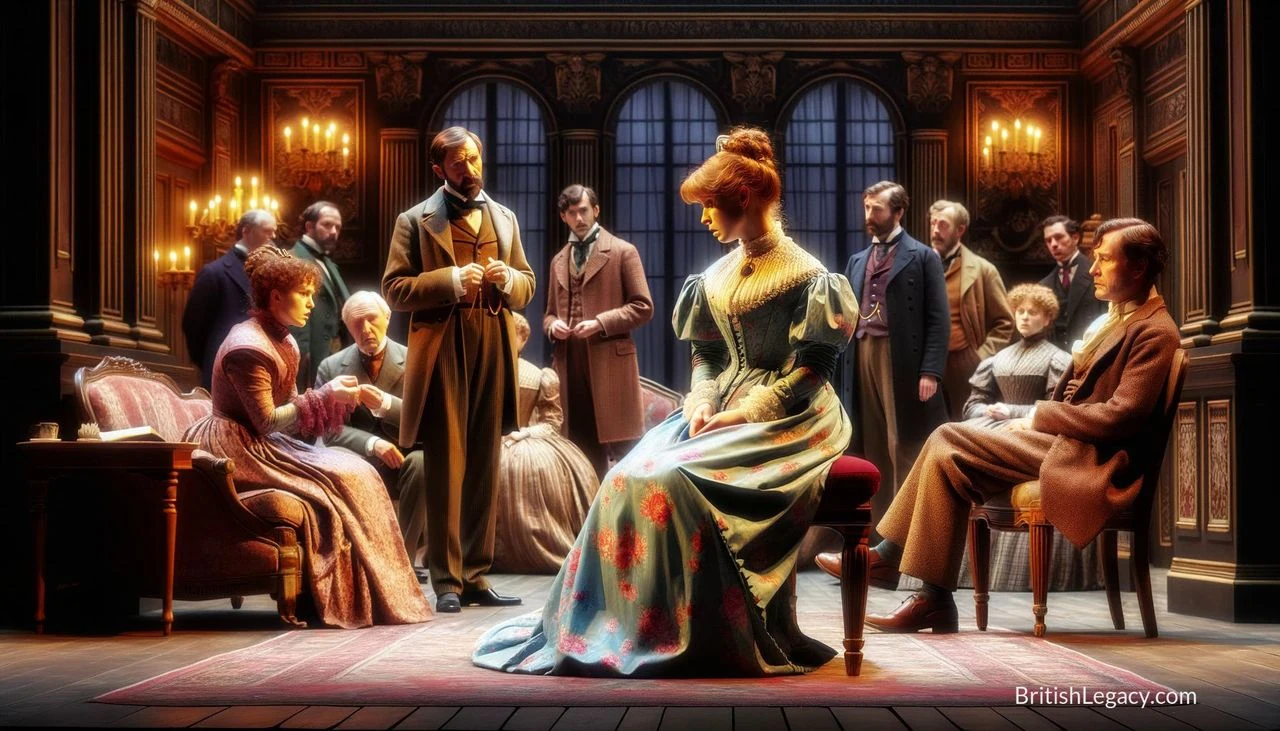
At the centre of Henrik Ibsen’s A Doll’s House is a domestic secret with public consequences. Nora Helmer has borrowed money to save her husband, Torvald, and forged her father’s signature to secure the loan. When the truth threatens the respectability Torvald prizes, his response forces Nora to reconsider the marriage and the life she has been playing a part in. First published in 1879, the Norwegian play became a landmark of modern drama. Its British history includes an early London production and, much later, a British-French film adaptation that took Ibsen’s one-room drama into a broader cinematic world.
A marriage built on a secret
The play takes place in the Helmer household over Christmas. At first, the home appears comfortable and secure. Torvald’s advancement to a managerial post at a bank promises greater prosperity, while Nora seems to occupy the familiar role of a dependent, lightly frivolous wife. Beneath this appearance, however, she is working to repay a private loan.
Nora borrowed the money when Torvald was seriously ill, believing it could help save him. Because she could not obtain the loan openly, she forged her father’s signature. Nils Krogstad, an employee at Torvald’s bank, knows what she has done. When Torvald is appointed to a senior position, he plans to dismiss Krogstad. Krogstad then threatens to expose Nora’s debt and forgery unless she intervenes to protect his job.
The danger is not simply that Nora’s secret will become known. She expects Torvald to understand that she acted to help him; instead, when he learns of the forgery, he condemns her for the damage it may do to his reputation and their standing. His anger makes visible the imbalance in a marriage that had seemed affectionate. Nora comes to see herself as having lived in a “doll’s house”, valued and managed rather than treated as an independent person. She leaves Torvald and their children to seek a life and identity of her own, rejecting the expectations imposed on a wife and mother.
An early London encounter
A Doll’s House was written by a Norwegian playwright and first published in 1879; its place in British theatre comes through performance and interpretation, not its origin. The existing account identifies a Royal Court Theatre production in London in 1889, with Janet Achurch as Nora Helmer and J. T. Grein directing. It presents that staging as an early introduction of Ibsen’s work to British audiences.
The play’s argument about marriage, money and a woman’s freedom gave British theatre a work that could be approached as both a domestic drama and a challenge to accepted social roles. Its concentrated setting and tightly connected secret, threat and confrontation place the pressure inside the Helmer home. The conflict is intimate, but Torvald’s concern with respectability shows how private choices are shaped by social judgement.
The play has continued to invite reinterpretation as attitudes towards marriage and women’s independence have changed. Its lasting value on stage rests not on a single prescribed reading of Nora, but on the hard question the ending leaves behind: what obligations should a person accept, and what must be learned before a life can be freely chosen?
From one room to the screen
A separate British connection came with Joseph Losey’s 1973 film adaptation, scripted by British dramatist David Mercer. The film was a United Kingdom–France co-production, distributed in the UK by British Lion, and starred Jane Fonda as Nora and David Warner as Torvald. Its cast also included Trevor Howard, Delphine Seyrig and Edward Fox. The film was shot on location in Røros, Norway, and was released in France on 17 May 1973.
Mercer and Losey made substantial changes for cinema. Ibsen’s play keeps its action in a single room over a single day; the film expands the story into additional scenes and locations. Events that the stage play discusses rather than shows—including Nora and Kristine’s earlier friendship, Kristine’s relationship with Krogstad, Torvald’s illness and Nora’s father’s death—become part of an extended prologue. Moving beyond the Helmer home offers the film a way to visualise the history behind Nora’s predicament, while the play’s confined room makes her isolation part of the stage form.
The film was one of two English-language versions of Ibsen’s play released in 1973; Patrick Garland’s version starred Claire Bloom and Anthony Hopkins. Losey’s adaptation received mixed reviews, and the simultaneous releases faced commercial difficulties in competing for a relatively small audience. Its arrival in the United States was also unusual: rather than receiving a conventional theatrical release there, it was first broadcast on ABC as a television film on 23 December 1973.
Adaptation and interpretation
Fonda’s public association with feminism shaped discussion of her casting and performance. Some critics praised her work; others argued that her star image affected how audiences saw Nora’s gradual change and final decision. Fonda herself criticised Losey in a letter written in June 1973, objecting to remarks he had made about women and arguing that his approach had harmed the film. Losey, in turn, complained about Fonda’s attention to political speeches during production. These disagreements are part of the film’s record, but they should not be mistaken for the play’s own argument: the positive feminist themes identified by some commentators derive from Ibsen’s drama.
The adaptations show how a work can change medium without losing its central conflict. The stage version concentrates attention on the marriage as it unfolds in a restricted domestic space. The film adds scenes and settings to make a longer history visible, while keeping Nora’s secret and the consequences of its discovery at the centre. Neither version closes off debate about her choice; each gives audiences a different way to encounter it.
Why A Doll’s House deserves a place in British Legacy
A Doll’s House deserves a place in British Legacy because its history in Britain connects a Norwegian play with a specific London stage production and a later screen adaptation made through British creative and production links. The reported 1889 Royal Court staging, with Janet Achurch as Nora and J. T. Grein directing, marks an early point in the play’s British performance history. Its importance is not that Ibsen was British, but that British theatre took up a work that placed marriage, financial dependence and women’s independence in open dramatic conflict.
The 1973 film extends that connection in another form. British dramatist David Mercer helped reshape the play for cinema; the co-production involved the United Kingdom and France, British Lion distributed it in the UK, and actors including David Warner, Trevor Howard and Edward Fox appeared alongside Jane Fonda and Delphine Seyrig. The film’s expanded scenes also make a useful contrast with Ibsen’s tightly confined stage structure. Together, the stage history and adaptation show how British performance and filmmaking have engaged with an internationally written drama, carrying its questions into different artistic forms. That continuing capacity for reinterpretation—not a claim of British authorship—is the work’s evidenced British legacy.
Sources
A Doll’s House (1973 Losey film), revision 1368107342
Adapted in part from A Doll's House (1973 Losey film) by Wikipedia contributors, under CC BY-SA 4.0. Text has been edited and combined with the existing article; this adapted text is shared under the same licence. Contributor history.