In Noël Coward’s Private Lives, two newly married couples discover that their hotel rooms share a terrace. For Elyot Chase and Amanda Prynne, the encounter is also a reunion: they were once married to each other, and the attraction between them has survived their divorce. Their decision to leave their new spouses and run away together sets in motion a comedy in which desire and quarrelling are inseparable. First staged in 1930, the play has endured through revivals, adaptations and performances on both sides of the Atlantic.
A comedy written far from home
Coward began sketching Private Lives while on an extensive tour of Asia. After contracting influenza in Shanghai, he used much of a two-week convalescence to work out the play, then completed the writing in four days. He cabled Gertrude Lawrence in New York to ask her to reserve the autumn of 1930 for it. Lawrence was initially uncertain about accepting the part, but by the time Coward returned to London she had cleared her schedule and was learning her lines in France. The two rehearsed together before returning to London, where Coward directed the production.
The play premiered at the King’s Theatre in Edinburgh on 18 August 1930. Coward played Elyot, with Lawrence as Amanda; Laurence Olivier played Victor and Adrianne Allen played Sibyl. The production toured before opening at the new Phoenix Theatre in London on 24 September. Its London season ended on 20 December, after three months of packed houses. The play’s first Broadway production opened in January 1931, with Coward, Lawrence and Olivier reprising their roles. That production ran for 256 performances, a figure sometimes wrongly attributed to the original London run.
The play’s romantic spark also brought it under scrutiny. During rehearsals, the Lord Chamberlain objected to the second act’s love scene, considering it too risqué because the characters were divorced but married to other people. Coward went to St James’s Palace to argue his case, acting out the scene and assuring the censor that it could be presented with dignity. The episode points to the social conventions against which the play’s frank, fast-moving exchanges played.
A reunion that cannot settle down
The action begins at a hotel in Deauville, France. Elyot is honeymooning with Sibyl; Amanda is there with Victor. The former couple’s marriage lasted three years and their divorce came five years before the play begins. Each new spouse asks about the past, but the questions only sharpen the awkwardness of the present. When Elyot and Amanda realise they are staying beside one another, they separately urge Sibyl and Victor to leave. Both refuse. The ex-spouses then abandon their honeymoons and go to Amanda’s flat in Paris.
There, reunion does not mean reconciliation. Elyot and Amanda are drawn to one another, but old arguments return almost at once. They have a code word, “Solomon Isaacs”, shortened to “Sollocks”, intended to stop a quarrel before it gets out of hand. It cannot prevent their arguments from escalating into physical violence. When Sibyl and Victor arrive, the four characters are caught in a fresh round of rivalry and recrimination.
The next morning, Amanda and Elyot again plan to slip away together. Their new spouses have agreed not to grant divorces for a year, leaving the former couple time to decide what they really want. But the scene turns into another argument. Sibyl and Victor begin quarrelling too, each defending the spouse they married. Amanda and Elyot forgive each other and quietly leave, as their partners’ dispute takes up the cycle of attraction and conflict that has driven the play.
Coward balances that volatility with musicality and comic timing. The play contains “Someday I’ll Find You”, one of his best-known songs, and concludes with a theatrical image he used elsewhere: the central pair tiptoe out as the curtain falls. The comedy’s lovers are not offered a neat resolution so much as another escape, leaving the pattern ready to begin again.
From first productions to changing revivals
The play’s history reflects how successive generations have reinterpreted its characters. The first West End revival opened at the Apollo Theatre in 1944, starring John Clements and Kay Hammond; Googie Withers later took over as Amanda. On Broadway, a 1948 revival starring Tallulah Bankhead and Donald Cook ran for 248 performances and toured widely in the United States.
A 1963 production at the Hampstead Theatre Club helped bring Coward back into critical favour. Directed by James Roose-Evans, it transferred to the Duke of York’s Theatre with its young cast retained. Later revivals included John Gielgud’s 1972 London production, starring Maggie Smith and Robert Stephens, and a 1983 Broadway staging with Elizabeth Taylor and Richard Burton. These productions made the play a vehicle for actors with markedly different stage personae, while keeping its four-person structure and its precarious balance of wit and aggression.
In 2001, Howard Davies directed Alan Rickman and Lindsay Duncan in a London revival that emphasised the play’s darker side. The production transferred to Broadway the following year and won major awards in both cities: the London staging received three Olivier Awards, and the Broadway production won three Tony Awards, including Best Revival. Duncan was recognised for her performance as Amanda, while Tim Hatley’s set design was honoured in both award seasons.
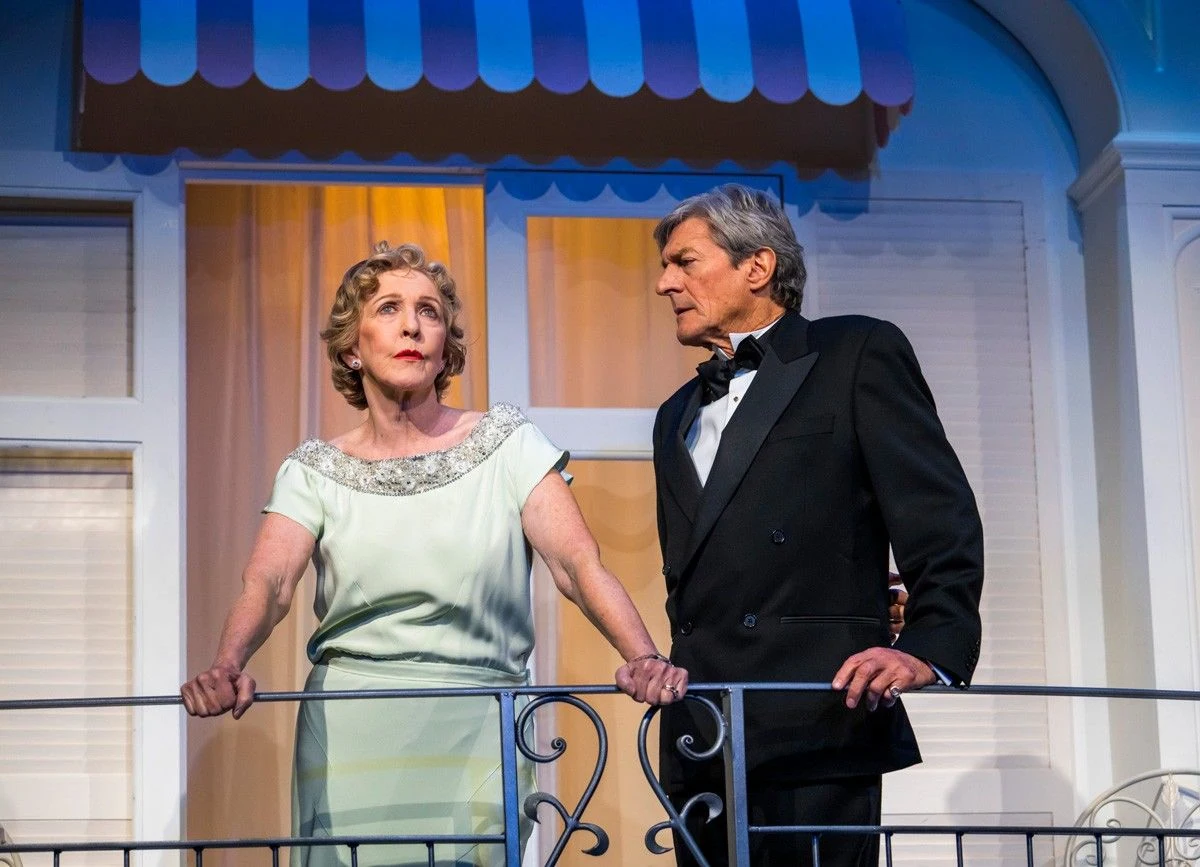
Other productions have taken the play to new audiences and tested different assumptions about its characters. A 2010 London revival, directed by Richard Eyre, starred Matthew Macfadyen and Kim Cattrall, then travelled to North America. In 2012, Jonathan Kent directed Anna Chancellor and Toby Stephens at Chichester Festival Theatre; the production transferred to London and was later broadcast to cinema audiences. A 2021 UK tour starring Patricia Hodge and Nigel Havers cast the leads as older than in many previous productions. After a successful tour, it played a West End season in 2023. That April, the Donmar Warehouse also mounted a separate revival.
A play beyond the stage
Private Lives moved early into other forms. The text was published in 1930, shortly after the London opening, and Coward and Lawrence recorded scenes from it. A film adaptation directed by Sidney Franklin followed in 1931, starring Norma Shearer and Robert Montgomery. The play has also been adapted for radio and television in Britain and the United States. In 1939, Gertrude Lawrence reprised Amanda for an American radio production, with Orson Welles as Elyot; that year, BBC Television broadcast an adaptation starring Diana Churchill and Denis Webb. Later BBC versions included a 1976 television production with Alec McCowen and Penelope Keith and a 2010 Radio 4 adaptation with Helena Bonham Carter and Bill Nighy.
Its reception has never been entirely uniform. Early reviewers praised its entertainment and performance while some questioned its depth or the plausibility of its characters. One response detected a sadder idea beneath the comedy: that the couple could neither live with nor without one another. That tension is central to the play’s construction. Its smart dialogue and brisk reversals invite laughter, but they also reveal how little the characters can change the terms of their relationship.
Why Private Lives deserves a place in British Legacy
Private Lives deserves a place in British Legacy because its story is tied to a clearly documented British theatrical history. Coward wrote it while abroad, but it first reached the stage in Edinburgh, toured British cities and then opened the new Phoenix Theatre in London. Its early success was followed by revivals across the West End and later productions at venues including Hampstead, Chichester and the Donmar Warehouse. These are not just milestones in one playwright’s career: they show a work repeatedly returning to British stages, where new casts and directors have tested what its comedy can reveal.
The play’s contribution also lies in its lasting dramatic design. Four people meet in a situation that quickly turns a conventional honeymoon into a contest between old desire and new commitments. Coward gives their conflict pace, verbal precision and a musical thread in “Someday I’ll Find You”, while resisting a simple romantic resolution. The play’s British theatrical journey has travelled internationally too: Broadway productions, film and radio adaptations have carried it to audiences beyond its first theatres. The 2001 revival’s Olivier and Tony recognition offers a specific measure of that continuing stage life. Remembering Private Lives means recognising both its British origins and the theatre-makers who have kept its volatile, sharply comic relationships in performance.
Sources
Adapted in part from Private Lives by Wikipedia contributors, under CC BY-SA 4.0. Text has been edited and combined with the existing article; this adapted text is shared under the same licence. Contributor history.