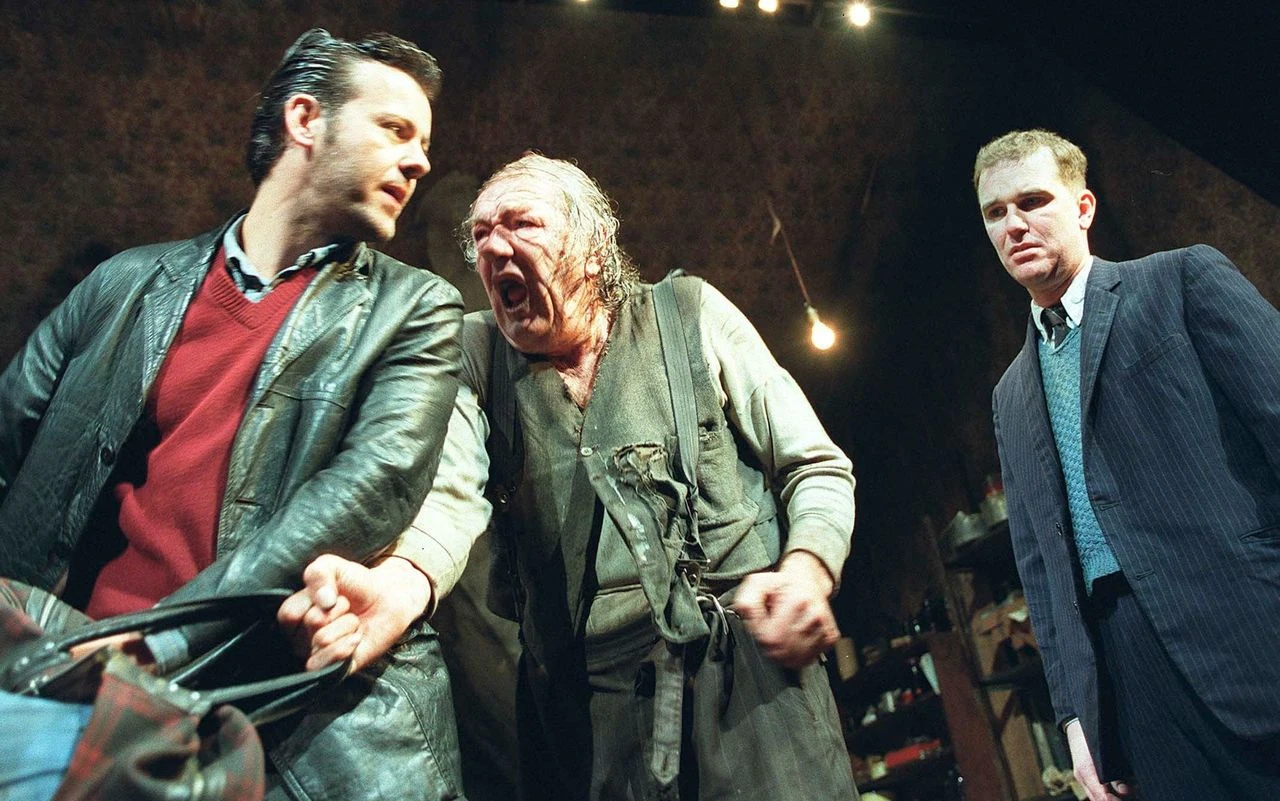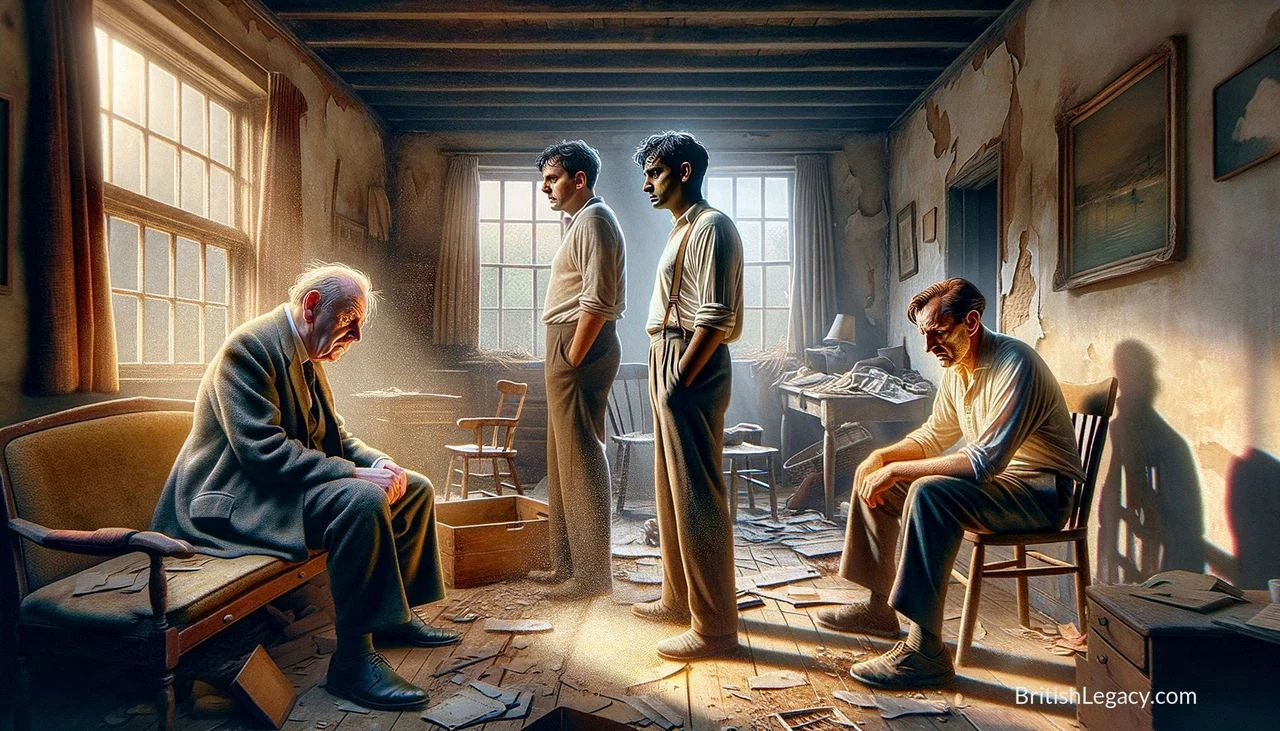
In Harold Pinter’s The Caretaker, a leaky roof, a disputed bag and the search for a decent pair of shoes become matters of power. Aston brings a homeless man into his flat and offers him a place to stay; the arrival of Aston’s brother, Mick, turns that act of kindness into a shifting contest over who belongs and who is in control. The play premiered in London on 27 April 1960. Its three men and single West London room gave Pinter a spare setting for comedy, menace and a final silence that refuses easy resolution.
A room shared uneasily
The play takes place in winter in a cluttered house in West London. Aston has rescued Davies from a fight in a bar and invited him into his flat. Davies is grateful enough to accept a bed, but almost at once he complains about the room and its condition. Aston tries to find him shoes; Davies rejects the pairs offered. He says he must get to Sidcup to retrieve papers establishing his identity, but the journey remains an intention rather than a solution.
Davies is not even consistent about his name. He admits to Aston that “Bernard Jenkins” is an assumed name and gives “Mac Davies” as his real one. Mick, Aston’s brother, arrives while Aston is out and treats Davies as an intruder, attacking him before demanding to know who he is. The brothers offer Davies the possibility of becoming caretaker, but the offer never settles into a secure arrangement. As Davies tries to win Mick over by disparaging Aston, he risks the fragile hospitality that brought him into the flat.
The room’s practical problems keep the drama grounded: rain drips through the roof into a bucket, the light can be switched off, and a bag becomes the object of a comic struggle. Yet these details also become tests. Who has the right to occupy the room, decide what needs fixing or set the terms of a bargain? Davies’s request for shelter, the brothers’ competing offers and his repeated plans to retrieve his papers all make belonging conditional.
Three characters, shifting loyalties
Aston’s quiet generosity is complicated by the account he gives of his past. He tells Davies that he was taken into a mental hospital and given electric shock treatment. After trying to escape, he was shocked while standing and says he was left with permanent brain damage. He has an ambition of his own: to build a shed in the garden. The plan gives him something to work towards, even as his restrained manner makes it difficult for him to establish what he wants from the people around him.
Mick is more forceful, but no more straightforward. He can be threatening, and his elaborate talk about the flat and its possible future leaves Davies struggling to follow him. He presents himself as having plans for the property, while also offering Davies work as caretaker. That offer briefly gives Davies reason to think he might secure a place there. But Mick’s loyalty is not a reliable route around Aston: when Davies turns against his brother, Mick ultimately sides with Aston.
Davies adapts his story to the person he is trying to influence. He complains, evades questions and tries to make each brother doubt the other. His shifting claims make it difficult to know what he believes about his own past, while his repeated promise to go to Sidcup keeps his identity unresolved. The play does not turn these uncertainties into a mystery with a neat answer. Instead, the men’s efforts to bargain, deceive and defend themselves make trust precarious and leave each of them isolated in the same room.
Comedy, threat and silence
The Caretaker is a drama in three acts that mixes comic exchanges with more painful material. The struggle over the bag, Davies’s complaints and his negotiations over shoes and work can tip towards farce. Aston’s account of hospital treatment changes the temperature of the play: what had seemed like an eccentric household dispute now includes the lasting consequences of institutional violence. At the end, Davies returns after being told to leave and asks Aston to let him stay. Aston does not answer. The long silence closes the play without supplying a settlement for either man.
Pinter’s dialogue often makes the gaps between people as striking as what they say. Characters interrupt one another, circle around questions and use long speeches to unsettle or persuade. A simple exchange may conceal a demand, while a pause can leave the balance of power uncertain. This is not just verbal ornament: the men’s inability to communicate openly is part of what keeps them from forming a stable arrangement. The play’s comedy and danger come from the same encounters, rather than from separate worlds of light and dark.
The play has been discussed in relation to the Theatre of the Absurd, a term associated with Martin Esslin’s account of drama in the late 1950s and early 1960s. Its affinities with that mode do not mean that nothing happens. The small shifts in who controls the room, who can offer work and who must leave carry real consequences for the characters. Pinter’s mixture of recognisable domestic detail and uncertainty makes the play both a household drama and a study of how people try to protect themselves through language.
From the Arts Theatre to later revivals
The first production opened at the Arts Theatre in London on 27 April 1960. Donald McWhinnie directed; Donald Pleasence played Davies, Alan Bates played Mick and Peter Woodthorpe played Aston. The production transferred to the Duchess Theatre on 30 May and ran for 444 performances before moving on to Broadway. This London success made The Caretaker Pinter’s first significant commercial success.
The play’s life did not end with its first West End run. A 1963 film adaptation, directed by Clive Donner, retained Pleasence and Bates in their stage roles, with Robert Shaw playing Aston. Later British productions included a 1981 staging at the Royal National Theatre, a 1983 production at the Royal Exchange in Manchester, and a 1991 London production directed by Pinter. Revivals in the twenty-first century included productions at the Comedy Theatre in 2000–01, Sheffield Theatres in 2006 and the Old Vic in 2016. A 2010 BBC Radio 4 production brought the play to listeners, with David Warner as Davies, Tony Bell as Aston and Daniel Mays as Mick.
These productions have offered different casts and audiences the same compact problem: how can three people share a space when each wants something different from it? The stage directions and dialogue leave room for performers to make the comedy, aggression and silences register in their own way, while the central tensions remain legible. The play’s successive London and regional stagings show its continuing place in British theatrical repertory without requiring its characters’ motives to be resolved.
Why The Caretaker deserves a place in British Legacy
The Caretaker deserves a place in British Legacy because its London premiere and long West End run mark a consequential moment in British post-war theatre. It was Pinter’s first significant commercial success, and its story of three men negotiating shelter, work and authority helped establish the dramatic force of his distinctive approach. The play makes the familiar—shoes, a leaking roof, a room to sleep in—carry the weight of questions about identity and belonging. Its comedy is not a break from its seriousness; the same negotiations that amuse can also expose how precarious Davies’s position is and how difficult it is for the brothers to communicate.
Its continuing performance history is another part of that legacy. British theatres from the National Theatre and the Royal Exchange to Sheffield, Liverpool and the Old Vic have returned to the play across several decades. Each revival brings new actors to a work whose pauses, evasions and shifts of allegiance demand close attention. The final silence does not explain the characters or offer a tidy resolution; it leaves the audience to reckon with the consequences of exclusion and failed trust. In that combination of formal economy, theatrical humour and enduring human conflict, Pinter’s play remains a substantial contribution to Britain’s stage tradition.
Sources
The Caretaker (play), revision 1370005050
Adapted in part from The Caretaker (play) by Wikipedia contributors, under CC BY-SA 4.0. Text has been edited and combined with the existing article; this adapted text is shared under the same licence. Contributor history.