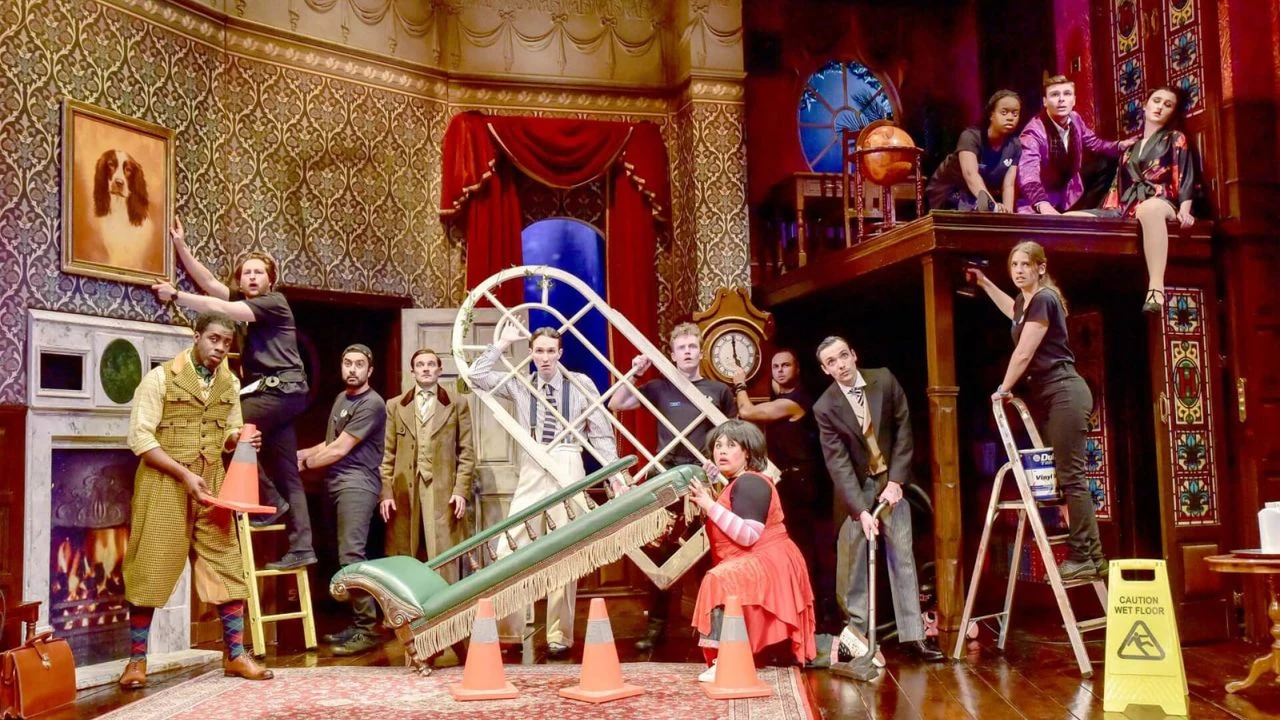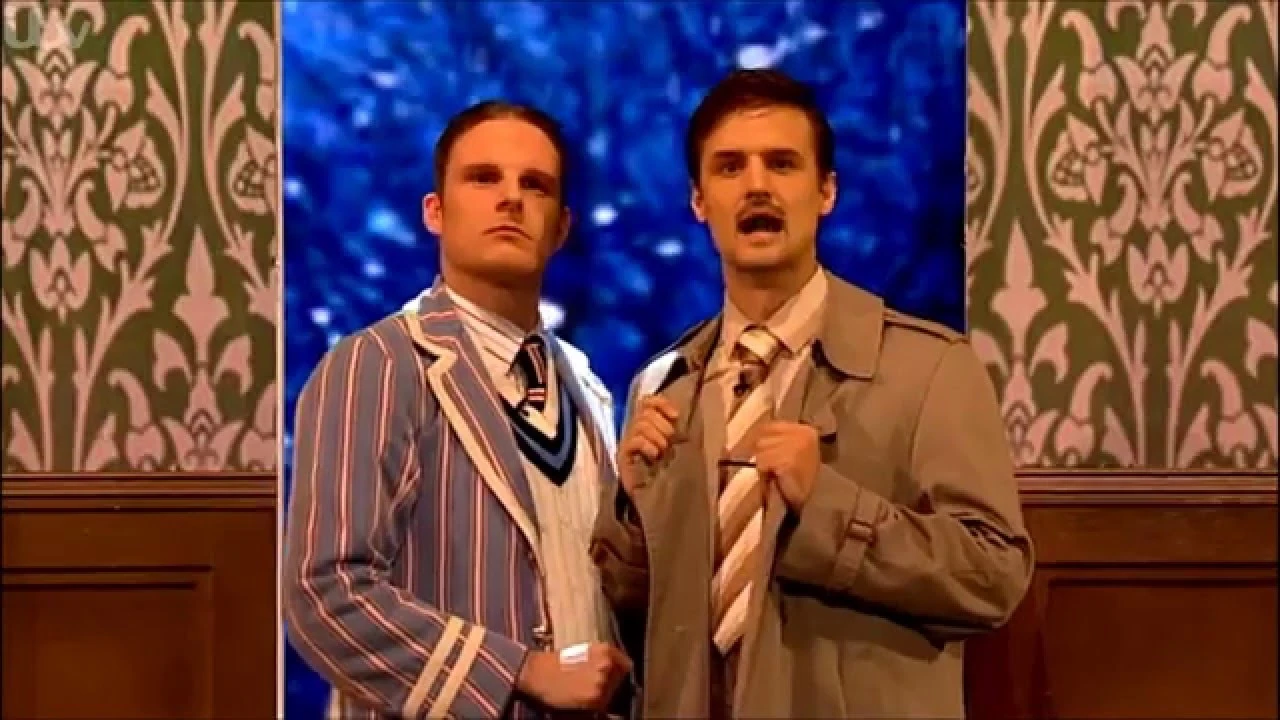
A door sticks. A prop goes missing. A performer loses a cue, and the scenery begins to give way. In The Play That Goes Wrong, each mishap is part of the design: the audience watches the Cornley Polytechnic Drama Society struggle through a murder mystery while the production appears to disintegrate around them. The comedy depends on a useful contradiction. The fictional company cannot keep its show on track; the real one must time every stumble, collapse and interruption with care.
Written by Henry Lewis, Jonathan Sayer and Henry Shields of Mischief Theatre, the play began at London’s Old Red Lion Theatre in 2012. It moved through another London venue before opening in the West End in 2014, and its theatrical life has since extended to UK tours, Broadway, Off-Broadway and productions in other countries. Its central joke is theatrical failure; its history is one of sustained performance.
A murder mystery in the wrong hands
The Cornley Polytechnic Drama Society is attempting to stage The Murder at Haversham Manor, a 1920s-style mystery. Within that play, Charles Haversham has been murdered on the night of his engagement party, and an inspector tries to establish what happened. But the fictional actors and crew cannot manage the practical business of putting on the show. The mystery is continually interrupted by the troubles of its performance.
Doors stick or refuse to stay shut; floorboards loosen; set pieces fall and platforms collapse. Props are lost or broken, lines are forgotten and cues missed. Performers fall, get caught in the scenery or are struck by pieces of the set. The comedy grows from the accumulation: a single error becomes the cause of another, until the production’s increasingly precarious physical world competes with the murder plot for attention.
The company’s problems are not confined to acting. Chris Bean, who plays Inspector Carter, is also the show’s director and takes responsibility for a long list of production jobs, including set and costume design, props, publicity, box office, voice and dialect coaching, and fight choreography. The story gives him authority over the production, but not control of its events. His determination to carry on becomes one of the engines of the farce.
The society’s circumstances help explain why it has chosen this particular mystery. Short of people, it has previously had to stage reduced casts of familiar works; a substantial bequest gives it the chance to put on a play with enough roles for its members. That opportunity does not make the company more capable. Instead, the mismatch between its ambitions and its mounting practical failures gives the show room to escalate.
From a London pub theatre to the West End
The play premiered at the Old Red Lion Theatre in London on 4 December 2012. Its early London history continued with a move to Trafalgar Studios in 2013, before it opened at the Duchess Theatre in the West End on 14 September 2014. These dates clarify a discrepancy in earlier descriptions that place its premiere in 2013: that year marked the move to Trafalgar Studios, not the first performance.
The West End production was directed by Mark Bell. Its original cast included Henry Shields as Chris, Henry Lewis as Robert and Jonathan Sayer as Dennis, alongside Dave Hearn, Rob Falconer, Charlie Russell, Greg Tannahill and Nancy Zamit. Nigel Hook designed the sets, built by Splinter Scenery, and Roberto Surace designed the costumes. The physical comedy relies on performers and production design working together: the disorder has to look consequential while remaining carefully arranged for the stage.
The show’s West End run brought recognition as well as longevity. It won the 2014 WhatsOnStage Award for Best New Comedy, the 2015 BroadwayWorld UK Award for Best New Play, and the 2015 Laurence Olivier Award for Best New Comedy. In September 2026, Mischief announced an extension of the Duchess Theatre booking to 31 January 2028, taking the production into the company’s twentieth anniversary year.
Different stages, the same escalating disaster
UK touring began in January 2014, before the West End opening. The first tour started at the Marlowe Theatre in Canterbury, visited 17 venues and ended in Darlington in July. Later UK tours began in Bath in 2017, at Northampton’s Royal and Derngate in 2018, in Canterbury in 2021 and again in Bath in 2022. The 2022 tour included two weeks in Manchester and Newcastle with members of the original West End cast.
The play also crossed the Atlantic. Its Broadway production opened at the Lyceum Theatre on 2 April 2017, following previews that began the previous month. Directed by Bell and featuring the original London cast, it marked film director J. J. Abrams’s theatrical producing debut. The production closed on 6 January 2019 after 745 regular performances and 27 previews. It then transferred to New World Stages Off-Broadway, where Matt DiCarlo directed. After a suspension during the COVID-19 pandemic, it reopened in October 2021.
Other productions included an Australian tour beginning in 2017, a North American tour in 2018, a Chicago production in 2021 and a further Australian tour beginning in 2025. The 2018 North American tour began in Pittsburgh; another US tour started in 2019 but closed early during the pandemic. These versions carried the same basic theatrical premise into different venues and casts, rather than relying on the original performers to sustain the show’s success.
International licensing and translation have taken the play beyond English-speaking audiences. The article’s account lists productions in more than 30 countries, across Europe, Asia, Africa, the Americas and Oceania. The list includes France, Germany, India, Japan, South Africa and South Korea, among others. That reach does not require the comedy to abandon its particular setting: the spectacle of a stage production going wrong supplies a recognisable structure for audiences seeing it in different languages.
A stage comedy with a screen afterlife
The creators extended the “goes wrong” idea to television. BBC One broadcast Peter Pan Goes Wrong in 2016 and A Christmas Carol Goes Wrong in 2017. A television series, The Goes Wrong Show, followed in 2019, using the same cast as the two specials. Its first series comprised six episodes; a second series was commissioned and began broadcasting in 2021.
The theatre and television versions share a basic pleasure: a group tries to present a story while the machinery of presentation becomes part of the joke. On stage, that machinery includes the set, props, cues and performers’ bodies; on television, the format carries the comic premise to viewers beyond the theatre. The play’s adaptations therefore extend its central idea without changing what makes it work: the gap between the show the company intends to give and the one that actually unfolds.
Why The Play That Goes Wrong deserves a place in British Legacy
The Play That Goes Wrong belongs in a British cultural story not simply because it is a successful comedy, but because its route from a small London theatre to the West End and international stages is unusually clear. The work was created by three writers associated with Mischief Theatre and first performed at the Old Red Lion in 2012. It went on to win major British theatre awards, sustain a long West End run and tour the UK. Those milestones show how a contemporary play can develop through the country’s theatre network, rather than arriving fully formed as a commercial institution.
Its craft is also worth recognising. The fictional amateur company’s repeated errors have to be arranged with precision: a misplaced prop or broken cue must appear accidental while setting up the next event. The production makes stage work itself visible—scenery, costume, timing, backstage preparation—and turns that practical labour into the subject of comedy. Its performances in Britain, the United States and elsewhere demonstrate that the premise can travel while retaining its theatrical specificity. The television specials and The Goes Wrong Show broadened that reach further. Together, the play’s awards, touring history and adaptations make it a substantial example of recent British popular theatre, built on exacting physical comedy rather than on claims of influence that the evidence cannot establish.
Sources
Adapted in part from The Play That Goes Wrong by Wikipedia contributors, under CC BY-SA 4.0. Text has been edited and combined with the existing article; this adapted text is shared under the same licence. Contributor history.