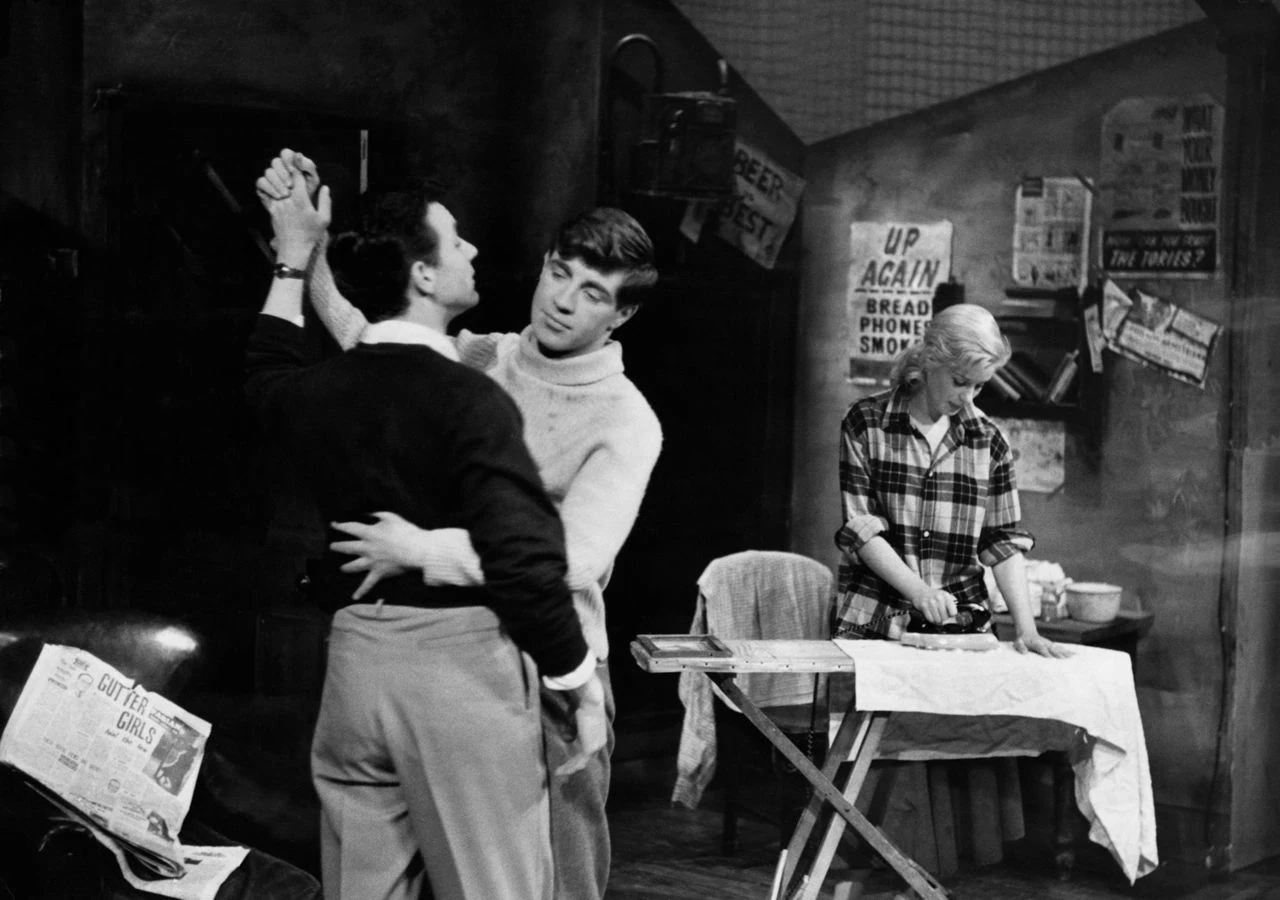
On 8 May 1956, a cramped Midlands flat arrived on the stage of London’s Royal Court Theatre. In John Osborne’s Look Back in Anger, an ironing board, a Sunday paper and the sour exchanges of a married couple made ordinary domestic life the setting for a theatrical argument about class, gender and post-war discontent. Its impact was not universally welcomed at first: some reviewers objected to its setting and characters. But the play’s arrival helped establish a new kind of realism in British theatre, and the phrase “angry young men” became attached to Osborne and writers associated with his generation.
A flat, a marriage and a class divide
The play centres on Jimmy Porter, an educated young man of working-class origin, and Alison, his upper-middle-class wife. They share a small attic flat in the English Midlands with Cliff Lewis, Jimmy’s easy-going friend and lodger. Their everyday routine is charged by the gap between Jimmy’s background and Alison’s military family, and by his anger at a society he sees as complacent and unresponsive. Their income comes from a confectionery stall in the local market, a modest business at odds with Jimmy’s education and his ambitions.
Jimmy’s sharp attacks fall particularly heavily on Alison. In the opening act, he and Cliff read the papers while Alison irons; the domestic activity does not soften the argument but gives it a concrete, repeated setting. Jimmy’s tirade ends in physical horseplay that overturns the ironing board and burns Alison’s arm. Alone with Cliff, she reveals that she is pregnant but has not told her husband. When she announces that her friend Helena Charles is coming to stay, Jimmy’s hostility escalates.
Helena urges Alison to leave and sends for her family. Alison’s father, Colonel Redfern, collects her, and his conversation with his daughter makes clear that he feels out of step with a changed world. Helena, who had intended to leave too, remains; she and Jimmy begin a relationship. Months later, Alison returns after losing the baby. Helena recognises that her relationship with Jimmy cannot continue and decides to go. The play ends not with a simple resolution but with Jimmy and Alison renewing their private game of pretending to be bears and squirrels, a reconciliation that offers a truce rather than an answer to the strains between them.
From an unfashionable play to a new label
Osborne wrote Look Back in Anger in 17 days on Morecambe Pier. The play drew on his unhappy marriage to Pamela Lane and their life in cramped accommodation in Derby. It also carried echoes of his earlier life: one speech about witnessing a loved one’s death drew on the death of his father, Thomas. The play’s realism and domestic subject matter differed from the more escapist theatre against which it was understood to be reacting.
The English Stage Company production at the Royal Court was directed by Tony Richardson, with a setting by Alan Tagg and music for songs by Tom Eastwood. Kenneth Haigh played Jimmy, Mary Ure played Alison, Alan Bates was Cliff, Helena Hughes was Helena Charles and John Welsh was Colonel Redfern. The production’s press release called Osborne an “angry young man”; the description soon became a name for a wider generation of writers and artists, rather than simply a label for one character or play.
The first critical response was divided, and a number of reviews were hostile. Kenneth Tynan and Harold Hobson were among the critics who recognised the play’s importance. Tynan praised its rejection of “official” attitudes and its sense of humour; Hobson identified it as a landmark in British theatre. The disagreement itself marks a change in the conversation around the play: its everyday setting and confrontational voices provoked reactions that a more conventional theatrical subject might not have drawn.
The production became a commercial success, transferring to the West End and then Broadway, and touring to Moscow. The Broadway production received three Tony Award nominations, including Best Play and Best Actress in a Play for Ure. In 1956, Bates reprised his role as Cliff in an ITV television version, with Richardson and Silvio Narizzano as co-directors. These productions carried Osborne’s drama beyond its original London audience, while keeping its difficult marriage and class tensions at the centre.
After the Royal Court: revivals and adaptations
The play’s subsequent life included productions by prominent British theatre-makers. In 1989, Judi Dench directed Kenneth Branagh and Emma Thompson at the Lyric Theatre in London; a television version was broadcast in Britain later that year. A 1995 Royal Exchange, Manchester production directed by Greg Hersov featured Michael Sheen as Jimmy, Claire Skinner as Alison, Dominic Rowan as Cliff and Hermione Norris as Helena. Hersov directed a further production with Sheen at the Royal National Theatre in 1999.
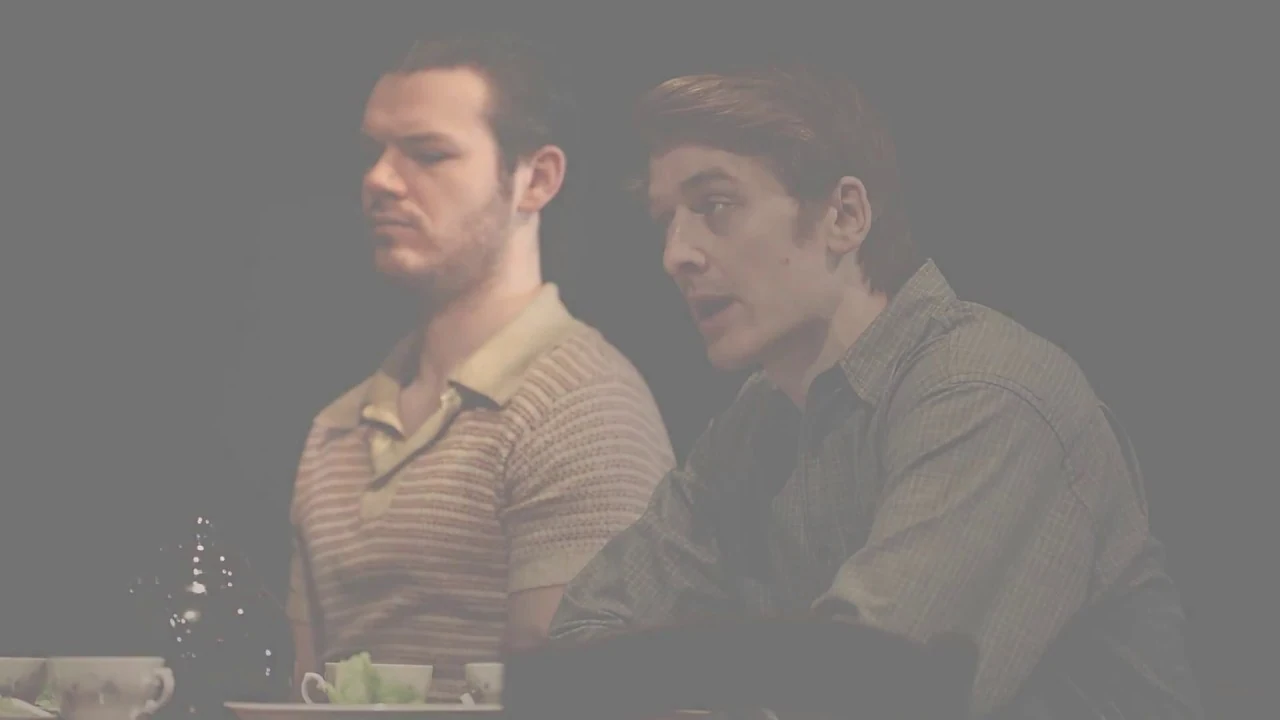
Later stage versions included Sam Gold’s 2012 Off-Broadway production, starring Matthew Rhys, Adam Driver and Sarah Goldberg, and an Almeida Theatre production in 2024 directed by Atri Banerjee. The play also reached the screen. Tony Richardson directed a film adaptation starring Richard Burton, Claire Bloom and Mary Ure, released in 1959; it received four BAFTA nominations but won none. A television production of Dench’s 1989 staging followed in December of that year. The BBC broadcast a radio dramatisation, directed by Richard Wilson and starring David Tennant as Jimmy and Ian McKellen as Colonel Redfern, in 2016.
Osborne returned to Jimmy Porter in Déjàvu, a sequel first produced in 1992. Its Jimmy, now called J.P., is middle-aged and lives with his daughter Alison, while continuing to rail against the state of the country. Cliff is again his friend, and the domestic image of Alison ironing echoes the earlier play. It closed after seven weeks and was Osborne’s last play. The sequel’s altered household and repeated domestic pattern show how closely Look Back in Anger had joined political complaint to private relationships.
Why Look Back in Anger deserves a place in British Legacy
Look Back in Anger deserves its place in British Legacy because it made a recognisable British social setting—the small flat, the ironing, the strained marriage and the differences of class—into the substance of serious theatre. Its attention to a working-class man’s frustration and his relationship with an upper-middle-class wife challenged the more escapist conventions associated with the stage before it. The result was not a simple portrait of an entire generation: Jimmy is an individual, often cruel, whose attacks on Alison are part of the play’s troubling subject as well as its force. That tension gives the drama more than a slogan. It asks audiences to confront how social resentment can be expressed within the home and directed at those closest to its speaker.
The production’s London opening, its transfer to Broadway and tour to Moscow, and its later revivals and screen adaptations demonstrate a British play that continued to travel and be reinterpreted. Its association with the phrase “angry young men” also records how one work became shorthand for a wider change in post-war cultural expression. British Legacy can remember the play not as an uncontested triumph, but as a drama that provoked sharply divided responses and helped shift what British theatre put before an audience: ordinary rooms, class conflict, marital strain and language that refused to remain polite.
Sources
Look Back in Anger — Wikipedia revision 1370399884
Adapted in part from Look Back in Anger by Wikipedia contributors, under CC BY-SA 4.0. Text has been edited and combined with the existing article; this adapted text is shared under the same licence. Contributor history.