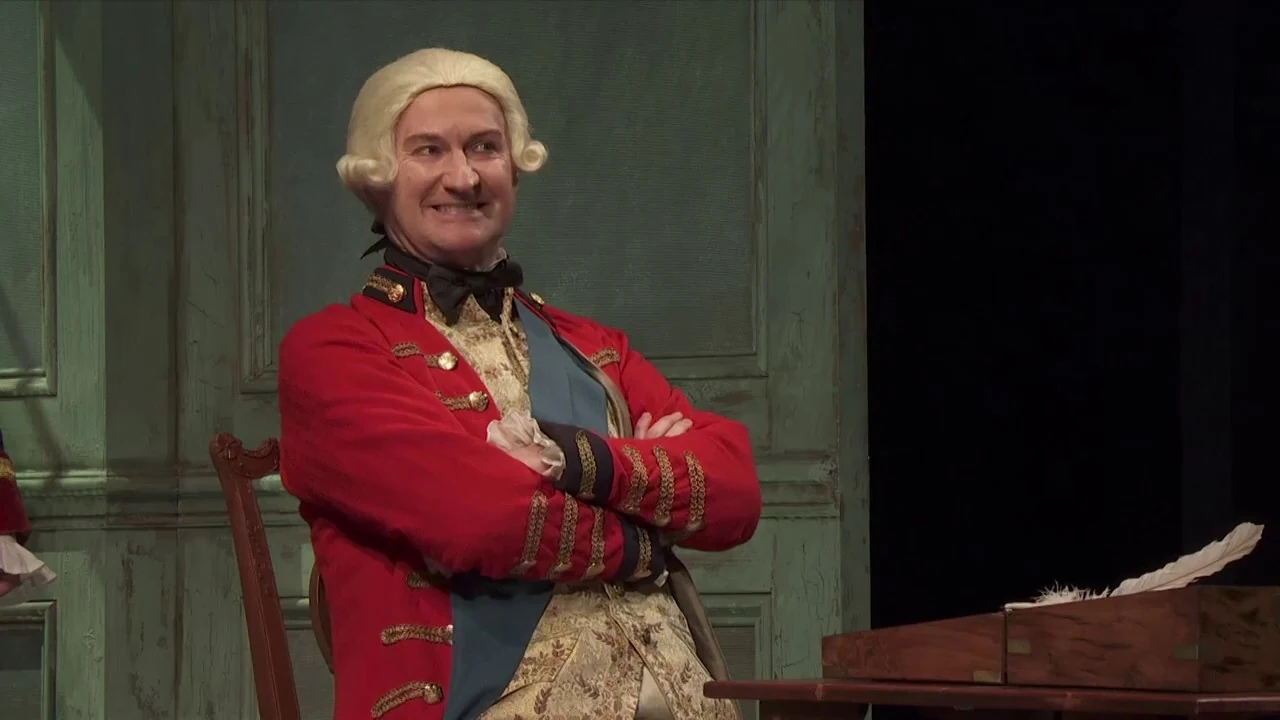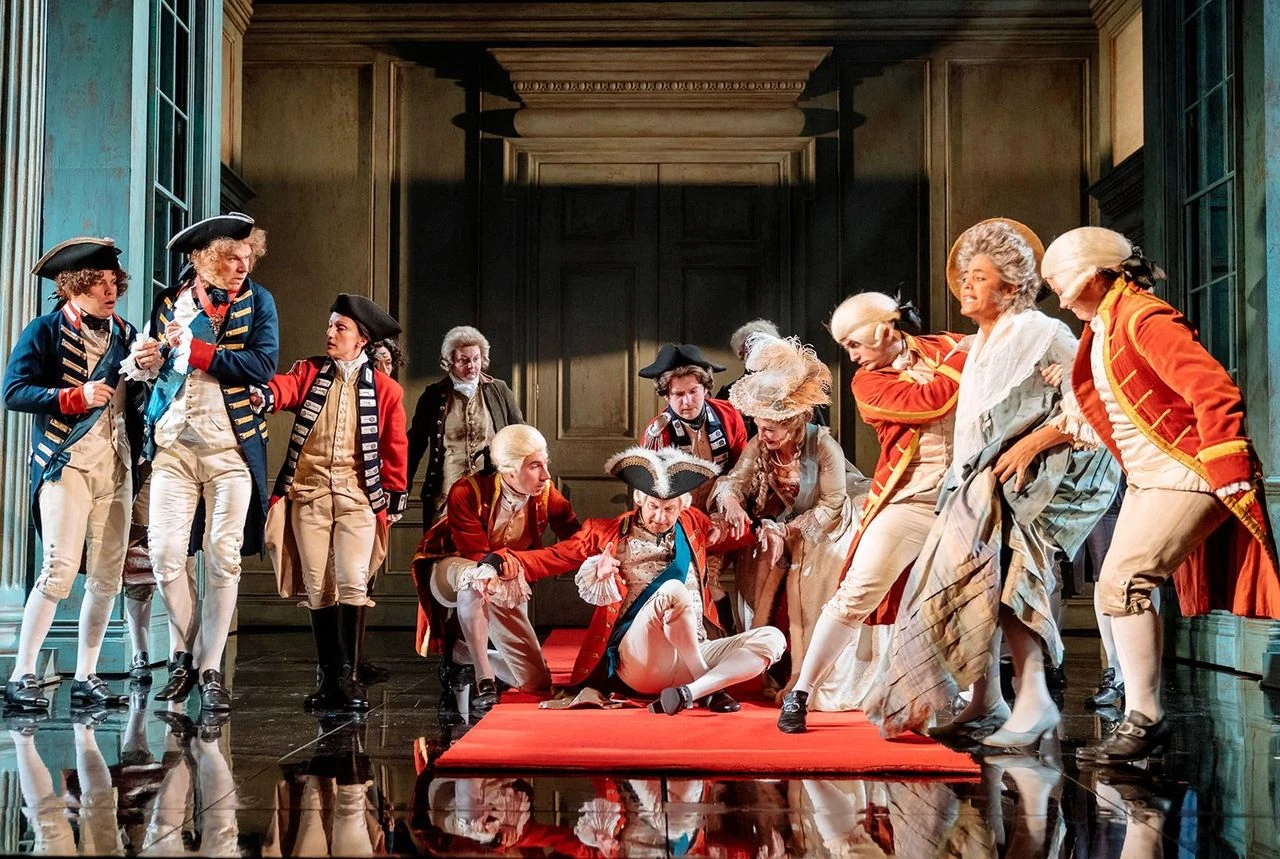
When King George III becomes ill, his condition is more than a private crisis: it unsettles the court and raises the question of who can govern in his place. Alan Bennett’s The Madness of George III brings that collision between personal suffering and public authority to the stage. First performed at London’s National Theatre in 1991, the play follows the king’s battle with mental illness and the court’s struggle to manage it.
A king’s illness becomes a political crisis
The play is a fictionalised study of the latter half of George III’s reign. Its focus is not a full account of the monarch’s life, but the period in which his mental illness disrupts both his household and the business of government. The king experiences incoherence and erratic behaviour; as his condition worsens, anxiety spreads beyond the royal family into the political world around him.
At court, illness quickly becomes a question of power. The Prince of Wales, George’s son, stands ready to become Regent, while those around the king attempt to decide how he should be treated and who should act in his absence. Bennett places the private struggle beside these competing interests. The result is a drama in which the king’s vulnerability has consequences for the people seeking to control events as well as for George himself.
The play also depicts the treatments used by physicians of the period, including restraint and bloodletting. Set against present-day understandings of mental health, these scenes make the gap between distress and the care available to the king especially stark. Bennett’s story combines dark humour with serious personal and political conflict, rather than treating the monarch’s illness as a matter of spectacle alone.
From the Lyttelton stage to the screen
The Madness of George III premiered at the Lyttelton Theatre of the National Theatre on 28 November 1991. Nicholas Hytner directed the production, designed by Mark Thompson. Nigel Hawthorne played George III, with Janet Dale as Queen Charlotte and Michael Fitzgerald as the Prince of Wales. The original cast also included Julian Wadham as William Pitt, Charles Kay as Dr Willis and David Henry as Charles Fox.
After its first London run, the production toured the United Kingdom and the United States. It returned to the National Theatre in 1993, followed by performances in Athens and Israel in 1994. These later stages of its performance history show how the play travelled beyond its original London home while retaining the story of a British monarch at its centre.
In 1994, the play was adapted as the film The Madness of King George, with Hawthorne reprising his stage role. The screen version carried Bennett’s dramatisation to audiences beyond the theatre. Hawthorne was nominated for the Academy Award for Best Actor for his performance in the film.
New productions, new kings
The play has returned to the stage with different actors taking on George III. In January 2012, David Haig played the king in a revival at the Apollo Theatre. A further production opened at Nottingham Playhouse in November 2018, with Mark Gatiss as George and Adrian Scarborough as Dr Willis. Its cast also included Debra Gillett as Queen Charlotte and Wilf Scolding as the Prince of Wales.
The Nottingham production reached another audience when it was streamed on the National Theatre’s YouTube channel in June 2020 as part of the NT at Home season. In 2010, meanwhile, the play had been staged at the Lowell Davies Festival Theatre in San Diego. Together, these productions and presentations give the work a performance life that extends from its National Theatre premiere to later British and international audiences.
Reviewers have often drawn attention to the actor playing George. Writing about the 2012 revival, Lyn Gardner described the play as exploring appearance and reality, and emphasised the humanity of the man behind royal ceremony. That tension is built into Bennett’s premise: the figure invested with the most authority is also a person who can become ill, suffer and need care.
History seen through a human crisis
George III reigned from 1760 to 1820, a period that included the American Revolution and the Napoleonic Wars. Bennett’s play does not attempt to encompass all those events. Instead, it narrows its attention to the king’s illness and the responses it provokes. That scale gives political history a personal focus: the question of royal authority is tested through the changing condition of one man.
This approach invites audiences to look beyond a familiar public image of the king and consider the pressure exerted by the court around him. George’s illness creates uncertainty, and the people closest to power must navigate both his need for treatment and the prospect of a regency. The physicians’ interventions, the family’s position and the government’s interests meet within the same drama. Bennett’s use of comedy alongside suffering makes the conflict legible without removing its unease.
Why The Madness of George III deserves a place in British Legacy
The Madness of George III deserves a place in British Legacy because it makes a specific moment in the history of the British monarchy accessible through theatre. Rather than summarising a reign defined by major political events, Bennett concentrates on the illness of George III and its effects on court and government. The play connects the private experience of mental distress with the public responsibilities of a king, showing how quickly a personal crisis can become a constitutional and political one.
Its British legacy also lies in the work’s life across performance and adaptation. The National Theatre premiere, later returns to the stage, productions in Britain and abroad, and the 1994 film adaptation carried the story to audiences in different settings. The changing actors who have played George—from Nigel Hawthorne to David Haig and Mark Gatiss—have each brought a new performance to the central role. The play continues to prompt attention to the humanity beneath royal status and to the treatment of people experiencing mental illness. Its enduring value is not simply that it dramatises a king’s suffering, but that it asks audiences to consider the human consequences when illness and power meet.
Sources
Adapted in part from The Madness of George III by Wikipedia contributors, under CC BY-SA 4.0. Text has been edited and combined with the existing article; this adapted text is shared under the same licence. Contributor history.