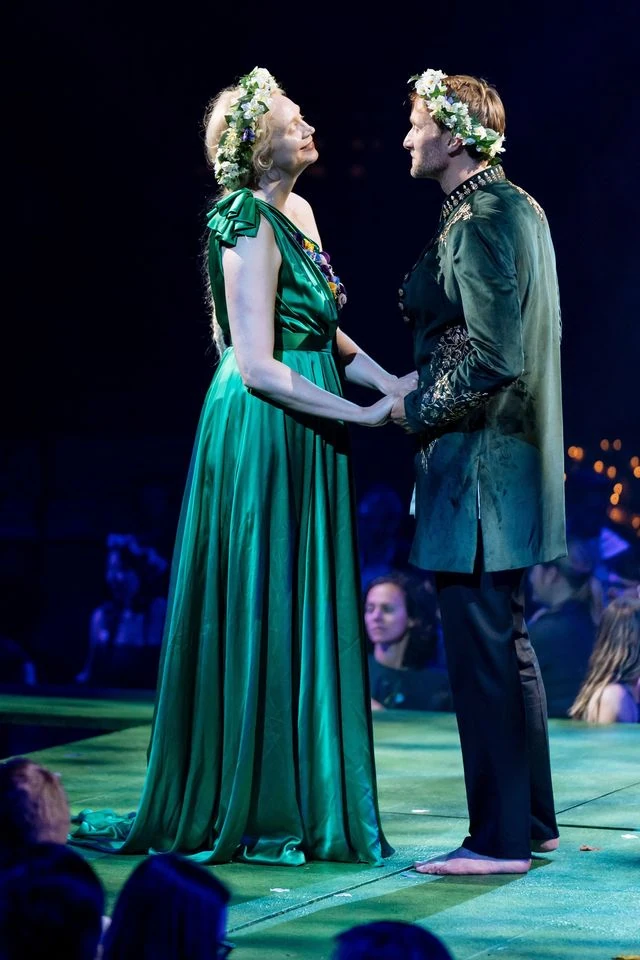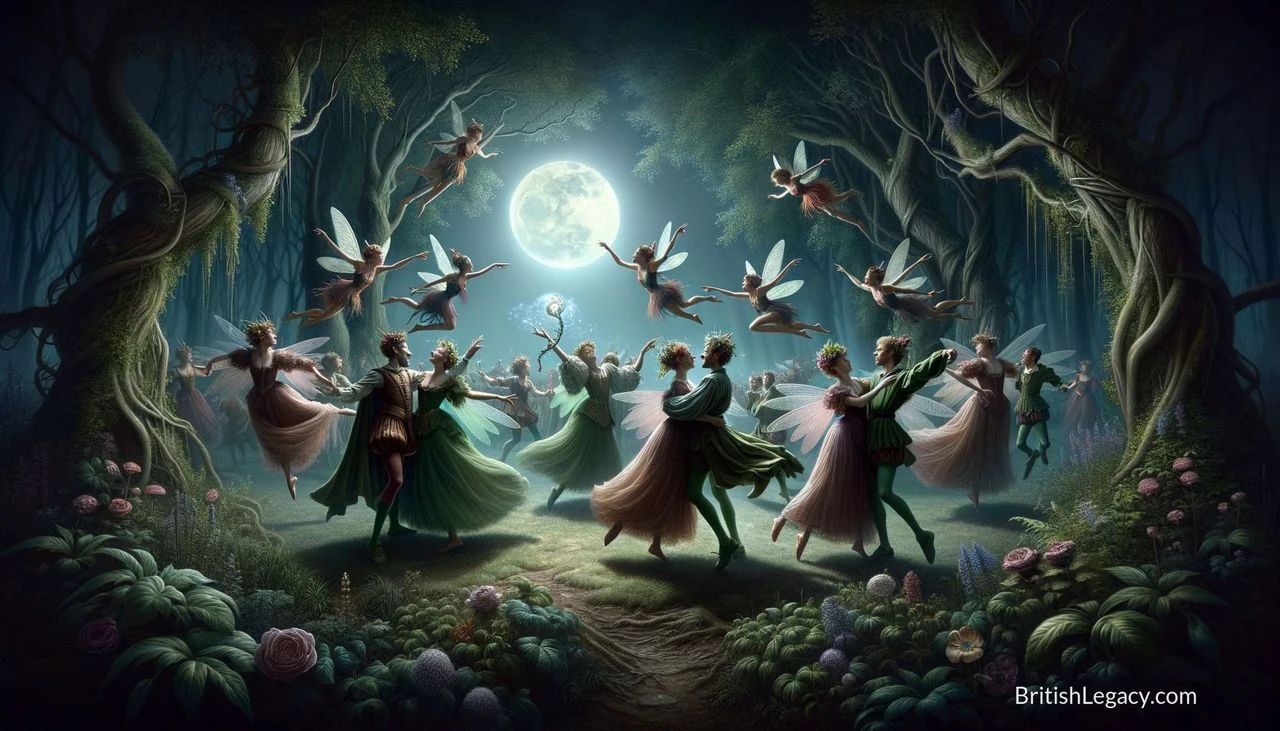
In A Midsummer Night’s Dream, a flower’s magic sends four lovers into a bewildering forest, a fairy queen falls for a weaver with a donkey’s head, and a troupe of amateur actors prepares a tragedy for a wedding celebration. William Shakespeare brings these unlikely threads together in a comedy about desire, imagination and the uncertain border between dream and waking life. Written in the 1590s, the play has proved unusually adaptable: British theatre-makers have repeatedly changed its scale, music and staging while keeping its tangled comedy in view.
Introduction
The comedy’s world joins three groups whose concerns collide in the woods: the Athenian court, four young lovers and a company of craftsmen rehearsing a play. The fairies are not merely decorative figures within that world. Oberon and Titania’s disagreement helps set the human plots in motion, while Puck’s misapplied magic turns affection into confusion. The craftsmen’s efforts to stage a tragedy add a second performance to the first, making theatre itself part of the joke.
Authorship and Premier
Shakespeare probably wrote the play between 1594 and 1596, though its exact date of composition and first performance are unknown. Its title page records that it had been performed publicly before the first quarto appeared in 1600. It was probably staged at The Theatre in London. The first court performance known with certainty took place at Hampton Court on 1 January 1604.
The proposed first performance at Queen Elizabeth I’s court for celebrations of the Feast of St John the Baptist is not established. An aristocratic wedding has also been suggested as a possible occasion, but the first performance cannot be assigned confidently to either event. Thomas Fisher registered the play in 1600 and published its first quarto that year; it later appeared in the First Folio of 1623.
Synopsis
The play opens as Theseus, Duke of Athens, prepares to marry Hippolyta, Queen of the Amazons. Egeus brings his daughter Hermia before Theseus because she will not marry Demetrius, the suitor her father has chosen. Hermia loves Lysander, and the two plan to escape through the forest. Helena, who loves Demetrius, tells him of their flight; he pursues the pair, and Helena follows him.
In the forest, Oberon and Titania are at odds over a changeling boy in Titania’s care. Oberon asks Puck to fetch a flower whose juice makes a sleeper fall in love with the first person seen on waking. Puck’s mistake sends the lovers’ affections further awry. Oberon also uses the flower on Titania. She wakes and becomes enamoured of Bottom, one of the craftsmen rehearsing a play for the wedding. Puck has given Bottom an ass’s head.
The craftsmen, often called the mechanicals, are preparing Pyramus and Thisbe, a tragedy to perform for the wedding company. Their earnest rehearsal and performance supply a comic counterpoint to the lovers’ romantic confusion. By the end, the lovers’ relationships are settled and the night’s events can be treated as a dream. The resolution restores order, but the comedy has depended on mistaken identity, unruly desire and the transformation of familiar people into something strange.
Background and Legacy
The play’s sources are varied rather than singular. Its lovers’ woodland trials, fairy conflict and craftsmen’s performance combine in a dramatic world where the supernatural interferes with ordinary affairs. The play also makes uncertainty part of its design: characters misread one another, and the lovers struggle to decide whether the night’s events were real or dreamt. The amateur performance of Pyramus and Thisbe brings that question onto the stage itself, as the wedding guests watch the craftsmen represent a story of love and death.
For generations, audiences often encountered the comedy in altered form rather than as Shakespeare wrote it. During the theatre closures of the Puritan Interregnum, the comic episode of Bottom and his companions circulated as a short playlet, or droll. After theatres reopened in 1660, adaptation continued. Henry Purcell’s The Fairy Queen, first staged in 1692, transformed the material into a musical masque. Other versions rearranged or extracted the scenes involving the mechanicals and the fairies.
A relatively full text returned to the stage at Covent Garden in 1840 in a production by Madame Vestris, with music and ballet. Later nineteenth-century productions often turned the forest into a spectacle, using elaborate scenery and large casts. Augustin Daly’s London production opened in 1895 and ran for 21 performances. The play’s stage history has never depended on one fixed way of representing its magic.
Contribution to British Heritage and Worldwide Theatre
British productions have offered markedly different answers to how the play should look and sound. In 1914, Harley Granville-Barker reduced the cast and used Elizabethan folk music instead of Mendelssohn’s familiar score, favouring a simpler staging. In 1970, Peter Brook’s Royal Shakespeare Company production set the action in a bare white box and gave the fairies circus-like movement. Its cast included Patrick Stewart, Ben Kingsley, John Kane as Puck and Frances de la Tour as Helena. Rather than building a naturalistic forest, Brook’s production asked performance and imagination to create the play’s world.
Music has carried the comedy into other forms. Felix Mendelssohn composed a concert overture inspired by the play in 1826 and later wrote incidental music for a production in Potsdam in 1843. The “Wedding March” from that score became a familiar feature of wedding ceremonies. British composer Ralph Vaughan Williams set “Over Hill, Over Dale” for unaccompanied choir in 1951; it remains part of the British choral repertoire. Benjamin Britten’s operatic version, with a libretto by Britten and Peter Pears, was first performed at Aldeburgh in 1960.
Screen versions have extended its reach beyond the stage. The Royal Shakespeare Company’s 1968 film featured Ian Holm, Diana Rigg, Helen Mirren and Judi Dench. The BBC’s 1981 television production starred Helen Mirren as Titania, Peter McEnery as Oberon and Brian Glover as Bottom. In 2016, Emma Rice’s first production as artistic director of Shakespeare’s Globe combined gender-switched characters with Bollywood influences. Russell T Davies’s BBC television adaptation that year brought the comedy to another audience in a new screen version.
These examples show how much room the play leaves for reinterpretation. Its forest can be made through elaborate scenery, a bare stage or a contemporary theatrical language; its music can invoke an established tradition or change the production’s mood. The play within a play gives performers an additional way to examine the distance between taking on a role and being oneself.
Why A Midsummer Night’s Dream deserves a place in British Legacy
A Midsummer Night’s Dream merits a place in British Legacy not simply as a famous work by an English playwright, but as a play whose British performance history shows how a classic can be continually remade. Purcell’s The Fairy Queen, the Victorian stage’s elaborate fairyland, Granville-Barker’s reduced staging and Brook’s white-box production for the Royal Shakespeare Company each give the comedy a different theatrical shape. Those contrasting choices make the history specific: the work has not survived by remaining untouched, but by offering theatre-makers ways to rethink spectacle, music and performance.
Its life across art forms has also strengthened its place in British cultural history. Mendelssohn’s music became associated with weddings; Vaughan Williams and Britten brought the play into British choral and operatic traditions; and stage and television adaptations have introduced it to audiences in new settings. At its centre, the craftsmen’s performance makes the act of creating an illusion part of the story. That connection between a memorable comic plot and the work of performers helps explain why the play remains a resource for British theatre. Its legacy lies not only in repeated performances, but in the opportunity each new staging has to make its comedy, its forest and its uncertainties newly legible.
Sources
Adapted in part from A Midsummer Night's Dream by Wikipedia contributors, under CC BY-SA 4.0. Text has been edited and combined with the existing article; this adapted text is shared under the same licence. Contributor history.