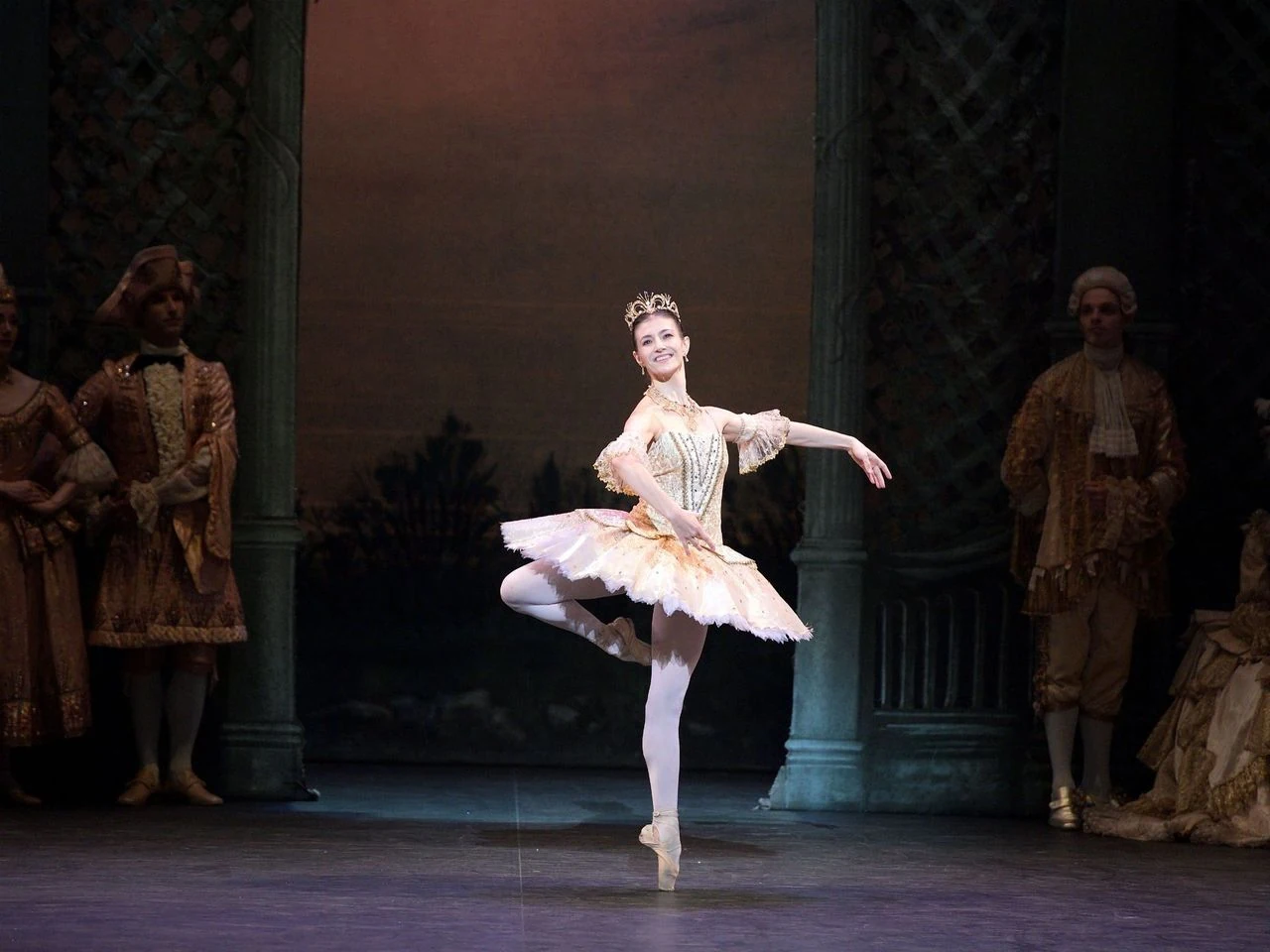
Alina Cojocaru’s route to the Royal Ballet began in Bucharest, continued through Kyiv and Lausanne, and brought her to London as a young dancer who had never seen a ballet performed live. She joined the Royal Ballet in 1999, became a principal dancer in 2001 and later joined English National Ballet. Across those companies and international engagements, her work included a long-running partnership with Johan Kobborg, two Prix Benois de la Danse awards and roles ranging from Juliet to Giselle.
A Journey to Stardom
Born in Bucharest on 27 May 1981, Cojocaru studied gymnastics as a child before beginning ballet classes. At nine, she entered a Bucharest ballet school that acted as a feeder for the Romanian State Ballet school. She passed the entrance examination for the latter and, a few months later, was selected with eight other Romanian students for an exchange at the Kyiv Ballet school. She left her family to train there and initially did not speak Ukrainian. The Romanian students were taught separately before joining the other pupils in their third year.
Her first stage appearance came in a school performance, dancing Amor in Don Quixote. In January 1997, aged 15, she competed at the Prix de Lausanne and won a six-month scholarship to train at the Royal Ballet School in London. That June, she won a silver medal at the Moscow Ballet Competition and performed in Alla Rubina’s Musketeer. She moved to London later in the year to continue her training, despite not speaking English when she arrived.
After her six-month Royal Ballet School training, Cojocaru was offered a place in the Royal Ballet’s corps de ballet and a principal contract with the Kyiv Ballet. She chose Kyiv, joining the company in November 1998 to gain experience in principal roles. After a season there, she auditioned for the Royal Ballet while on leave. Offered a corps de ballet contract, she accepted and joined the London company in November 1999.
Rising to Prominence with the Royal Ballet
Cojocaru’s early appearances with the Royal Ballet included the opening gala for the refurbished Royal Opera House. She also danced in the corps in the Kingdom of the Shades from La Bayadère, as a snowflake in The Nutcracker and as a doll in Coppélia. In 2001, she was promoted to principal dancer.
That year, she also began her artistic partnership with Danish dancer Johan Kobborg. Cojocaru stepped in for the injured Miyako Yoshida to dance Juliet opposite him in Romeo and Juliet. The partnership became a recurring feature of their work at Covent Garden and on international stages. Their shared repertory included Giselle; Cojocaru’s performances in that ballet continued to feature in her career, including her later title-role appearance in Akram Khan’s production.
Her role as the sylph in La Sylphide is another of the performances associated with her career. The range of these roles, from the young Juliet to the supernatural figures of classical ballet, sits alongside the more specific record of awards and productions that marked her development.
Recognition and international work
Cojocaru received the Prix Benois de la Danse in 2004 for her portrayal of Cinderella. In 2012, she became the first ballerina to receive the award twice, this time for Julie in John Neumeier’s Liliom with Hamburg Ballet. The role marked the first time a full-length ballet had been created around her. She also received the 2004 Nijinsky Prize.
In 2017, she won the Critics’ Circle National Dance Award for Outstanding Female Performance (Classical) for the title role in Akram Khan’s Giselle. The award recognised a performance in a production that brought a contemporary choreographer’s interpretation to a familiar ballet title. Cojocaru also worked as a guest with Hamburg Ballet, where her relationship with choreographer John Neumeier developed into a close creative collaboration.
Leaving Covent Garden, returning to London stages
In June 2013, Cojocaru announced that she and Kobborg would leave the Royal Ballet at the end of the 2012–13 season. Their final London performance with the company was in Kenneth MacMillan’s Mayerling on 5 June, followed by scheduled performances in Tokyo on 10 and 12 July. In July, she joined English National Ballet as a principal dancer, extending her London career beyond Covent Garden.
In December 2013, she also joined the Romanian National Ballet as a principal after Kobborg became its artistic director. In 2016, the pair resigned following actions by new leadership at the Bucharest National Opera House, prompting protests by dancers. The account of the episode also reports that the new management apparently barred them from entering the theatre.
In 2020, Cojocaru presented Alina, a self-produced show at Sadler’s Wells. Its programme included Frederick Ashton’s Marguerite and Armand and Reminiscence, a newly commissioned work by Tim Rushton, danced with Kobborg. That November, English National Ballet announced that her contract had ended. Her final performance with the company was in January, as Clara in The Nutcracker.
Stage work beyond the theatre
Filmed performances carried some of Cojocaru’s work to audiences beyond the auditorium. Her Clara in Peter Wright’s Royal Ballet production of The Nutcracker was taped and first shown on television in the United States in 2001; the production was later released on DVD. Her performance as Aurora in the Royal Ballet’s production of The Sleeping Beauty is also available on DVD. A recording of her Giselle, with Kobborg as Albrecht, was broadcast in England on Boxing Day 2006 and released the following year.
In 2008, she suffered a whiplash injury during rehearsal when a partner handled her awkwardly in a lift. The injury could have ended her career. After surgery and months of rest, and with a rehabilitation regimen guided by Patrick Rump, she recovered and returned to dancing.
Cojocaru was appointed an Honorary Officer of the Order of the British Empire in the 2023 Special Honours for services to ballet. The honour recognises a career that moved between countries and companies, with major chapters in Britain as well as work in Kyiv, Hamburg and Bucharest.
Why Alina Cojocaru deserves a place in British Legacy
Cojocaru’s place in British Legacy rests on a substantial record of work within British ballet institutions. She trained at the Royal Ballet School, joined the Royal Ballet in 1999 and rose from its corps de ballet to principal dancer. At Covent Garden, her partnership with Kobborg began with an unexpected performance in Romeo and Juliet and developed across performances in London and abroad. Her later appointment as a principal with English National Ballet extended her contribution to another leading British company. In 2023, her appointment as an Honorary OBE for services to ballet gave formal recognition to that British connection.
Her career also shows the international exchange on which British ballet depends. Cojocaru’s route from Bucharest through Kyiv and Lausanne to London brought her into British companies, while her work with colleagues and choreographers took her to stages elsewhere. The two Prix Benois awards, including the 2012 prize for a role created around her, recognise achievements that crossed institutional and national boundaries. Her self-produced Alina at Sadler’s Wells and the filmed performances of The Nutcracker and Giselle widened the settings in which audiences could encounter her dancing. Together, her training, company appointments, performances and honours make her British legacy a story of sustained artistic work and recognition within the country’s ballet life, rather than of birthplace alone.
Sources
Alina Cojocaru · Alina Cojocaru
Adapted in part from Alina Cojocaru by Wikipedia contributors, under CC BY-SA 4.0. Text has been edited and combined with the existing article; this adapted text is shared under the same licence. Contributor history.