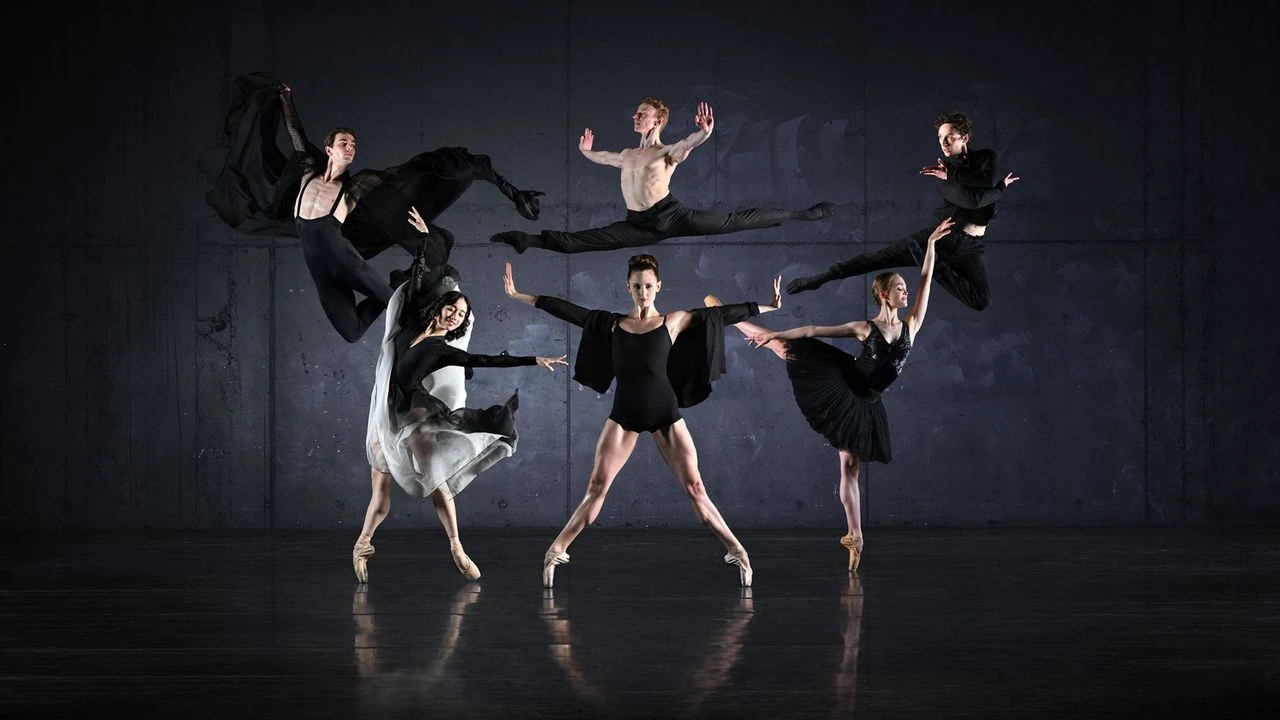
English National Ballet began with a practical ambition: to take ballet to people who had not had the opportunity to see it. Founded in 1950 by dancers Alicia Markova and Anton Dolin, the company developed as a touring ensemble, performing across Britain and abroad. It has changed its name and artistic leadership over the decades, but touring and a broad repertory have remained central to its story.
A company founded to travel
The company’s origins lie in the partnership of Markova and Dolin, leading dancers who had previously performed together in the Markova-Dolin Company. They set out to create an ensemble that could tour nationally and internationally, bringing ballet to new audiences. The company was founded in 1950 as Gala Performances of Ballet, with financial backing from the Polish impresario Julian Braunsweg. Its early names included Festival Ballet and London Festival Ballet; it adopted the name English National Ballet in June 1989.
Dolin became its first artistic director and established touring as a defining part of the company’s work. It toured abroad for the first time in 1951. He also introduced educational programmes in its early years, extending the effort to make ballet accessible beyond the performance itself. The company’s growth was not smooth: it expanded its reach and profile while repeatedly facing the threat of bankruptcy. After Braunsweg left in 1965, Donald Albery took over and stabilised the budget through safer programming.
Beryl Grey, a former Royal Ballet dancer, directed the company from 1968 to 1979. She raised technical standards, continued wide touring and invited prominent guest artists and choreographers, among them Leonide Massine and Rudolf Nureyev. Nureyev chose Eva Evdokimova as the first Princess Aurora in his production of The Sleeping Beauty in 1975. John Field followed as director from 1979 to 1984.
A change of name, and a wider artistic range
In 1984 Peter Schaufuss became director. During his tenure, the company took the name English National Ballet and established English National Ballet School, which is independent of the company. Schaufuss also brought works by a wide range of choreographers into its repertory, including Frederick Ashton, Kenneth MacMillan, Christopher Bruce, Michael Clark, John Neumeier, George Balanchine, Alvin Ailey, Roland Petit, Maurice Béjart and John Cranko.
The company’s history of classical ballet sits alongside that openness to different choreographic voices. Its repertory has included familiar works such as Swan Lake, Giselle and The Nutcracker. A particularly visible example of its capacity to rework the form came with Akram Khan’s Dust, a one-act ballet about the First World War commissioned by the company. Khan had not previously worked with a ballet company. The production premiered in 2014 and later that year was performed at Glastonbury Festival, the company’s debut there.
In 2016, working with Manchester International Festival and Sadler’s Wells, English National Ballet presented the world premiere of Khan’s Giselle at the Palace Theatre in Manchester. The production combined classical ballet with Kathak and contemporary dance. That same year, She Said brought together works by women choreographers, including Annabelle Lopez Ochoa’s Broken Wings, based on the life of Frida Kahlo. These projects show the company working with ballet’s inherited vocabulary while making space for other movement traditions and perspectives.
Leadership and performance beyond the theatre
After Schaufuss, the artistic directors included Ivan Nagy, Derek Deane and Matz Skoog. Wayne Eagling took over in 2006. In 2012, following Eagling’s announced resignation, principal dancer Tamara Rojo was named as his successor; she began in the role in August that year. Rojo announced in 2022 that she would leave at the end of that year to lead San Francisco Ballet. Aaron S. Watkin, who had performed with the company earlier in his career, became artistic director in August 2023.
The company has also made large-scale productions part of its identity. Deane’s Swan Lake in the round, staged with 60 swans, has been filmed for BBC iPlayer at the Royal Albert Hall. The venue has hosted other specially staged performances, while the company regularly performs seasons at the London Coliseum. In 2014, it became an Associate Company of Sadler’s Wells.
Touring remains a key way the company reaches audiences. It performs in theatres around the United Kingdom and undertakes international tours, continuing the founding intention to take ballet beyond a single home stage. Its work has included performances at special events as well as seasons in theatres. The company employs dancers and an orchestra, the English National Ballet Philharmonic, bringing live musical performance together with its stage productions.
Why English National Ballet deserves a place in British Legacy
English National Ballet deserves a place in British Legacy because its history links an enduring cultural form with a specific effort to broaden who can encounter it. Markova and Dolin founded the company to tour nationally and internationally; from its first overseas tour in 1951 to its continuing performances in theatres across the United Kingdom, that purpose has shaped its work. The company’s early education programmes extended the invitation beyond audiences in a theatre. Its history also records the practical difficulty of sustaining that ambition: it grew in size and status while repeatedly facing bankruptcy, and its finances required stabilisation after Braunsweg’s departure.
Its contribution is not confined to carrying classical ballet from one venue to another. The company has invited major choreographers into its repertory and commissioned work that crosses artistic boundaries. Khan’s Dust brought a First World War subject to ballet and then to Glastonbury; his Giselle combined ballet, Kathak and contemporary dance. She Said offered a programme of women choreographers. Alongside these works, the company continues to stage classics and large-scale productions such as Swan Lake in the round. This combination of touring, teaching, repertory and experimentation gives the company a clear British cultural connection: it has built an institution whose work travels, while keeping the art form open to new audiences and ideas.
Sources
English National Ballet — Wikipedia, revision 1360144523
Adapted in part from English National Ballet by Wikipedia contributors, under CC BY-SA 4.0. Text has been edited and combined with the existing article; this adapted text is shared under the same licence. Contributor history.