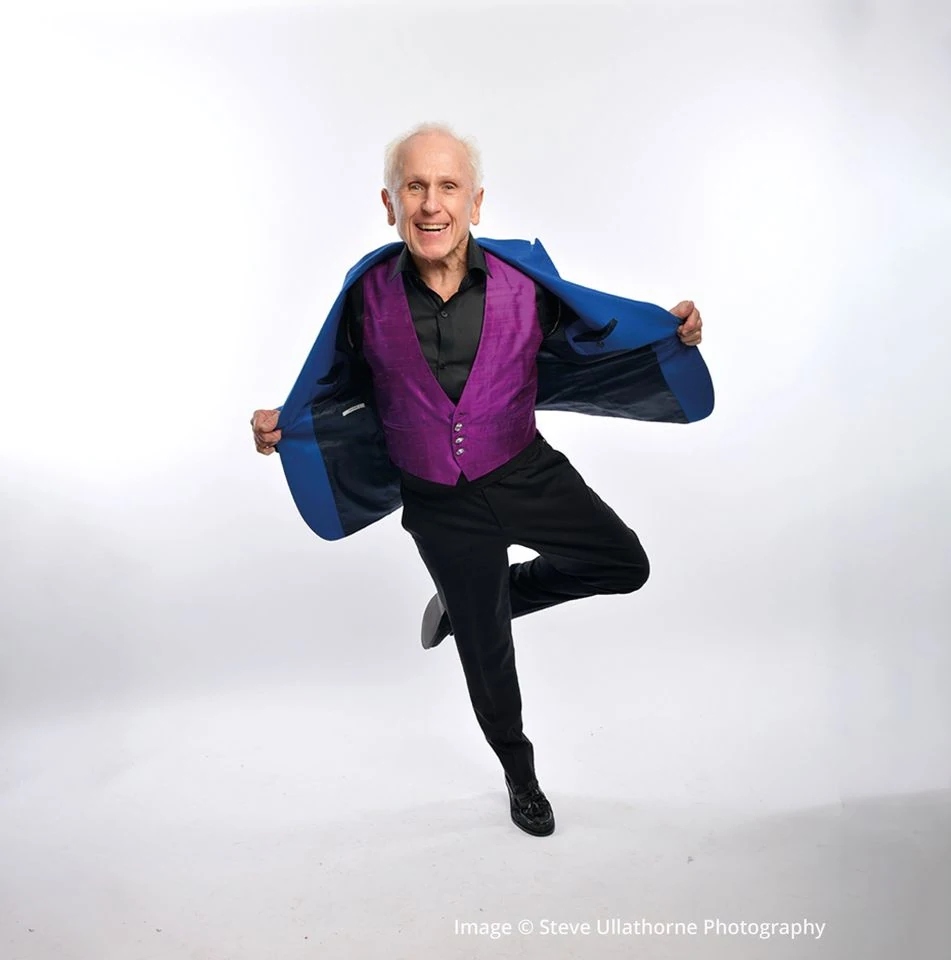
Wayne Sleep’s career has crossed ballet, musical theatre, film and television. He joined the Royal Ballet in 1966 and became a senior principal dancer, performing internationally. His short stature could make directors reluctant to cast him in traditional male lead roles, but choreographers also created parts that drew on his distinctive physique. From the Royal Ballet stage to the West End and work with students, Sleep’s career has taken dance into a range of settings.
From tap and jazz to ballet
Sleep was born in Plymouth, Devon, on 17 July 1948. His mother enrolled him at Geraldine Lamb Dance School, where he studied tap and jazz. At first, he hoped to follow performers such as Gene Kelly or Fred Astaire rather than become a ballet dancer. Around 1951, his family moved to Hartlepool, where they spent about ten years. He attended Baltic Street Junior School and began ballet lessons with Muriel Carr in 1955.
In 1961, Sleep won a Leverhulme Scholarship to the Royal Ballet School. At 157 centimetres, or 5 feet 2 inches, he was the shortest male dancer admitted to the school. He joined the Royal Ballet in 1966 and went on to become a senior principal, performing around the world. His stature presented a challenge in a company where directors could be reluctant to cast him in conventional male leading roles. Choreographers, however, made roles for him that accommodated his unusual physique and gave his abilities room to register.
Royal Ballet and a record-breaking jump
Among the choreographers who created roles for Sleep were Frederick Ashton, Kenneth MacMillan, Ninette de Valois, Joe Layton, Rudolf Nureyev, Gillian Lynne and John Neumeier. He was often chosen for character roles. The work brought together technical demands and theatrical expression: his career was not confined to a narrow idea of the classical male lead.
In 1973, Sleep demonstrated his physical precision on the BBC programme Record Breakers. He performed an entrechat-douze, a jump in which the feet beat twelve times, establishing a world record that the biographical account says still stands. A later charity challenge involving presenter Roy Castle took a more comic turn. Castle challenged Sleep to beat his tap-dancing record on Castle’s terms, then jumped from an aircraft for charity. The joke was that Castle could perform entrechats while falling, while Sleep could not tap in mid-air.
Sleep also took the role of Puck in an early production of Benjamin Britten’s opera A Midsummer Night’s Dream. In 1982, Andrew Lloyd Webber adapted his Variations album as the second half of Song and Dance for Sleep. These projects placed his dancing in productions where music, character and theatrical storytelling met.
West End, film and television
Sleep created the role of Mr Mistoffelees in Andrew Lloyd Webber’s Cats, which opened at the New London Theatre in the West End on 11 May 1981. The part brought his ballet technique into musical theatre. His stage work continued in other forms: in 2009 he appeared as the master of ceremonies in the Birmingham Repertory Theatre production Life is a Cabaret, and later performed in pantomime, including Jack and the Beanstalk in Norwich in 2016 and Cinderella in Cambridge in 2019.
His film work included acting roles in The Virgin Soldiers (1969), The First Great Train Robbery (1979) and Elizabeth (1998). He danced as Squirrel Nutkin in The Tales of Beatrix Potter (1971) and directed the choreography for the tango scene in Death on the Nile (1978). Across these credits, he worked both in front of the camera and in shaping movement for a film scene.
Television brought Sleep to audiences in formats beyond dance. He appeared in I’m a Celebrity... Get Me Out of Here! in 2003 and judged Strictly Dance Fever in 2005–06. In 2014, he appeared in Big Ballet, a programme about overweight ballet dancers, and finished fourth in Celebrity MasterChef. From 2016 he appeared in the BBC’s The Real Marigold Hotel, travelling with the series to India and later taking part in journeys to Florida, Japan, China and Cuba. In 2017, he joined The Real Full Monty, which raised awareness of prostate and testicular cancer, and appeared in the BBC documentary Queer as Art. The next year, he reached the final of Celebrity Big Brother, finishing fifth.
Writing, professional life and support for students
Sleep has published Variations on Wayne Sleep and his autobiography, Precious Little Sleep. His recognition includes honorary degrees from the Universities of Exeter, Teesside and Plymouth, and the Carl Alan Award, an industry honour voted for by dance professionals. He is a patron of the British Ballet Organisation and a vice-president of the Royal Academy of Dance and the Vic-Wells Association.
His work also includes helping students who have gained a place at a vocational performing-arts college through the Wayne Sleep Foundation. He continues to pass on his experience through private tuition and workshops for people of different ages. Sleep is an ambassador for Prostate Cancer UK and the Royal Voluntary Service, and supports the Terrence Higgins Trust and other charities. Those commitments connect his professional experience with student training, dance organisations and public causes.
Why Wayne Sleep deserves a place in British Legacy
Wayne Sleep deserves a place in British Legacy because his career gives a concrete account of how a British ballet institution and its performers can develop beyond conventional casting expectations. After winning a Leverhulme Scholarship, he trained at the Royal Ballet School and joined the Royal Ballet in 1966. He became a senior principal, performing internationally, while choreographers including Ashton, MacMillan, Nureyev and Lynne created roles for him. The contrast is significant: his stature could make traditional leading roles harder to secure, yet it also became part of the particular stage presence for which choreographers made work. His record-setting jump on Record Breakers further brought a highly technical dance achievement to a broad television audience.
His contribution extends beyond the ballet company. Creating Mr Mistoffelees in the West End production of Cats, working on film choreography, and appearing across television formats took his dance experience into different kinds of performance and public life. The Wayne Sleep Foundation offers a practical link to the next generation, helping students who have already gained places at vocational performing-arts colleges; his tuition and workshops continue that exchange of knowledge. His roles with British dance organisations and support for charities add further dimensions to a career that has moved between performing, teaching and public engagement. That combination, grounded in a documented British training and performance career, gives his place in British Legacy its particular meaning.
Sources
Adapted in part from Wayne Sleep by Wikipedia contributors, under CC BY-SA 4.0. Text has been edited and combined with the existing article; this adapted text is shared under the same licence. Contributor history.