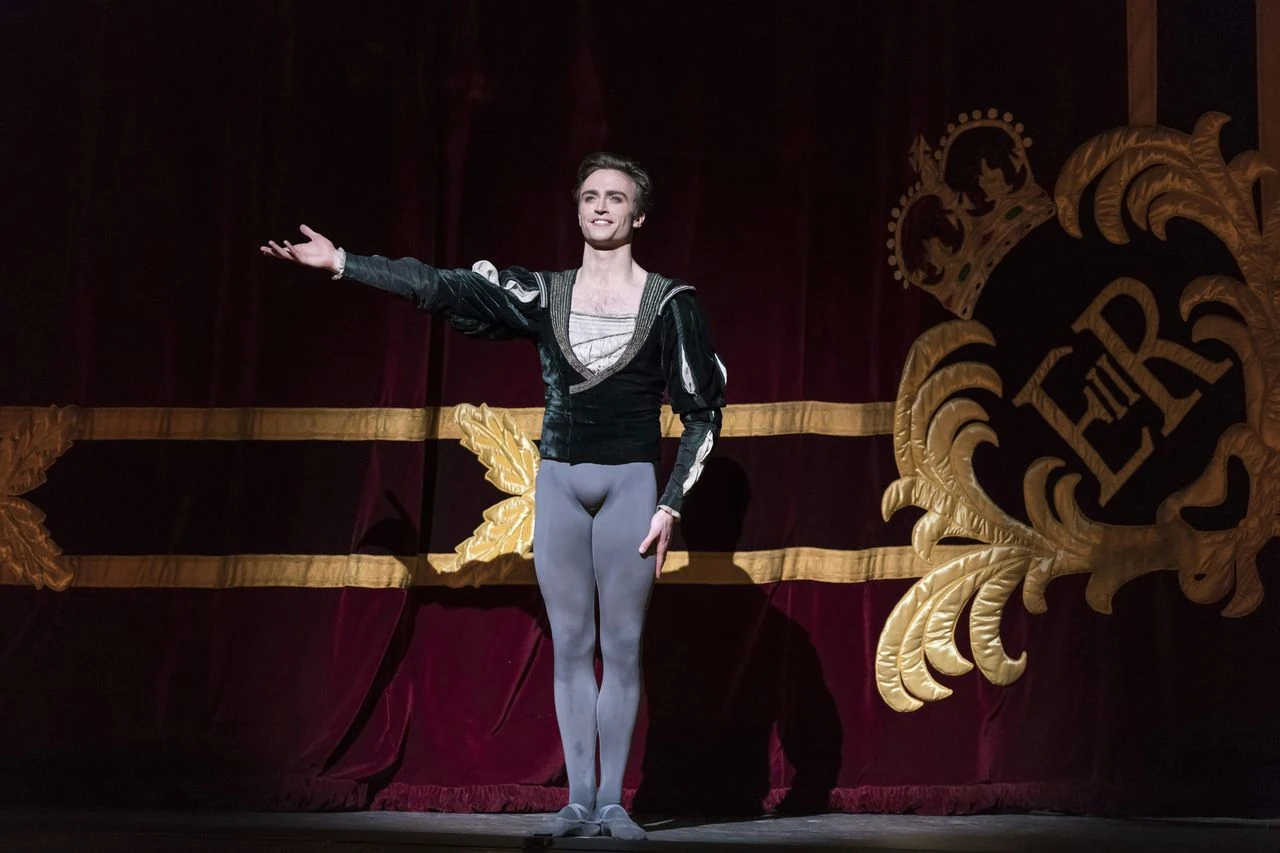
Matthew Ball’s career with The Royal Ballet has taken him from its training school to principal dancer, with a succession of demanding roles along the way. Born in Liverpool in 1993, he began dancing as a child and entered the Royal Ballet School at 11. His path through the company’s ranks was measured rather than instant: he joined in 2013, became a First Artist in 2015, a Soloist in 2016 and a First Soloist in 2017, before his promotion to principal dancer the following year.
Training in the Royal Ballet system
Ball started dancing at the age of six. At 11, he entered the Royal Ballet Lower School; at 16, he moved to the Upper School. He graduated in 2013, but knee surgery prevented him from taking part in the graduation performance. That same year, he joined The Royal Ballet for the 2013/14 season.
The progression from school to company gave Ball a sustained period of development within one institution. His successive promotions marked distinct stages in that career: First Artist in 2015, Soloist in 2016 and First Soloist in 2017. In July 2018, he became a principal dancer. The sequence offers a clearer picture of his rise than the idea of a sudden ascent: each step followed years of training and work in the company.
A defining test in Giselle
One episode in 2018 brought Ball to wider attention within the company. In March, he was asked to replace the injured David Hallberg as Albrecht in Giselle, midway through a performance. Ball had danced the role only once and had not previously performed a full-length ballet with Natalia Osipova, who was dancing the title role. The audience gave his performance an ovation, and The Times praised it in its review.
The demands of that assignment were unusually immediate: Ball had to take over a principal role during the show, with limited prior experience of the part and a new partnership to manage. His promotion to principal dancer followed in July. The timing places the Giselle performance within a crucial year of his career, without reducing that progression to one night alone.
Later that year, Ball took time away from The Royal Ballet to perform for 32 performances as the lead swan in Matthew Bourne’s Swan Lake at Sadler’s Wells Theatre. The engagement gave him a substantial role in another choreographer’s production, outside the company where he had trained and advanced.
Range across the repertoire
Ball’s Royal Ballet repertoire includes principal roles across classical and modern works. He has danced Solor in La Bayadère, Basilio in Don Quixote, Prince Siegfried in Swan Lake and Romeo in Kenneth MacMillan’s Romeo and Juliet. In Giselle, his roles have included both Albrecht and the pas de six. Other parts include Crown Prince Rudolf in MacMillan’s Mayerling, Armand in Ashton’s Marguerite and Armand and Lysander in The Dream.
Some performances have required rapid preparation. For his debut as Crown Prince Rudolf in Mayerling, Ball had less than two weeks to prepare after another dancer was injured. The role sits alongside a varied repertory that includes the Officer in Anastasia, Lensky in Onegin, Escamillo in Carmen and the Prince in The Nutcracker. Together, these parts show the breadth of work entrusted to him, rather than a career confined to a single celebrated role.
Ball has also taken part in the creation of new work. Roles created for him include Albert de Belleroche in Strapless and Dr John Brown in Like Water for Chocolate. He was involved in works including Christopher Wheeldon’s Corybantic Games, Charlotte Marston’s The Cellist and Alastair Marriott’s The Unknown Soldier. Creating a role is a different responsibility from interpreting an established one: the dancer contributes to a work in the process of being made, rather than inheriting a settled performance tradition.
Performance in changing circumstances
In 2020, Ball appeared in the BBC documentary Men at the Barre. Later that year, after the Royal Opera House had closed during the coronavirus pandemic, the venue presented its first series of performances since the closure. Ball and Mayara Magri performed a pas de deux from Wheeldon’s Within the Golden Hour, which they had learnt in five days.
The performance belongs to a particular moment in the company’s recent history: a return to the stage after a prolonged closure, with a demanding piece prepared in a short time. It also shows Ball’s work extending beyond full-length narrative ballets. Across his career, his recorded repertory includes works such as Infra, Woolf Works, Yugen and Jewels, as well as classical story ballets.
Why Matthew Ball deserves a place in British Legacy
Matthew Ball’s British connection is grounded in a specific institution and a sustained professional record. Born in Liverpool, he trained at the Royal Ballet School and joined The Royal Ballet in 2013. His progression through the company’s ranks to principal dancer provides a clear account of how a major British ballet institution develops and promotes performers. That journey is not simply a title or a claim to national distinction: it is documented through successive appointments and a substantial body of work.
His contribution also lies in the range and demands of that work. Ball has performed leading roles in ballets from Giselle and Romeo and Juliet to Mayerling, and has helped bring new roles into productions including The Cellist and Like Water for Chocolate. Replacing an injured dancer during Giselle, preparing a Mayerling debut in under two weeks and returning to performance in 2020 with a pas de deux learnt in five days illustrate different kinds of pressure faced by a working dancer. His career connects British training, a leading London company and the ongoing creation and performance of ballet. That combination makes his story a worthwhile part of British Legacy’s record of people shaping the country’s cultural life.
Sources
Matthew Ball (dancer), revision 1373390610
Adapted in part from Matthew Ball (dancer) by Wikipedia contributors, under CC BY-SA 4.0. Text has been edited and combined with the existing article; this adapted text is shared under the same licence. Contributor history.