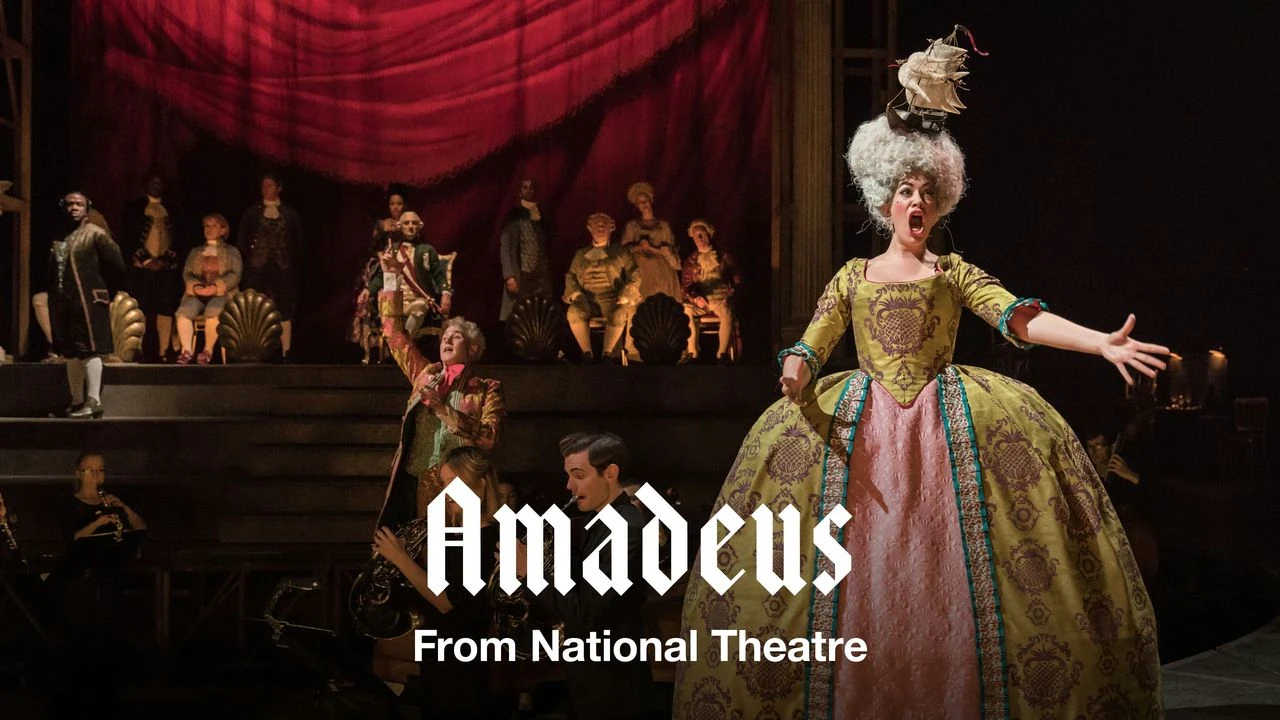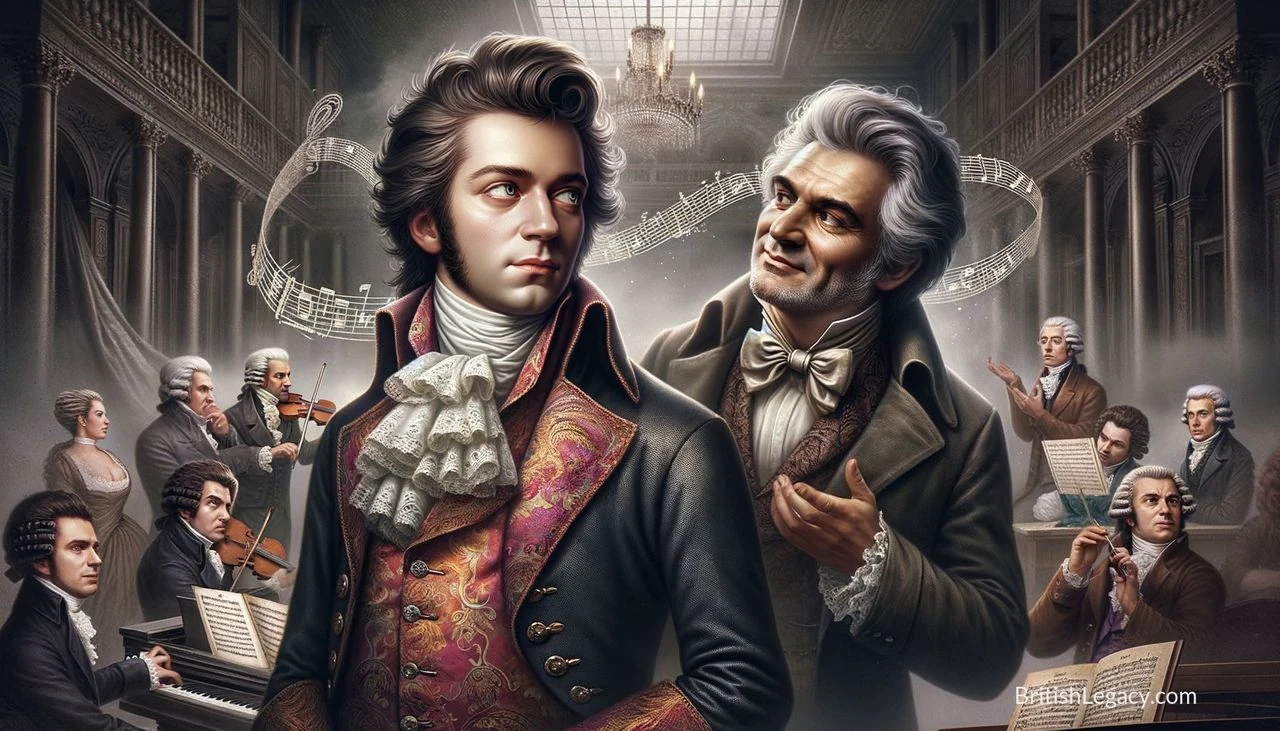
In Peter Shaffer’s Amadeus, Antonio Salieri tells a story in which admiration for Mozart’s music curdles into envy. The older composer recognises a talent he cannot match, and his efforts to frustrate Mozart become entangled with the music’s enduring power. First staged at London’s National Theatre in 1979, the play brought a drama about two composers to British and international audiences.
A rivalry told by Salieri
The play opens with an aged, embittered Salieri looking back on his life and on Mozart’s legacy. He recalls first admiring the younger composer’s extraordinary ability, then finding that admiration increasingly painful. As court composer to Emperor Joseph II, Salieri has influence within Vienna’s musical world; in Shaffer’s account, he uses it covertly to obstruct Mozart.
Mozart is presented as prodigiously gifted but impetuous and socially inept. He struggles to establish himself in Vienna even as his compositions leave Salieri acutely aware of the distance between them. The contrast drives the drama: Mozart’s work commands attention, while Salieri’s narration exposes his own resentment and sense of inadequacy.
Salieri’s schemes are directed not only at Mozart’s career but, ultimately, at his life. Mozart dies, and Salieri is left to confront what his jealousy has achieved. The play ends with him calling himself the “Patron Saint of Mediocrity”, a bitterly self-aware description of the position he believes he occupies. This is Shaffer’s dramatic construction of the rivalry, rather than a neutral account of the composers’ lives.
From the National Theatre to screen
Amadeus opened at the National Theatre in London on 2 November 1979, in a production directed by Peter Hall. Paul Scofield played Salieri and Simon Callow played Mozart. The production ran for more than a year before transferring to the West End and then Broadway. Subsequent revivals have returned to Shaffer’s text, giving directors and performers new opportunities to interpret its tension between public reputation and private grievance.
The play’s reach extended beyond the stage. Miloš Forman directed the 1984 film adaptation, which won eight Academy Awards and brought the story to a wider international audience. In both forms, the central conflict places music alongside questions of envy, artistic achievement and the desire to be remembered. The drama invites audiences to hear Mozart’s compositions through Salieri’s troubled perspective, while making Salieri’s narration part of the spectacle.
Why Amadeus deserves a place in British Legacy
Amadeus belongs in a British theatrical story because its first production was mounted at London’s National Theatre and its subsequent West End and Broadway runs carried that stage success beyond its original setting. The play’s subject is European music history, but its theatrical identity is closely tied to Shaffer’s writing and the London production directed by Peter Hall, with Paul Scofield and Simon Callow in the leading roles. Its international life, including a major film adaptation, shows how a work first staged in Britain could travel without losing the dramatic idea at its centre.
Shaffer made the imagined rivalry more than a contest over musical skill. By letting Salieri narrate, the play makes the audience witness both his recognition of Mozart’s genius and the envy that distorts that recognition. Its enduring value lies in this uneasy combination of character, music and self-deception. The National Theatre premiere, the long run and the later screen adaptation give Amadeus a specific place in British cultural history: a British-stage success whose reach became international, and whose central questions continue to make its story compelling.