
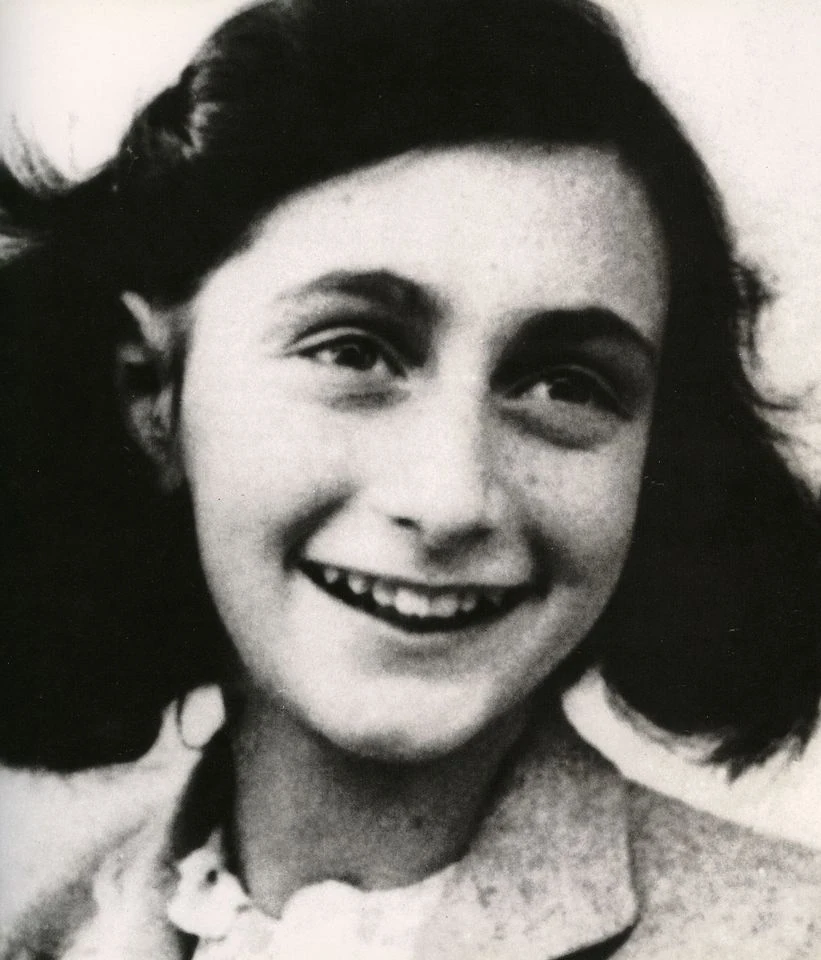
Anne Frank began her diary as a private record of adolescence. In hiding from Nazi persecution in Amsterdam, she wrote about family tensions, fear, study and hopes for the future. She also revised her writing with publication in mind. Frank was murdered at Bergen-Belsen before the war ended, but her father, Otto, brought her diary into print. Published in English in Britain in 1952, it would reach readers around the world and become an important part of how many encounter the Holocaust.
A childhood interrupted
Annelies Marie Frank was born in Frankfurt, Germany, on 12 June 1929, to Edith and Otto Frank. Her older sister was Margot. In 1934, when Anne was four and a half, the family moved to Amsterdam, after Adolf Hitler’s appointment as German chancellor. The Franks were among the many Jewish families who fled Germany during the Nazi rise to power.
Anne attended Amsterdam’s 6th Montessori School and settled into life in the Netherlands. After Germany invaded the country in May 1940, the occupation government imposed discriminatory restrictions on Jewish people. Anne and Margot were required to leave their schools and attend Jewish institutions. Anne went to the Jewish Lyceum, which opened in 1941.
On her thirteenth birthday, 12 June 1942, Anne received an autograph book bound in red-and-white checked cloth. She chose to use it as a diary and addressed entries to “Kitty”. She wrote about the restrictions imposed on Dutch Jews and the changes in her family’s life. In July, after Margot received a call-up notice, the family brought forward its plan to go into hiding.
Life behind the bookcase
On 6 July 1942, Anne, Margot, Edith and Otto moved into concealed rooms in the building where Otto worked. The entrance was later hidden behind a bookcase, and the rooms became known as the Secret Annex. Four of Otto’s employees knew about the people in hiding; with associates, they brought food, supplies and news from outside. Sheltering Jews exposed these helpers to serious danger.
The family were joined by Hermann, Auguste and Peter van Pels in July, and by Fritz Pfeffer in November. Eight people shared the confined rooms for more than two years. Anne’s account records both the pressure of this arrangement and the ordinary details of life inside it: relationships, disagreements, studying and the changing fortunes of the war.
Her diary was not simply a record of events. Anne examined her relationships with her mother and sister, wrote about her growing closeness to Peter, and considered subjects she could not easily discuss with others. She continued her studies while in hiding and wrote about her beliefs, ambitions and understanding of human nature. She also developed as a writer, revising entries and thinking about what she might publish after the war.
A young writer shaping her account
In March 1944, Anne heard a broadcast by Gerrit Bolkestein, a member of the Dutch government in exile, calling for documents about life under occupation to be collected after the war. The broadcast prompted her to edit her diary. She rewrote passages, removed some material and began preparing a version for possible publication. Her writing therefore survives in more than one form: as a personal diary and as work she deliberately reshaped for readers.
In an entry dated 5 April 1944, Anne wrote about wanting to become a journalist or writer. She hoped to be useful to people she had never met and to continue to live through her writing. Her final diary entry is dated 1 August 1944. Three days later, German police raided the hiding place and arrested its occupants.
Arrest, deportation and death
The people from the Annex were taken to Westerbork transit camp and then deported to Auschwitz-Birkenau. Anne and Margot were transferred to Bergen-Belsen in November 1944. Their mother, Edith, had been left behind at Auschwitz and died there. Otto survived his imprisonment and was the only member of the immediate Frank family to return after the war.
Anne and Margot died at Bergen-Belsen in February or March 1945, probably during a typhus epidemic. Their exact dates of death were not recorded. For many years, their deaths were thought to have occurred shortly before British forces liberated the camp in April 1945; later research has suggested that they may have died earlier. The uncertainty is a reminder of the conditions in which so many prisoners’ lives ended and were documented.
From saved pages to publication
After the arrest, Miep Gies and Bep Voskuijl returned to the Annex and gathered Anne’s papers, keeping them in the hope that she would come back. In July 1945, after the sisters’ deaths were confirmed, Gies gave the notebooks and loose pages to Otto. He later described reading them as a revelation: he had not known how fully Anne had recorded her thoughts and feelings.
Anne’s diary was first published in the Netherlands in 1947 as Het Achterhuis. An English translation appeared in the United Kingdom in 1952 as The Diary of a Young Girl. The book initially failed to find an audience in Britain and was out of print there by 1953, although its readership grew over time. Its publication gave English-language readers access to the work of a young writer who had herself hoped to reach an audience.
The published diary reflects both Anne’s own revisions and Otto’s decisions in preparing an edition. Later editions have restored material that was not included at first. The book has since been translated into more than 70 languages and has inspired plays and films. Its history as a text—written, revised, edited and republished—sits alongside its importance as a record of a particular family’s life under persecution.
Remembrance and education
The Anne Frank House opened in Amsterdam in 1960 in the building that contained the Secret Annex. The site preserves the place where Anne and the others hid and helps present their story in its historical setting. The diary’s international reach has made Anne a widely recognised figure in Holocaust remembrance, but her experience was one individual life, not a substitute for the millions of people persecuted and murdered by the Nazis.
In Britain, the diary’s English publication in 1952 is a concrete point of connection. The Anne Frank Trust UK, established in 1991, extends that connection through educational work in schools on prejudice and discrimination. The focus is not only on remembering what happened to Anne, but also on considering how prejudice affects people and communities. Her writing can open a way into that history while retaining its specificity: it is the work of a particular young person, with her own voice, relationships and ambitions.
Why Anne Frank deserves a place in British Legacy
Anne Frank’s place in British Legacy does not depend on claiming that she was British. She was born in Germany, lived in the Netherlands and was murdered at Bergen-Belsen. The British connection lies in the life of her writing here. The diary was published in English in the United Kingdom in 1952, bringing Anne’s work to British readers, even though it initially failed to attract a large audience. Its later reach and continuing use in education have made her account part of Britain’s encounter with the history of the Holocaust.
Her achievement is literary as well as historical. Anne did not merely keep notes: she revised her entries, shaped a version for readers and wrote with the ambition of becoming a journalist or author. The diary that reached the public after her death preserves that purposeful work as well as its witness to life under Nazi persecution. The Anne Frank Trust UK’s educational activity gives the story a further British dimension, using it to address prejudice and discrimination. Anne cannot stand for every victim, and no single diary can contain the scale of the Holocaust. But her precise, personal account helps readers approach that history through an individual life. Its combination of writing, historical testimony and continuing educational relevance makes her legacy significant to British readers and institutions.
Sources
Anne Frank — Wikipedia revision 1375541911
Adapted in part from Anne Frank by Wikipedia contributors, under CC BY-SA 4.0. Text has been edited and combined with the existing article; this adapted text is shared under the same licence. Contributor history.

.jpg)