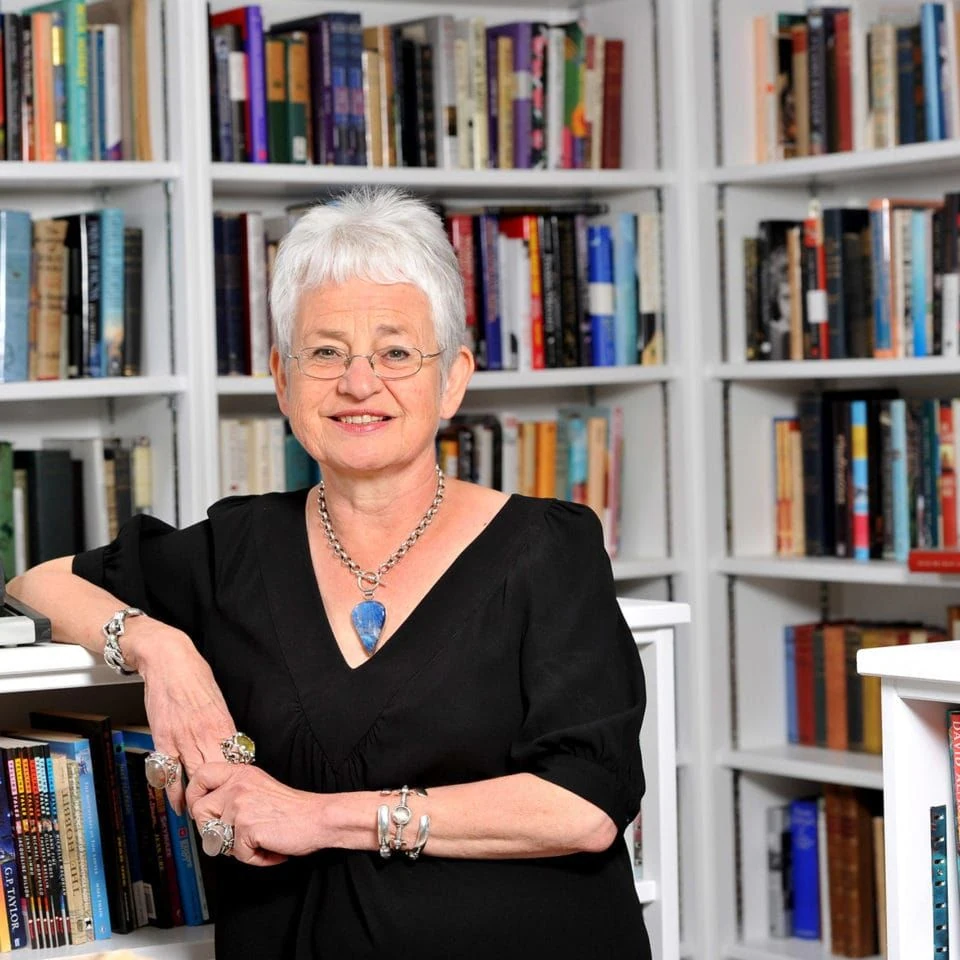
Jacqueline Wilson’s children’s books make room for subjects that can be difficult to discuss: adoption, divorce, abuse and mental illness. Her characters encounter unsettled family lives and personal challenges, but they are not reduced to them. Wilson’s breakthrough, The Story of Tracy Beaker, published in 1991, brought that realistic approach to a wide readership and began a series that would also inspire television adaptations. Her career, which began with a novel for adults in 1969, has since extended across more than 100 books, literary awards and a public role promoting reading.
From Jacqueline Aitken to a writing career
Wilson was born Jacqueline Aitken in Bath, Somerset, on 17 December 1945. Her father, Harry, was a civil servant, and her mother, Margaret “Biddy” Clibbens, was an antiques dealer. As a child she enjoyed books by Noel Streatfeild and American classics including Little Women and What Katy Did. At nine, she wrote a 21-page story called Meet the Maggots. At school she acquired the nickname “Jacky Daydream”, which she later used for an autobiographical book about her primary-school years.
She attended Coombe Girls’ School in Surrey and Carshalton Technical College. After leaving school at 16, she began training as a secretary, then applied to work for Dundee-based publisher DC Thomson on a new girls’ magazine, Jackie. Wilson has said the magazine was named after her. These early encounters with reading, writing and publishing preceded a career that would move between adult fiction, children’s novels and work in education.
Wilson’s first novel appeared in 1969. Before concentrating on children’s books, she wrote several crime novels. Her early career brought mixed success: she had written about 40 books before The Story of Tracy Beaker became her breakthrough in 1991. At 40, she took A-level English and achieved an A grade. That detail sits alongside the breadth of her output: a long writing life shaped not by one sudden beginning, but by persistence across different genres and audiences.
Tracy Beaker and realistic childhoods
Tracy Beaker is a girl living in a care home, and her story established the direct, realistic register for which Wilson became widely known. The novels address experiences including adoption, abuse and divorce. Rather than treating such subjects as peripheral to childhood, Wilson makes them part of the material her young characters must interpret and live with. Her stories can attract controversy for their themes, while finding readers among both children and adults.
The 1991 book was the start of a larger body of work, not the limit of it. Wilson’s notable children’s novels include Double Act, Girls in Love, Vicky Angel, The Illustrated Mum, Hetty Feather, Cookie, Candyfloss and Love Frankie. Their subjects and settings vary, but her writing repeatedly takes young people’s feelings and family circumstances seriously. Across more than 100 books, she has sustained a substantial readership without confining her career to a single character or series.
Wilson’s popularity is also reflected in the reception of her books. In the BBC’s 2003 Big Read poll, four were among the UK’s 100 most popular: The Story of Tracy Beaker, Double Act, Girls in Love and Vicky Angel. Fourteen of her books appeared in the top 200. In 2002, she became the most borrowed author in British libraries, a position she held until 2008. These measures show her work reaching readers through both individual favourites and the everyday public institution of the library.
Books on stage, screen and in the classroom
Wilson’s stories have travelled beyond the page through stage and screen adaptations. Double Act was dramatised for the Polka Theatre in Wimbledon in 2003 and toured the UK. Other plays based on her books included The Lottie Project, Midnight, Bad Girls, Secrets and The Suitcase Kid. This theatrical life gave the stories another form and brought them to audiences in venues across the country.
Television adaptations have included Cliffhanger, Double Act, The Illustrated Mum, Best Friends, Girls in Love and Dustbin Baby. The Tracy Beaker books generated a longer-running screen world: The Story of Tracy Beaker was adapted for CBBC, followed by Tracy Beaker Returns and programmes including The Dumping Ground. Wilson’s other work has also reached CBBC, among it Hetty Feather and Katy. The adaptations demonstrate the continuing appeal of her characters while keeping the books at the centre of a wider cultural presence.
Her public contribution has included work in higher education and support for charities. In 2013, the University of Roehampton appointed her a professorial fellow and Pro-Chancellor. She became the university’s Chancellor in 2014, was reappointed in 2017 and held the post until August 2020. She teaches on its master’s programmes in children’s literature and creative writing. She is also a patron of Momentum, which supports children undergoing cancer treatment and their families, and of the Letterbox Club, a BookTrust initiative.
Recognition and advocacy for reading
Wilson’s honours recognise both her writing and her contribution to literacy. She was appointed an Officer of the Order of the British Empire in the 2002 Birthday Honours for services to literacy in schools. From 2005 to 2007, she served as the fourth Children’s Laureate. In that role, she urged parents and carers to keep reading aloud to children after they could read independently, campaigned for more books to be available to blind people, and spoke against cutbacks in children’s television drama.
Her books have also received major literary recognition. The Illustrated Mum won the Guardian Children’s Fiction Prize and the British Book Award for Children’s Book of the Year, and was shortlisted for the 1999 Whitbread Awards. The Story of Tracy Beaker and Double Act were highly commended runners-up for the Carnegie Medal. Other awards include the Smarties Prize and the Blue Peter People’s Choice Award for The Story of Tracy Beaker. Wilson received honorary degrees from the universities of Winchester and Roehampton, among others, and the BAFTA Children’s Awards gave her its Special Award in 2017.
In the 2008 New Year Honours, Wilson was made a Dame Commander of the Order of the British Empire for services to literature. In 2025, she was promoted to Dame Grand Cross of the Order of the British Empire, again for services to literature. The progression of those honours reflects a career with a long public reach: a large body of fiction, a prominent role in advocating for young readers and sustained recognition from literary and cultural institutions.
Why Jacqueline Wilson deserves a place in British Legacy
Jacqueline Wilson deserves a place in British Legacy because her fiction has made difficult experiences visible within popular children’s literature. The Story of Tracy Beaker placed a child living in a care home at the centre of a story read by generations of young people; Wilson’s wider work addresses adoption, abuse, divorce and mental illness without treating young readers as incapable of engaging with complicated lives. Her achievement is not simply the number of books she has written. The BBC poll and her years as Britain’s most borrowed author show the extent to which her work became part of reading life in homes and libraries.
Her contribution also reaches beyond authorship. As Children’s Laureate, she advocated reading aloud, access to books for blind people and the value of children’s television drama. Her connection to British cultural life is evidenced in the institutions and audiences her work has reached: UK libraries, theatres, schools, universities and broadcasters. The stage and screen versions of her books have widened that presence, while her teaching and charitable patronage connect her career to readers and families beyond the novels. Taken together, these achievements make Wilson an important figure in British children’s literature: a writer whose stories have entertained readers while giving serious attention to the lives young people lead.
Sources
Jacqueline Wilson — revision 1378039523 · Jacqueline Wilson
Adapted in part from Jacqueline Wilson by Wikipedia contributors, under CC BY-SA 4.0. Text has been edited and combined with the existing article; this adapted text is shared under the same licence. Contributor history.