
Edith Sitwell made poetry audible as well as visible. In Façade, her abstract verse met William Walton’s music in a performance delivered through a megaphone from behind a curtain. The work baffled some of its first audience, but it was characteristic of a writer who treated rhythm, sound and form as material to be tested rather than inherited unquestioningly. Sitwell’s career also encompassed criticism, public readings and practical support for other writers.
A difficult childhood and an early start
Edith Louisa Sitwell was born in Scarborough on 7 September 1887, the eldest child and only daughter of Sir George Sitwell and Lady Ida Sitwell. Her brothers, Osbert and Sacheverell, also became authors, and the three worked together as well as building individual literary careers. The family’s home included Renishaw Hall, but Edith’s childhood was not a comfortable idyll. She later described it as extremely unhappy, and her relationship with her parents was stormy. Her father rarely saw her, while a supposed spinal deformity led to her being locked into an iron frame as part of a so-called cure.
From 1903, Sitwell’s governess Helen Rootham was an important companion. In 1914, Sitwell moved with Rootham to a flat in Bayswater. She had already begun publishing: her poem The Drowned Suns appeared in the Daily Mirror in 1913, and her first collection, The Mother and Other Poems, followed in 1915. From 1916 to 1921, she and her brothers edited Wheels, an annual poetry anthology. The collaboration gave the siblings a shared literary platform while Sitwell’s own work developed in a more experimental direction.
Making sound part of the poem
In 1922, Sitwell and the composer William Walton brought Façade before an audience. The poems play with sound and rhythm, testing the boundary between spoken verse and music. At the first performance, Sitwell recited from behind a curtain through a megaphone; the words passed through a hole in a face painted by John Piper. The audience’s bemusement was part of the event’s history, but the production was more than a theatrical stunt: it made the relationship between language, voice and musical accompaniment impossible to ignore.
Sitwell’s early poetry drew on French symbolists, while later work explored different rhythms and subjects. Gold Coast Customs (1929), for example, uses the rhythms of the tom-tom and jazz to examine human behaviour and the barbarism beneath its surface. She was a forceful advocate of innovative English poetry and resisted what she saw as the backward-looking conventions of some contemporaries. Her poems were sometimes dismissed as mannered, yet their technique and craftsmanship also attracted praise.
War brought a renewed public audience for her writing. Sitwell returned from France during the Second World War and lived at Renishaw Hall with Osbert and his companion, David Horner. With no electricity in the house, she wrote by oil-lamp light and knitted clothes for friends serving in the army. Her wartime collections included Street Songs (1942), The Song of the Cold (1945) and The Shadow of Cain (1947). Still Falls the Rain, her poem about the London Blitz, became one of her best-known works; Benjamin Britten later set it to music as Canticle III: Still Falls the Rain.
Critic, host and public performer
Sitwell’s writing ranged beyond poetry. She published a study of Alexander Pope in 1930, arguing for his importance and identifying him as a precursor of Romanticism. Her prose books included The English Eccentrics (1933), Aspects of Modern Poetry (1934) and Victoria of England (1936). She also wrote about Elizabeth I in Fanfare for Elizabeth (1946) and The Queens and the Hive (1962). Her only novel, I Live Under a Black Sun, based on the life of Jonathan Swift, appeared in 1937.
Her flat became a meeting place for writers, including younger poets she wished to befriend and help. Sitwell supported the posthumous publication of Wilfred Owen’s poetry, and later welcomed writers such as Dylan Thomas and Denton Welch into her circle. Her friendship with the painter Pavel Tchelitchew, whom she met in the 1920s, lasted until his death in 1957. She helped him financially and promoted his work. These relationships were not simply a backdrop to her writing: Sitwell used her position in literary life to encourage and advocate for other artists.
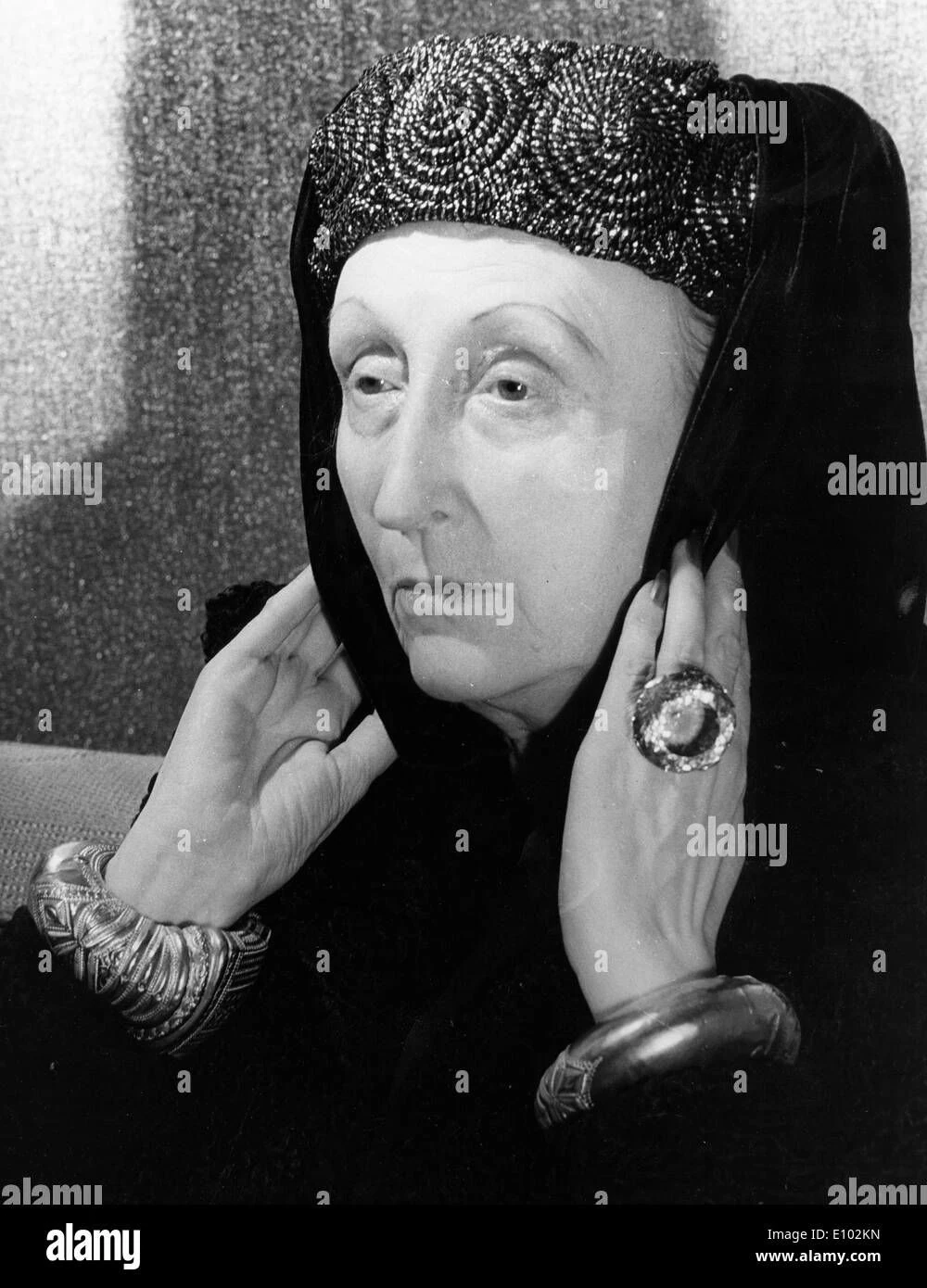
Performance remained central to her public presence. She gave poetry readings in Britain and abroad, including a 1948 tour of the United States with her brothers, and recorded her work. She was also known for striking dress: gowns of brocade or velvet, gold turbans and abundant rings. Her appearance attracted attention and personal attacks as well as admiration, sometimes threatening to overshadow the poetry itself. In 1959, she discussed her life and work with John Freeman on the BBC television series Face to Face. She was also the subject of This Is Your Life in 1962.
Recognition and later years
Sitwell became a Dame Commander of the Order of the British Empire in 1954. In 1963, the Royal Society of Literature named her a Companion of Literature, the first woman to receive the distinction. She had converted to Roman Catholicism in 1955, with the author Evelyn Waugh as her godfather. From 1961 she lived in a Hampstead flat, now marked by an English Heritage blue plaque. Joint problems led her to use a wheelchair from about 1957, and her last poetry reading was in 1962.
She died at St Thomas’ Hospital in London on 9 December 1964, aged 77, and was buried in the churchyard of Saints Mary and Peter in Weedon Lois, Northamptonshire. Her writing continued to travel beyond the printed page: poems including The Bee-Keeper and Still Falls the Rain were set by composers. The varied afterlives of her work reflect a career in which poetry, music, criticism and performance repeatedly met.
Why Edith Sitwell deserves a place in British Legacy
Sitwell’s place in British literary history rests on more than an unconventional public image. In Façade, she and William Walton made the sound and delivery of poetry part of its meaning, bringing verse into a deliberately challenging conversation with music and performance. Her writing ranged from early experiments and jazz-influenced rhythms to wartime poems such as Still Falls the Rain, which Benjamin Britten adapted for music. Her criticism and prose, including The English Eccentrics and Aspects of Modern Poetry, show that she was not only a maker of verse but also a participant in arguments about how poetry should be read and valued.
Her contribution also had a social dimension. Sitwell helped bring Wilfred Owen’s poetry to publication after his death, made her home a meeting place for writers and encouraged younger poets including Dylan Thomas and Denton Welch. Her support for Tchelitchew’s work extended to financial help and public advocacy. Those acts connect her creative experiment to the practical life of the arts: writers and artists need readers, advocates and places in which work can be shared. The British institutions that recognised her, from the DBE to the Royal Society of Literature’s Companion of Literature distinction, mark the public standing she achieved. Remembering Sitwell means recognising both the poems that challenged convention and the literary community she helped sustain.
Sources
Edith Sitwell — Wikipedia revision 1379253651 · Edith Sitwell — Wikipedia
Adapted in part from Edith Sitwell by Wikipedia contributors, under CC BY-SA 4.0. Text has been edited and combined with the existing article; this adapted text is shared under the same licence. Contributor history.

.png)