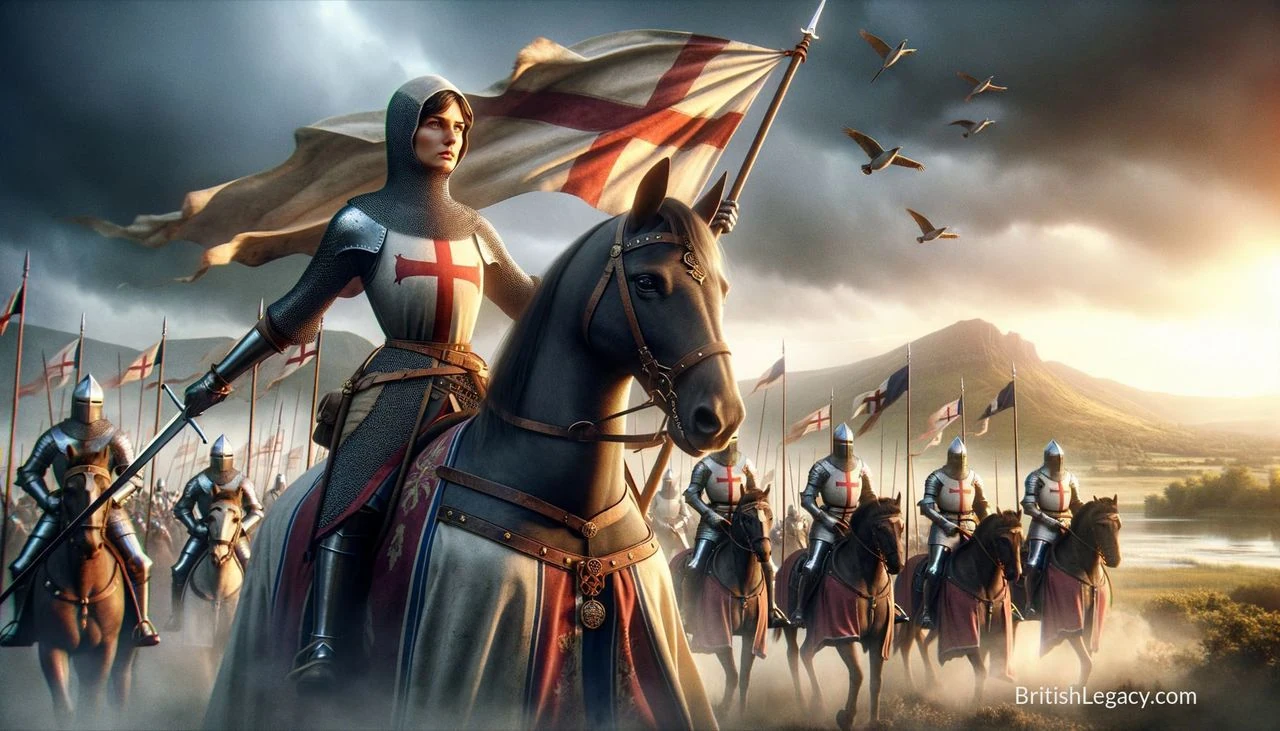
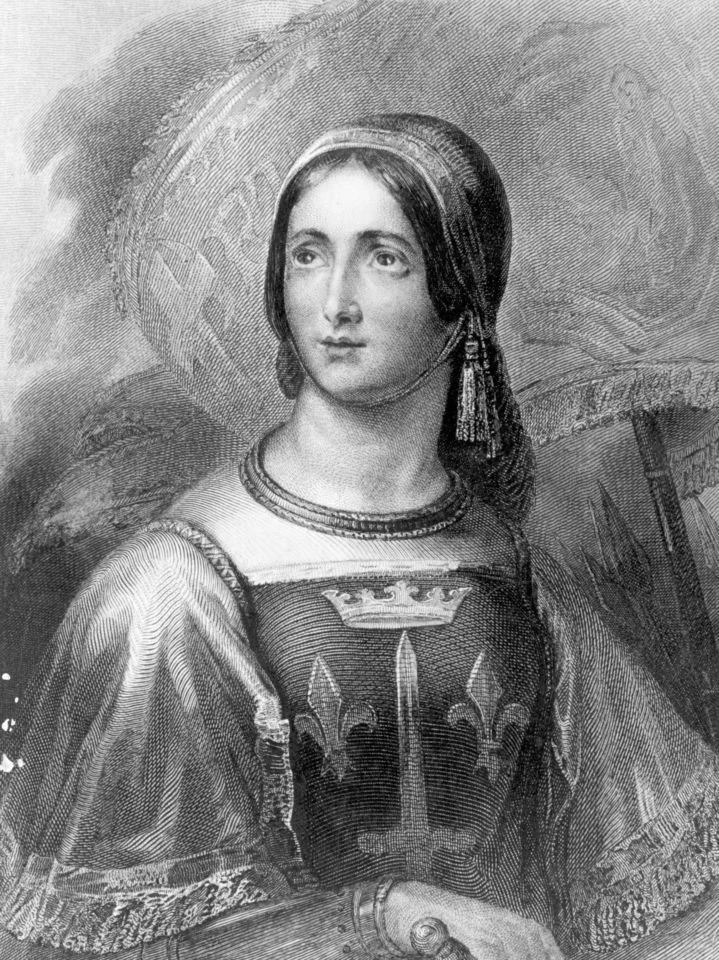
In 1429, as English forces pressed their advantage in France, a teenage peasant from Domrémy joined the French cause and helped change its prospects. Joan of Arc arrived at besieged Orléans carrying a banner; nine days later, the English had abandoned the siege. Her role in the campaigns that followed helped clear the way for Charles VII’s coronation at Reims. Joan was not British, but her brief military career became part of the history of England’s long attempt to control the French crown.
A kingdom divided
Joan was born around 1412 in Domrémy, in north-eastern France, to Jacques d’Arc and Isabelle Romée. Her family had land, and her father also served as a village official. The Hundred Years’ War, which began in 1337, was not simply a contest between two unified kingdoms: France was divided by conflict between the Armagnac supporters of the Dauphin Charles and the Burgundians, who allied with the English. The Treaty of Troyes had recognised the young Henry VI of England as heir to the French throne, while Charles also claimed it.
Joan later said that, from about the age of thirteen, she experienced visions of saints who instructed her to help Charles and drive the English from France. In 1428, she sought an escort to reach the Dauphin but was refused. After returning to Vaucouleurs in January 1429, she gained the support of two soldiers, Jean de Metz and Bertrand de Poulengy. The garrison commander, Robert de Baudricourt, eventually agreed to let her travel to Chinon.
Joan reached Charles’s court in late February or early March. She said she had come to relieve Orléans and lead him to Reims for his coronation. Charles’s advisers arranged examinations by theologians at Poitiers; women at Tours also examined her and affirmed her virginity. The court then sent her with a relief force towards Orléans. Her religious claims were consequential in a war in which Charles’s legitimacy was contested, but the campaign’s military outcome would also determine whether his cause could advance.
Orléans and the road to Reims
Joan arrived at Orléans on 29 April 1429. The city was not completely cut off, and she was initially more a figurehead than a formal commander. Her presence nevertheless helped revive the confidence of the French troops, and commanders sometimes followed her advice about attacks. On 4 May, she rode out to the assault on the English-held fortress of Saint-Loup, arriving as French soldiers were retreating. They rallied and took the position. Over the next few days the French captured further strongholds. On 7 May, Joan was wounded by an arrow while carrying her banner near the Tourelles; she returned to encourage the assault. The English withdrew the following day.
Joan pressed for an advance towards Reims so Charles could be crowned. During the Loire campaign, French forces took Jargeau, Meung-sur-Loire and Beaugency. Joan urged them to pursue the English after Beaugency surrendered; the resulting Battle of Patay on 18 June was a decisive French victory, although Joan arrived too late to take part in the fighting. The route north was then largely unopposed. Reims opened its gates on 16 July, and Charles was consecrated the next day, with Joan beside him.
The coronation strengthened Charles’s claim, but it did not end the war. A proposed transfer of Paris to the French side failed, and the court’s negotiations with Burgundy slowed the advance. During the assault on Paris in September, Joan was wounded by a crossbow bolt. Charles ordered the attack to stop the next day. Joan’s influence at court declined as the king favoured diplomacy; a later campaign against La-Charité-sur-Loire also failed.
Capture, trial and rehabilitation
In 1430, Joan gathered volunteers to relieve Compiègne, which was under siege by Burgundian forces. On 23 May, she was captured during a sortie from the town. After unsuccessful attempts to escape, she was transferred to the English, who paid her Burgundian captor’s ransom. She was taken to Rouen, where the trial began in January 1431.
The ecclesiastical court accused Joan of heresy. The charges included acting on supposedly demonic visions and wearing men’s clothes; her clothing was treated as evidence in the case, rather than as a separate charge of a different kind. Joan initially signed an abjuration, but later resumed wearing men’s clothes and said she would not deny her visions. The court declared her a relapsed heretic. On 30 May 1431, aged about nineteen, she was burned at the stake in Rouen.
In 1456, an inquisitorial court overturned the verdict, finding the original trial unjust and deceitful. Joan’s execution had not restored English military momentum. In 1435, Burgundy abandoned its alliance with England; the war ended in 1453 with a French victory at Castillon, and English rule in France was reduced to Calais. Joan’s victories had helped Charles’s cause, but the eventual outcome followed many further years of war and political change.
A French saint and a lasting symbol
Joan’s reputation as a French military leader took shape during her lifetime. Orléans began an annual celebration of the lifting of the siege in 1429, and the city’s commemoration continued to centre on her. Later, her public image took on different meanings: she was remembered as a defender of France, a religious figure, and a woman who challenged expectations of who could lead an army. She was beatified in 1909 and canonised by Pope Benedict XV on 16 May 1920. In 1922, she was declared one of France’s patron saints.
Her story also has a place in British history because her successes confronted English military and dynastic ambitions in France. That connection should not turn her into a British heroine: Joan served the French cause, and her enduring national symbolism is French. The consequence for England was that a struggle over the French crown continued under conditions increasingly favourable to Charles’s side.
Why Joan of Arc deserves a place in British Legacy
Joan deserves a place in British Legacy not because she was British, but because her actions became part of a defining episode in the relationship between England and France. At Orléans, her arrival helped rally a French force at a moment when the English siege threatened a strategically important city. The campaigns that followed opened a route to Reims, where Charles VII’s coronation strengthened his claim to the throne. These events challenged England’s effort to establish authority over France, making Joan’s story inseparable from the history of English power across the Channel.
Her place in this history also calls for precision about cause and consequence. Joan did not single-handedly end the Hundred Years’ War: she was captured in 1430 and executed in 1431, while fighting continued until 1453. Her early victories nevertheless raised French morale and helped Charles’s cause at a critical point. Her trial and its later reversal show how military rivalry and claims to royal legitimacy could meet in a courtroom. Remembering Joan in a British context offers more than a tale of an opponent’s victories. It helps explain the limits of English rule in France and gives proper weight to the French leadership that helped bring those limits into view.
Sources
Joan of Arc — supplied revision
Adapted in part from Joan of Arc by Wikipedia contributors, under CC BY-SA 4.0. Text has been edited and combined with the existing article; this adapted text is shared under the same licence. Contributor history.