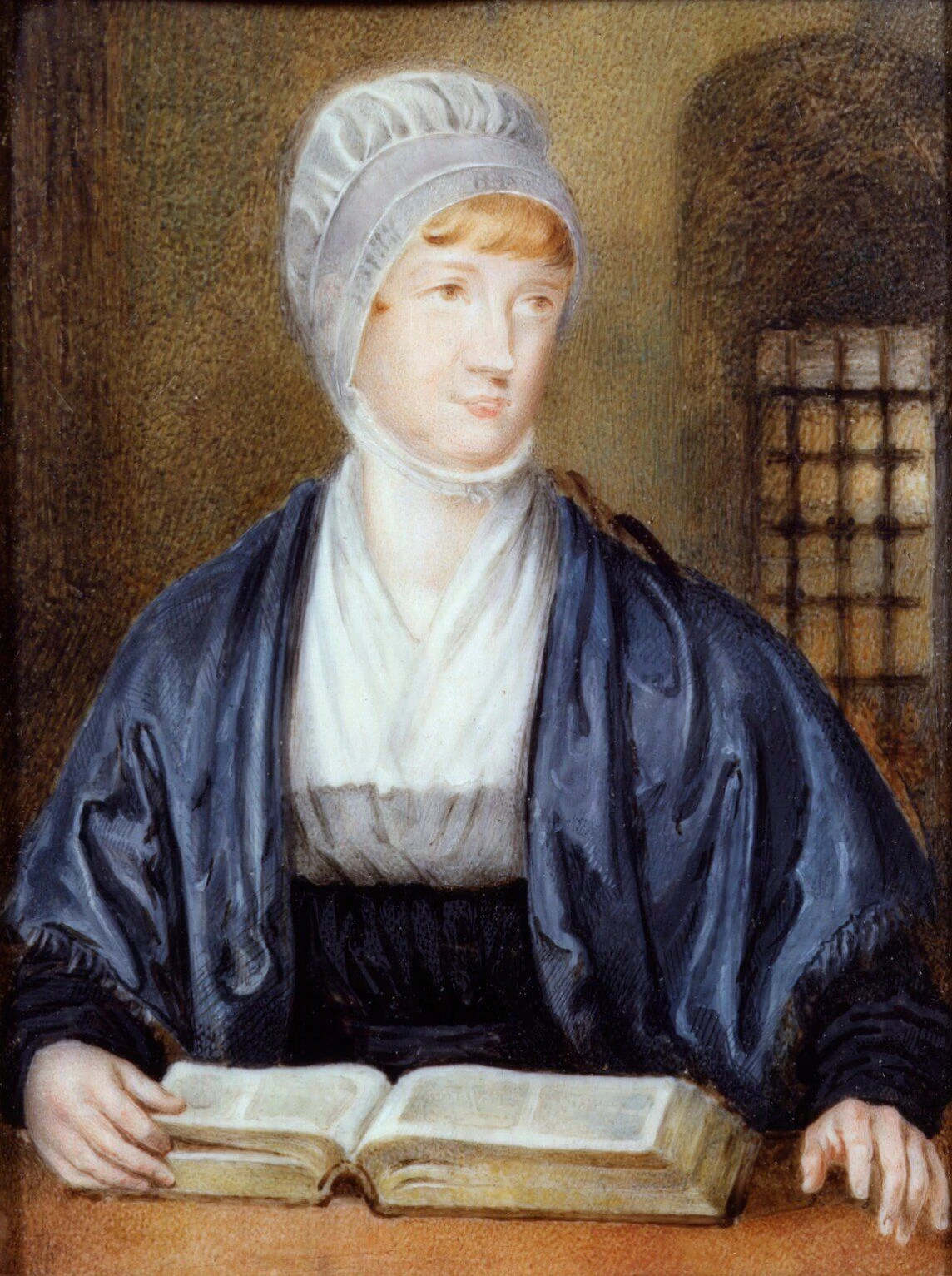
When Elizabeth Fry visited Newgate Prison in 1813, she found women and children crowded into small cells, sleeping on straw and doing their own cooking and washing. Some women had not yet stood trial. Fry returned with food and clothes, then built a campaign that joined immediate help to longer-term reform: education and useful work inside prison, better treatment for women being transported, and pressure on authorities to improve the system. Her work made her one of Britain’s most prominent nineteenth-century prison reformers, but its progress was neither simple nor complete.
A Quaker upbringing and a life in London
Born Elizabeth Gurney in Norwich on 21 May 1780, Fry was part of a prominent Quaker family. Her father, John Gurney, was a partner in Gurney’s Bank; her mother, Catherine, came from the Barclay family. After her mother died, when Elizabeth was 12, she took some responsibility for the care and education of her younger siblings. Her brother Joseph John Gurney later became a philanthropist and evangelical leader; her sister Louisa wrote about education.
At 20, Elizabeth met Joseph Fry, a Quaker banker. They married in Norwich on 19 August 1800 and moved to the City of London. The couple had 11 children. Fry was recorded as a minister of the Religious Society of Friends in 1811. Her religious commitments shaped her work, but the practical response she developed at Newgate was also rooted in close attention to what prisoners needed.
Newgate: from visiting to organised reform
Prompted by the Quaker Stephen Grellet, Fry went to Newgate in 1813. The crowded conditions and the presence of children among the prisoners stayed with her. She was not able to pursue the work continuously in the years immediately afterwards: difficulties within the Fry family included financial problems at the bank run by her husband and his brother. She returned to the project in 1816 and helped fund a school for children imprisoned with their mothers.
Fry did not simply prescribe rules for the women. She proposed regulations and invited the prisoners to vote on them. She also helped provide materials for sewing, patchwork and other needlework. These activities gave women something purposeful to do while imprisoned and could help them develop skills they might use to earn money after release. Her approach treated education and work as part of rehabilitation, rather than relying on harsh punishment alone.
In 1817, Fry helped establish the Association for the Reformation of the Female Prisoners in Newgate. The association supported the women’s work and helped organise reform beyond individual visits. Its model was taken up elsewhere; in 1821, the British Ladies’ Society for Promoting the Reformation of Female Prisoners was formed. Fry’s campaign combined direct assistance with efforts to change public and official attitudes towards imprisonment.
Evidence, legislation and the limits of reform
On 27 February 1818, Fry gave evidence to a House of Commons committee examining prisons. She is believed to have been the first woman called to give evidence to a parliamentary select committee. Her appearance brought the conditions she had observed before legislators, but the resulting reforms did not immediately resolve the problems she described.
The Gaols Act of 1823 provided for the separation of male and female prisoners and female warders for women. Fry’s views influenced the drafting and passage of the Act, but its provisions had limited effect: there was no mechanism to ensure compliance, and some prisons were outside its scope. Fry continued to press the case for change. Giving evidence to a Lords committee in 1835, she warned that many prisons remained badly run and that some offered neither instruction nor employment. The Prisons Act 1835 subsequently provided for prison inspectors and brought gaols and prisons under central control.
Fry’s work also extended beyond the prison walls. Women awaiting transportation were sometimes taken through London in open carts, exposed to abuse from crowds. Fry persuaded the Newgate governor to use closed carriages, and she and other members of the Ladies’ Society accompanied women to the docks. On transport ships, she pressed captains to provide women and children with adequate food and water. She arranged sewing materials and other supplies for the voyage, intended to provide occupation and practical skills on arrival, and campaigned for better conditions in the colonies. She visited 106 transport ships and saw 12,000 convicts. Her work contributed to a wider movement against transportation, which was abolished in 1868.
Beyond prisons: welfare and nursing
Fry’s concern for people in hardship was not confined to prisoners. After seeing the body of a young boy in winter, in 1819–20 she established a nightly shelter for homeless people in London. In 1824, she helped set up the Brighton District Visiting Society, organising volunteers to visit people in poverty and offer practical help. The approach was repeated in other towns and districts.
In 1840, she opened a nurse-training school at Guy’s Hospital, known as the Institution of Nursing Sisters. The programme influenced Florence Nightingale, who later took a team of Fry’s nurses to assist wounded soldiers in the Crimean War. Fry also campaigned against slavery in Danish and Dutch colonies, extending her reform work beyond prisons and domestic welfare.
A public legacy, and a reformer’s death
Fry’s work attracted support from prominent figures, including Queen Victoria and the Prussian emperor Frederick William IV. Robert Peel also supported legislation connected with prison reform. These connections helped give her cause visibility, but Fry’s own visits, evidence and continued criticism of poor conditions remained central to her campaign.
Fry died in Ramsgate on 12 October 1845, aged 65, after a stroke. She was buried at the Friends’ burial ground in Barking. More than a thousand people attended her burial, and Ramsgate Coast Guard seamen flew their flag at half-mast. A practical memorial followed: the first Elizabeth Fry refuge opened in Hackney in 1849, offering temporary shelter to young women discharged from prisons or police offices. Training, including laundry and needlework, formed part of its work.
Her name has since been commemorated in buildings, plaques and other memorials in Britain and abroad. She appeared on the reverse of Bank of England £5 notes, shown reading to prisoners at Newgate, with a key representing the prison key awarded to her in recognition of her work. The note later featured Winston Churchill instead. Her continuing commemoration reflects the public reach of her reputation; the lasting significance of her work lies in the reforms she pursued and the practical institutions established in response to it.
Why Elizabeth Fry deserves a place in British Legacy
Elizabeth Fry deserves a place in British Legacy because she brought sustained public attention to the treatment of prisoners, particularly women, and connected that attention to specific measures. At Newgate, she helped establish a school for children living in prison with their mothers, supported needlework and other useful activities, and involved prisoners in deciding rules. She helped organise associations that carried this work beyond one prison. Her evidence to Parliament placed conditions behind prison walls before legislators, and her continued scrutiny exposed the distance between legal reform and its implementation.
Her contribution also reached beyond the prison itself. Fry campaigned for women being transported, pressing for greater dignity on the journey and basic provisions aboard ship. She helped establish a shelter for homeless people and founded a nurse-training school whose influence reached the nursing work of Florence Nightingale. These efforts show a reformer attentive both to immediate needs and to the systems shaping people’s lives. Her legacy is not a claim that one campaign solved the injustices it confronted: the Gaols Act was imperfectly enforced, and Fry herself continued to criticise prison conditions. Rather, it is the example of practical, organised reform—visiting, documenting, educating, supporting and arguing for institutional change—that gives her story its enduring place in Britain’s social history.
Sources
Elizabeth Fry — Wikipedia revision 1368167916 · Elizabeth Fry — Wikipedia
Adapted in part from Elizabeth Fry by Wikipedia contributors, under CC BY-SA 4.0. Text has been edited and combined with the existing article; this adapted text is shared under the same licence. Contributor history.