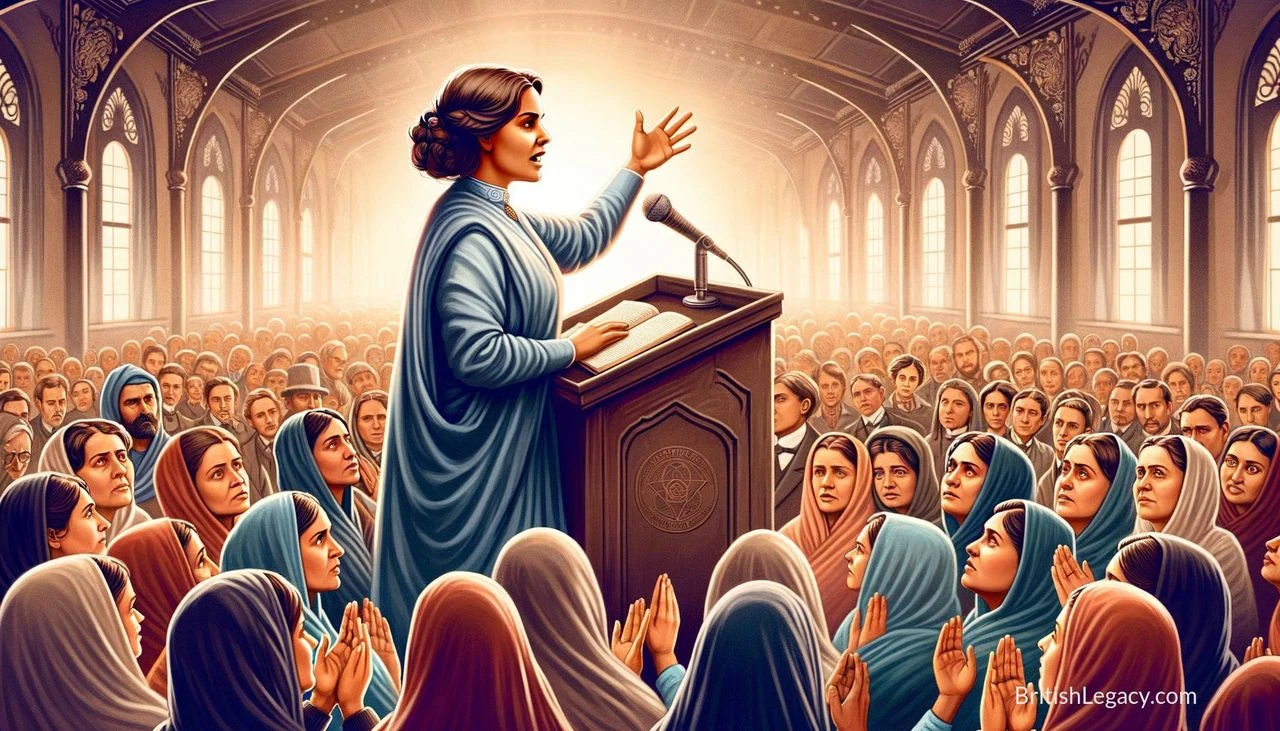
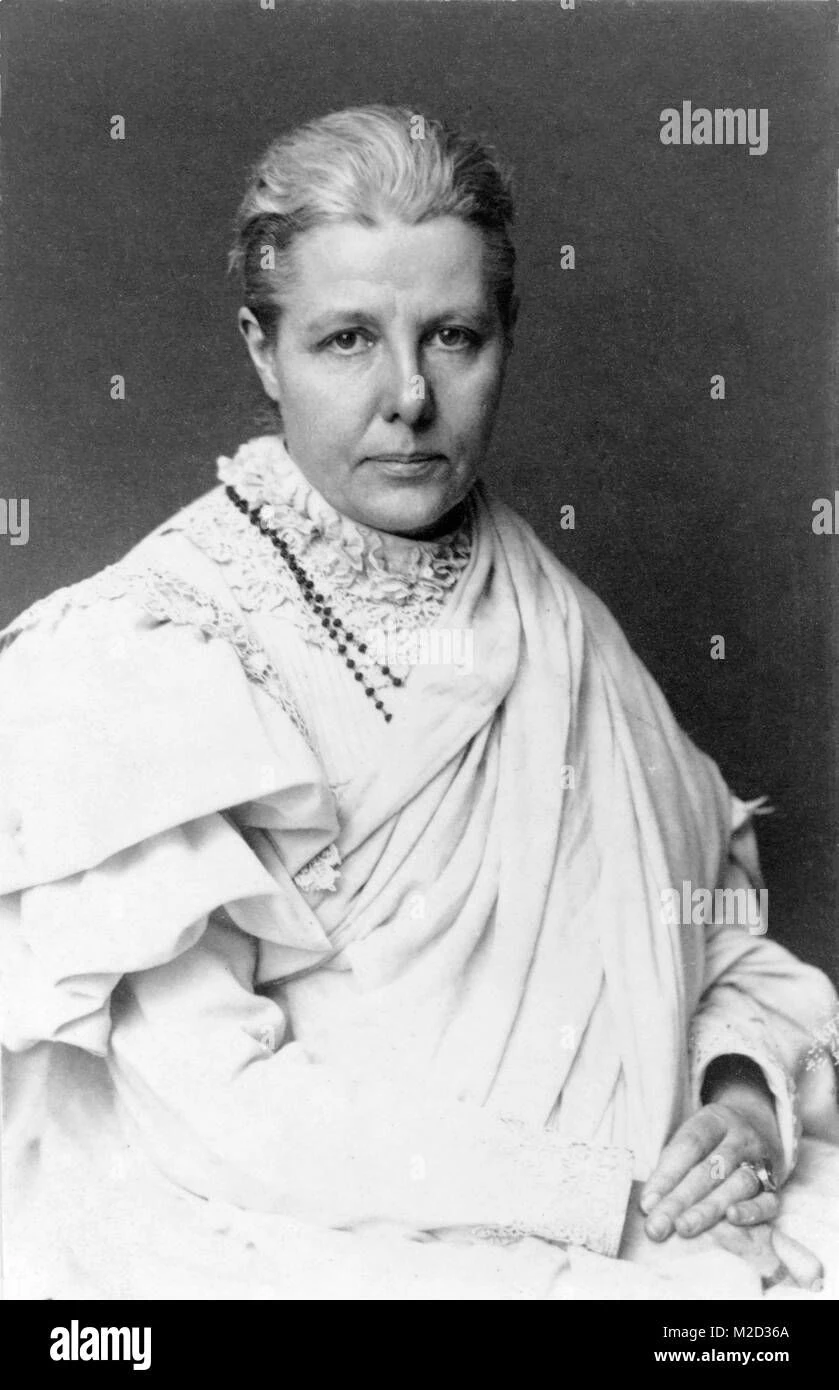
Annie Besant moved through causes that Victorian Britain often treated as incompatible. She began as a freethought writer and campaigner for birth control, became a prominent socialist and organiser in London, and later devoted much of her life to theosophy, education and Indian self-government. Her public career crossed continents, but its British beginnings—in arguments over religious authority, women’s lives and industrial labour—remained central to the way she made politics public.
A young marriage and a break with orthodoxy
Born Annie Wood in Clapham, London, on 1 October 1847, she was the daughter of William Wood and Emily Morris. Her father died when she was young. She was educated at a school in Charmouth run by Ellen Marryat, and travelled in Europe before returning to England. In December 1867, aged 20, she married Frank Besant, an Anglican clergyman. They had two children, Arthur and Mabel.
The marriage deteriorated as Besant’s religious beliefs changed. After refusing to attend Communion, she left her husband in 1873 and moved to London with Mabel. The separation brought financial difficulty and a prolonged dispute over the children. Besant wrote for a living, initially contributing to freethought publications, while developing a public voice that challenged the religious and social expectations placed on women.
In 1874 she joined the National Secular Society and began speaking on women’s political status. The organisation’s campaign for a secular state and freedom of thought gave her a platform; she also wrote and lectured on women’s rights, workers’ rights and birth control. Her activism was not simply a change of belief. It involved building a career as a writer and orator at a time when women had limited access to formal political power.
Birth control, socialism and London’s workers
Besant’s partnership with the secularist Charles Bradlaugh brought her into a major legal controversy. In 1877 they published Fruits of Philosophy, an American work on birth control by Charles Knowlton. The prosecution that followed made their publication a public test of whether information about contraception could be circulated. Besant and Bradlaugh were found guilty, but the verdict was later overturned on a technical point. The case made Besant widely known and sharpened her commitment to giving working-class families information about limiting the size of their families.
Her political thinking continued to change. In the mid-1880s she moved towards socialism, joining the Fabian Society and then becoming a leading speaker for the Social Democratic Federation. She founded the periodical Our Corner and, for a time, edited The Link. In 1887, after the violence at the Trafalgar Square demonstration remembered as Bloody Sunday, she helped organise legal aid for workers who had been arrested and support for their families.
The 1888 matchgirls’ strike at the Bryant & May factory in Bow brought Besant into the debate over women’s industrial work. She wrote about the workers’ conditions in The Link and supported the wider campaign. The strike became a landmark in the growth of women’s trade unionism, though accounts differ over the extent of Besant’s role in leading it. She also supported the London dockers’ strike of 1889, helping Ben Tillett with union rules and speaking at public meetings. These campaigns linked public advocacy to the practical work of organising workers.
In 1888 Besant was elected to the London School Board for Tower Hamlets, topping the poll. Women could vote in this local election, although they were excluded from parliamentary politics. Her campaign joined socialist priorities to education and child welfare, with the appeal “No more hungry children”. The result gave her a formal public office in Britain and placed her among a small number of women shaping local policy.
Theosophy, education and a new home in India
Besant’s encounter with Helena Blavatsky’s writing led her towards theosophy. She joined the Theosophical Society in 1889 and gradually left her earlier secularist and socialist organisations. The shift did not end her public activity; it redirected it towards spiritual teaching, education and, increasingly, India. She travelled there for the first time in 1893, and in 1907 became president of the Theosophical Society, whose headquarters were at Adyar, near Madras.
Education became one of her most substantial projects. In 1898 she helped establish the Central Hindu School in Benares, now Varanasi. The school combined religious teaching with modern science and aimed to prepare Indian students for leadership. Besant and fellow trustees later agreed that the college should form part of a new university. The Central Hindu College became a constituent college of Banaras Hindu University, which began operating in 1917.
Besant also supported the International Order of Co-Freemasonry, an organisation in which women and men could work together. In 1902 she established its first lodge in Britain. Her work in this field reflected her continuing interest in women’s participation in institutions, even as the ideas that shaped her activism had changed significantly since her secularist years.
Home Rule and public leadership
Besant’s campaigning in India took an explicitly political form during the First World War. She joined the Indian National Congress and, in 1916, launched the All India Home Rule League with Bal Gangadhar Tilak. The League sought self-government for India and built local branches that could sustain meetings, demonstrations and agitation throughout the year. Its organising model helped turn Home Rule into a more continuous political campaign.
In June 1917, the government arrested and interned Besant. The arrest provoked protest, and she was released in September. Later that year she became the first woman president of the Indian National Congress. The office marked the reach of her political work, but it did not mean that she and the Congress leadership agreed on every question. After the war, she continued to argue for Indian independence, while differences emerged between her and the newer leadership associated with Mohandas Gandhi.
Besant’s standing in India grew from more than the Home Rule campaign. She wrote and spoke extensively, edited the newspaper New India, and connected education, religious thought and political self-government in her public work. Her influence was not uncontested: her theosophical beliefs and political positions changed over time, and the later Indian independence movement developed under leaders with different methods and priorities.
Belief, influence and final years
Besant’s role in theosophy included her involvement with Jiddu Krishnamurti, whom the movement came to present as a future “World Teacher”. She became his legal guardian with his father’s consent. In 1929 Krishnamurti rejected the role, dissolved the Order of the Star in the East and left the movement. Besant and Krishnamurti remained friends, despite their different views. The episode captures both her power within the organisation and the limits of her influence over the people around her.
She continued to campaign for Indian independence and to write and lecture in her later years. Besant died in Adyar on 20 September 1933, aged 85. Her work left distinct legacies: a career in British freethought and labour politics, educational institutions in India, and a prominent place in the Home Rule movement. Those strands do not resolve into a single, unchanging political programme; they record a life repeatedly reshaped by new commitments.
Why Annie Besant deserves a place in British Legacy
Besant belongs in a British history of reform because her early campaigns show how arguments about private life became public disputes. Her work with Bradlaugh over Fruits of Philosophy challenged restrictions on publishing information about birth control. Her writing and speeches connected women’s rights with secularism and workers’ conditions, while her involvement in the matchgirls’ and dockers’ campaigns helped make industrial labour a matter of public debate. Her election to the London School Board gave that activism a formal local role: she could press for the welfare and education of London’s children within a public institution.
Her later career also makes the British connection more than a story of domestic reform. Besant carried experience as a British organiser and speaker into campaigns for Indian self-government, where she helped launch the Home Rule League with Tilak and became the first woman president of the Indian National Congress. Her life joined British political culture to the struggle against British rule in India—a connection that requires acknowledging both her influence and the limits and changes in her politics. The schools and political organisations associated with her work offered practical ways to educate, organise and make demands. That combination of public argument and institution-building is the specific legacy her story contributes to British history.
Sources
Annie Besant — Wikipedia, revision 1379021073
Adapted in part from Annie Besant by Wikipedia contributors, under CC BY-SA 4.0. Text has been edited and combined with the existing article; this adapted text is shared under the same licence. Contributor history.