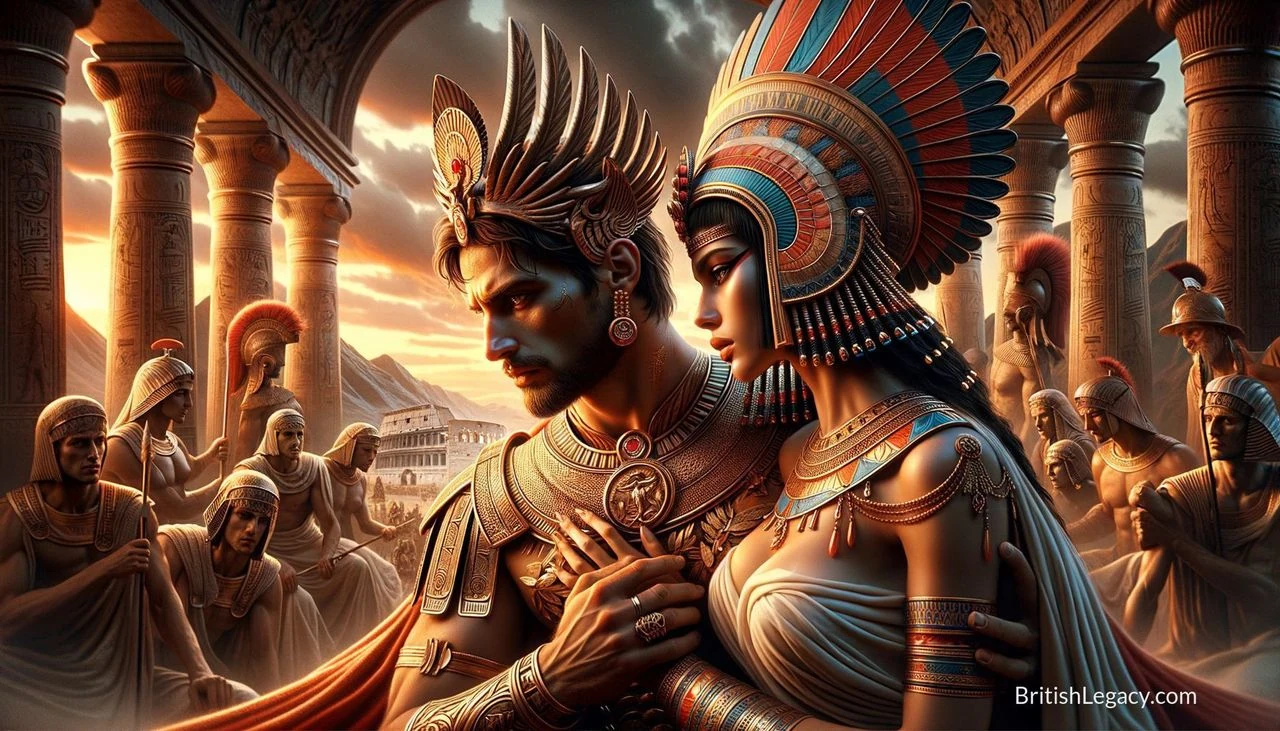
In Shakespeare’s Antony and Cleopatra, a Roman commander’s love for Egypt’s queen is inseparable from the struggle for power. The play travels between Rome and Alexandria, changing pace and tone as Antony is pulled between his political position and his attachment to Cleopatra. Its ending is both a personal catastrophe and a change in the balance of power: Antony and Cleopatra die, and Octavius Caesar is left to prevail.
A tragedy moving between worlds
Shakespeare wrote the play around 1606–07, though some scholars have argued for an earlier date. It was first performed around 1607 by the King’s Men, at either the Blackfriars Theatre or the Globe Theatre. The first known printed text appeared in the First Folio of 1623, under the title The Tragedie of Anthonie, and Cleopatra. The Folio remains the play’s only authoritative early text.
The story draws on Thomas North’s 1579 English translation of Plutarch’s Lives, particularly the life of Mark Antony. Shakespeare reshaped that historical narrative for the stage rather than simply reproducing it. His play ranges across the Roman Republic and Ptolemaic Egypt, with frequent changes of place and register. Alexandria is associated with imaginative, sensual abundance; Rome with political calculation and military order. These contrasts help frame the action, but the characters do not fit neatly into either world.
That instability is central to Antony’s predicament. He is one of Rome’s three triumvirs, alongside Octavius Caesar and Lepidus, but his relationship with Cleopatra draws him away from Roman affairs. The play’s swift shifts between locations mirror the competing claims on him: political duty, personal desire and the effort to retain authority.
Alliances, defeat and loss
Octavius summons Antony from Alexandria to help confront Sextus Pompey and the threat he poses to the triumvirs. In Rome, Antony agrees to marry Octavia, Octavius’s sister, in an attempt to mend the political relationship between the two men. The marriage does not end his bond with Cleopatra. When he returns to Egypt, the personal and political conflict resumes, now sharpened by the division of power between the Roman leaders.
Antony’s forces meet Octavius’s at Actium. Cleopatra’s ships flee, and Antony follows, abandoning the battle. He later resolves to fight again, but his position deteriorates as soldiers desert and his trusted lieutenant Enobarbus defects to Octavius. Antony’s response to Enobarbus is unexpectedly generous: he sends his former companion’s possessions after him rather than seizing them. Overcome by shame at his desertion, Enobarbus dies.
After defeat, Antony believes Cleopatra has betrayed him. She sends word that she is dead, intending to draw him back; instead, he tries to kill himself. Badly wounded, he learns that Cleopatra is alive and is carried to her monument, where he dies in her arms. Captured by the Romans, Cleopatra fears being displayed in Octavius’s triumph. She takes her own life with an asp. Her death denies Octavius the public spectacle he intended, while leaving him free to become Rome’s first emperor.
Character, language and contested meanings
Cleopatra is not presented as a simple emblem of seduction or power. Shakespeare gives her a volatile public presence and a political role, while showing how others attempt to define and diminish her. Her character has consequently prompted sharply different readings. The play’s tensions resist an easy division between a disciplined Rome and an indulgent Egypt: Antony moves between them, and both love and political ambition disrupt the apparent order of each.
The tragedy is also difficult to assign to a single dramatic category. It is a Roman play, but its mixture of history, tragedy, romance and comedy complicates a straightforward label. Its many short scenes shift rapidly between locations, contributing to a sense of events unfolding across a broad political landscape. Shakespeare’s language makes that scale intimate as well as grand: the lovers’ private exchanges sit beside military decisions and the fate of kingdoms.
The source story itself is transformed. Shakespeare develops Enobarbus’s role and adds scenes, including episodes of Cleopatra’s domestic life. He also changes the chronology: in Plutarch, Antony’s final defeat came weeks after Actium, while Shakespeare brings the events closer together. These choices make the play’s history a dramatic construction, shaped to intensify its conflicts rather than serve as a neutral record.
A continuing British stage tradition
The play’s stage history includes productions by leading British companies and performers. At the Shakespeare Memorial Theatre in 1953, Michael Redgrave played Antony and Peggy Ashcroft played Cleopatra. Trevor Nunn directed a Royal Shakespeare Company production in 1972, with Janet Suzman and Richard Johnson in the title roles and Patrick Stewart as Enobarbus. The RSC returned to the play in 1978, in a production directed by Peter Brook and starring Alan Howard and Glenda Jackson.
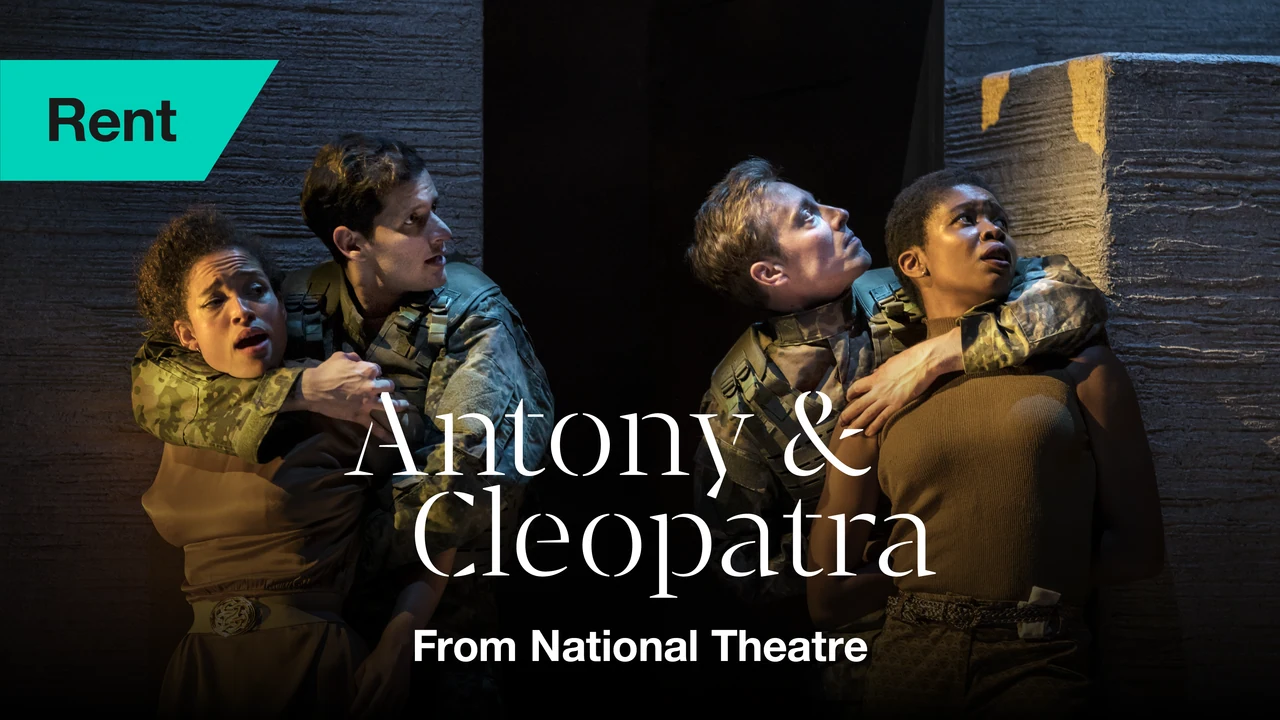
Later British productions included the Royal National Theatre’s 1987 staging with Anthony Hopkins and Judi Dench, and its 1998 production with Alan Rickman and Helen Mirren. Shakespeare’s Globe in London presented an all-male production in 1999, with Paul Shelley as Antony and Mark Rylance as Cleopatra. The play was also staged by the RSC in 2006 with Patrick Stewart and Harriet Walter, and at the National Theatre in 2018 with Ralph Fiennes and Sophie Okonedo. Such productions place different performers and interpretations in conversation with a work whose characters and cultural contrasts remain open to argument.
Why Antony and Cleopatra deserves a place in British Legacy
Antony and Cleopatra belongs in British Legacy because it shows the reach of Shakespearean theatre beyond a story of two famous historical figures. Written for the London stage in the early seventeenth century, the play draws on a classical source and turns it into a drama of political rivalry, personal attachment and contested authority. Its movement between Rome and Egypt gives those conflicts a distinctive theatrical form: rapid changes of place and tone keep the audience alert to how public power and private feeling affect one another.
Its British legacy is also visible in the documented history of performance. From the Shakespeare Memorial Theatre and the Royal Shakespeare Company to the Royal National Theatre and Shakespeare’s Globe, British stages have repeatedly returned to the play, giving its roles to performers including Peggy Ashcroft, Janet Suzman, Glenda Jackson, Judi Dench and Helen Mirren. Those productions are not simply a measure of longevity. They demonstrate how the work can be re-examined through casting, performance and changing interpretations of Cleopatra, gender and empire. Shakespeare’s tragedy remains useful to British theatre because it offers no settled answer to the conflict between political duty and personal desire; it gives successive companies a complex dramatic structure with which to test those questions before an audience.
Sources
Adapted in part from Antony and Cleopatra by Wikipedia contributors, under CC BY-SA 4.0. Text has been edited and combined with the existing article; this adapted text is shared under the same licence. Contributor history.