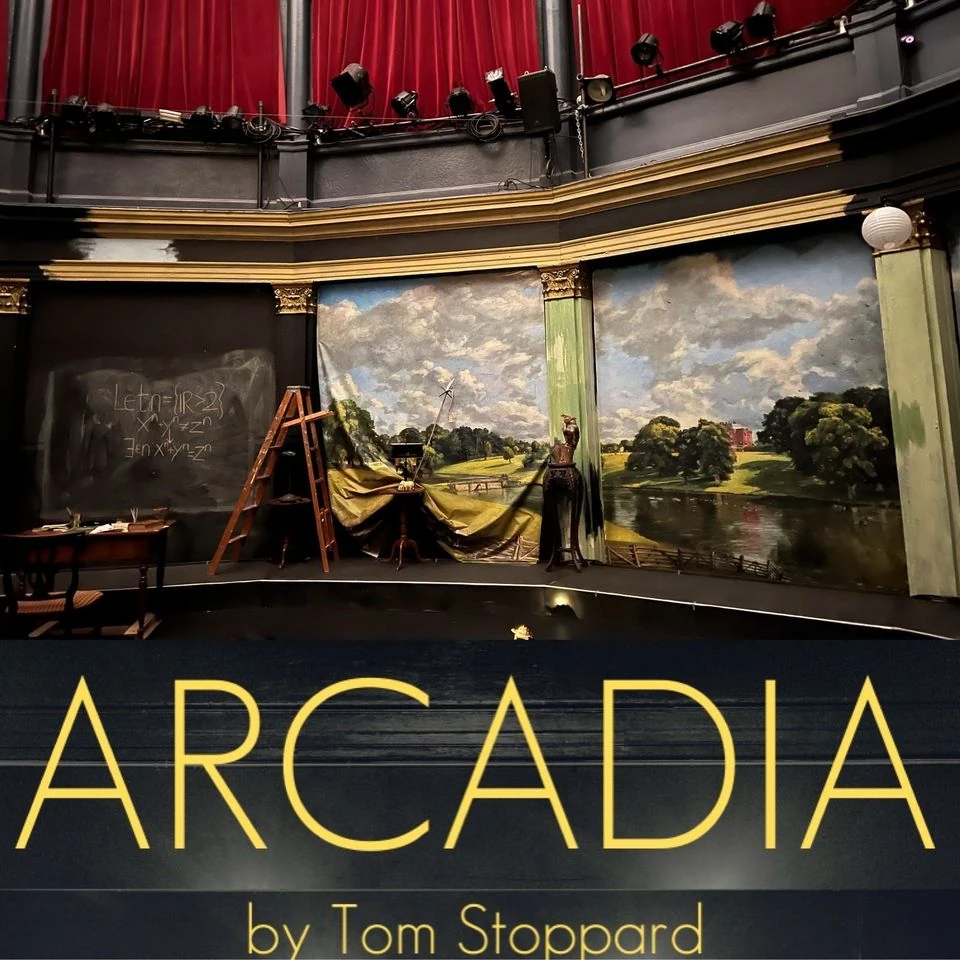
In Tom Stoppard’s Arcadia, the same room holds two centuries of argument. In the early nineteenth century, a young girl and her tutor discuss mathematics and the natural world. In the present day, researchers try to establish what happened at the country house where those earlier conversations took place. Their enquiries bring science, historical evidence and human feeling into one drama.
A play of two periods
Arcadia premiered at the Royal National Theatre in London on 13 April 1993, directed by Trevor Nunn. The original production’s leading cast included Felicity Kendal, Bill Nighy and Rufus Sewell. Its setting is Sidley Park, a stately home in Derbyshire. The action moves between the early nineteenth century and the present day, with characters from both periods occupying the same room.
The earlier story centres on Thomasina Coverly, a precocious 13-year-old, and Septimus Hodge, her tutor. Their conversations range across mathematics and physics, including ideas associated with chaos and thermodynamics. These discussions place the play’s intellectual curiosity against the atmosphere of the Enlightenment and Romantic periods. Thomasina’s youth gives particular force to the questions she pursues, while her exchanges with Septimus make abstract subjects part of a relationship between two people.
In the contemporary strand, literary scholar Hannah Jarvis and academic Bernard Nightingale investigate Sidley Park’s past. Their research includes a supposed duel involving the poet Lord Byron. They examine historical records and mathematical ideas, and their attempts to reconstruct earlier events connect their work to the people who once lived at the estate. The audience encounters the two periods in parallel, piecing together the links rather than being given a single, settled account of the past.
Knowledge, evidence and change
The play’s structure makes uncertainty part of its subject. Its researchers seek to explain what happened, but their conclusions depend on the evidence available to them. The movement between periods lets the audience compare what the characters know with what later investigators can recover. Historical research can illuminate the past without making it wholly present again; knowledge is shaped by the limits of records and interpretation.
Stoppard brings scientific ideas into contact with art and emotion. Order and disorder, rational thought and personal feeling, and the durability of human achievement all run through the linked stories. References to chaos and thermodynamics give these themes a specific intellectual setting, while the characters’ relationships keep the discussions grounded in dramatic life. Science is not merely a subject for the dialogue: it forms part of how characters think about change, pattern and what can be understood.
The shared room gives the passage of time a theatrical form. People separated by generations occupy the same stage, but their circumstances and knowledge remain distinct. The audience must make connections between the strands, much as the researchers assemble clues about Sidley Park. That structure makes historical interpretation an activity within the drama, rather than background information supplied in advance.
From London to international stages
After its London premiere, Arcadia was revived, appeared on Broadway and was staged internationally. Its English country-house setting travels with the play, but the estate also serves a specific dramatic purpose: it gives both timelines a common place in which changing ideas, histories and tastes can be brought into view.
The combination of an intricate structure and recognisable human concerns gives the play room to move between intellectual discussion and personal drama. Its characters investigate the past, debate ideas and negotiate relationships; these strands meet in the same space without being reduced to one another. The result is a play in which the form of the story helps express its interest in time, knowledge and the difficulty of establishing what is true.
Why Arcadia deserves a place in British Legacy
Arcadia deserves a place in British Legacy because it makes demanding subjects part of a live dramatic story. Its 1993 premiere at the Royal National Theatre in London connects it to British theatre, while its Derbyshire setting gives the play a distinct English landscape. Mathematics, physics and historical research are not detached lectures: they shape what the characters ask, what they hope to discover and how they understand change. By placing these concerns alongside art and personal feeling, Stoppard’s play invites audiences to follow complex ideas through character and action.
Its two-period structure is central to that achievement. The recurring room lets successive generations share a stage while preserving the differences between their worlds. Audiences are asked to make connections between the earlier story and the later investigation, experiencing the work of interpretation as part of the performance. The play’s Broadway appearance and international productions show that a drama rooted in a British theatre and an English country estate has also travelled beyond that setting. Its place in British cultural history rests on this particular combination: a London premiere, a recognisably English setting and an ambitious dramatic exploration of how people understand the past and the natural world.