
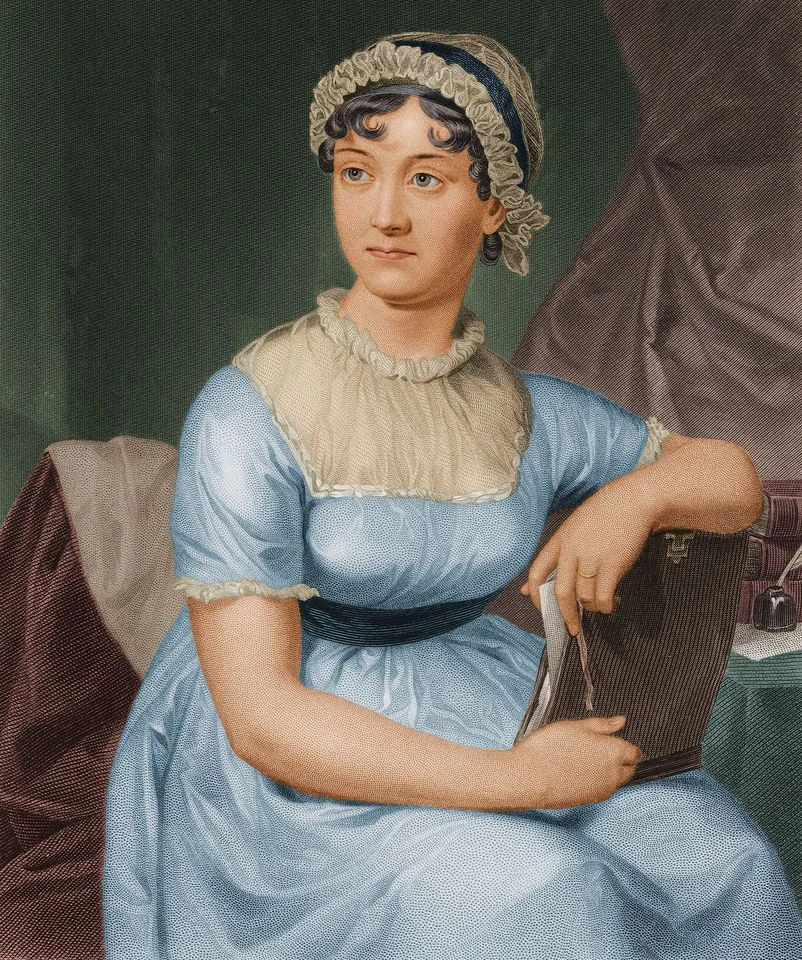
Jane Austen wrote about courtship, family and social standing, but her novels are not simply love stories. They examine how women’s choices were narrowed by dependence on marriage, how money shaped apparently private decisions, and how people misread one another. Austen’s comedy made those pressures visible without losing sight of the individuals caught within them. Her six novels have remained in print since the nineteenth century, and their wit and close attention to everyday life continue to draw readers and inspire adaptations.
A childhood of reading, performance and writing
Austen was born on 16 December 1775 in Steventon, Hampshire, where her father, George Austen, was rector of the Anglican parishes of Steventon and Deane. She was the seventh of eight children. Her family’s modest income was supplemented by her father’s farming and by teaching boys at home. The rectory was a lively intellectual household: family members read aloud, discussed ideas and staged plays. Austen’s brother James wrote prologues and epilogues for some performances, and Jane took part in the family’s theatricals.
Her formal schooling was brief. Jane and her sister Cassandra were sent to Oxford in 1783, but both returned home after contracting typhus; Jane nearly died. They later attended Reading Abbey Girls’ School, leaving before the end of 1786 when the fees became too expensive. Her education continued through reading, with guidance from her father and brothers. The family library and the plays performed at home provided material and models for a young writer learning to test literary conventions.
By the age of eleven, Austen was writing poems and stories for her family. She copied many of these early pieces into three notebooks, now known as the Juvenilia. Their exuberant plots and parodies already show her enjoyment of overturning convention. In her teens she wrote the epistolary satire Love and Freindship and The History of England, a comic answer to familiar historical writing. Between eighteen and twenty she wrote Lady Susan, an unusually sharp portrait of a woman who uses charm and intelligence to manipulate those around her.
Finding a form for her fiction
Austen began the novel that became Pride and Prejudice in 1796, calling it First Impressions. She finished an early draft the following year. Her father tried to interest a London publisher in it, but the manuscript was declined. She was also revising an earlier work, Elinor and Marianne, which would become Sense and Sensibility. The revision involved a significant formal change: she replaced its original series of letters with third-person narration.
In 1800 her father announced that he would retire and move the family from Steventon to Bath. The change unsettled Austen, and her writing slowed. She began but did not complete The Watsons, a novel about an impoverished clergyman and his four unmarried daughters. Its situation reflected a central concern of her fiction: the financial insecurity faced by women without independent means. After her father died in 1805, Austen, Cassandra and their mother relied on support from male relatives and moved between rented homes.
In 1809, Austen and her immediate family settled in Chawton, in a cottage made available by her brother Edward. There she returned to her manuscripts and, through her brother Henry, arranged for Sense and Sensibility to be published. It appeared anonymously in 1811, described on its title page as written “By a Lady”. The novel’s commercial success gave Austen some financial independence. Pride and Prejudice, a revised version of First Impressions, followed in 1813. Its first edition sold well enough for a second to be issued the same year.
Six novels and the economics of marriage
Pride and Prejudice brings Elizabeth Bennet and Mr Darcy’s changing judgements of one another into a society where land, family connections and income determine much of a person’s security. Its romantic plot moves through comic misapprehension, but Austen gives those misunderstandings material consequences. Sense and Sensibility sets the different temperaments of Elinor and Marianne Dashwood against the practical demands of their circumstances. In both novels, character and social constraint are inseparable.
Mansfield Park appeared in 1814, followed by Emma in 1815. Austen’s central character in Emma is wealthy and confident enough to believe she understands the lives of others; the comedy turns on the gap between her assumptions and what is actually happening. Northanger Abbey plays with the conventions of Gothic fiction, while Persuasion considers love and choice from the perspective of its heroine, Anne Elliot. Austen’s plots repeatedly ask what a woman can choose when social position and economic security depend so heavily on marriage.
Her method was neither solemn treatise nor simple parody. Austen used irony, realism and comedy to expose the limits of her characters’ understanding, while allowing readers to see more than they do. A flexible narrative voice moves between the narrator and a character’s thoughts, often without a formal signal; the result can make a mistaken belief seem persuasive for a moment before its flaws become clear. Dialogue, too, carries social information: phrasing and sentence structure help reveal temperament, embarrassment and anger.
Publication brought Austen neither a public identity nor celebrity in her lifetime. Her books appeared anonymously, and she earned money through different arrangements with publishers. Pride and Prejudice was sold outright for a one-off payment, while most of her other novels were published on commission, leaving the author exposed to costs if sales failed. These circumstances sit beside the novels’ lively social worlds: Austen understood that the business of authorship, like the economics of marriage, could determine how much independence a woman possessed.
Illness, posthumous novels and a changing reputation
Austen’s health deteriorated in 1816, although she continued to write. She completed revisions to Persuasion and began another novel, Sanditon, which she abandoned in March 1817. She died in Winchester on 18 July that year, aged 41, and was buried in Winchester Cathedral. The precise cause of her final illness remains uncertain; proposed retrospective diagnoses have included Addison’s disease and Hodgkin’s lymphoma.
Northanger Abbey and Persuasion were published together after her death in 1817. A biographical notice by her brother Henry identified her as the author of the novels. Her reputation grew over time rather than arriving fully formed. Richard Bentley’s illustrated editions in the 1830s helped keep the books before readers, and Austen’s novels have remained in print since their publication in that series. In 1869, her nephew’s memoir brought her life to a wider public, though the family portrait of “Aunt Jane” was later challenged by biographers seeking a more balanced account.
Readers and critics have continued to interpret Austen in different ways, and scholars have examined her work through approaches including feminist criticism. Her novels have also travelled through film, television and theatre. The BBC’s 1995 television adaptation of Pride and Prejudice became a conspicuous modern example, while screen versions of Sense and Sensibility, Emma and other works have introduced her stories to new audiences. These adaptations renew interest in the original books, whose humour depends on the precision of Austen’s observation as much as on their plots.
Why Jane Austen deserves a place in British Legacy
Jane Austen’s place in British Legacy rests on the particular force of her fiction, not simply on the fame of its titles. Her novels turn the routines of family and courtship into close studies of social power. By showing how inheritance, income and rank shaped women’s prospects, she made the economic pressures behind marriage part of the story rather than background decoration. Her comic method also matters: irony lets her reveal self-deception and social pretension without reducing her characters to examples in an argument. The result is fiction that entertains while asking readers to notice who has choices, who lacks them and what people misunderstand about one another.
Her career also gives British literary history a clear account of the distance between achievement and recognition. Austen published anonymously, negotiated a publishing world in which women’s authorship was constrained, and died before the full shape of her reputation emerged. Her novels’ continuing publication, critical study and adaptation show how a distinctly observed English social world can speak to readers far beyond its original setting. The many interpretations of her work are not a reason to flatten it into a single message; they reflect the richness of its attention to class, gender, feeling and conduct. Austen’s contribution is therefore both literary and cultural: she helped expand what the novel could do, and left succeeding generations a body of work capable of being read, debated and reimagined anew.
Sources
Jane Austen — Wikipedia revision 1377221096 · Jane Austen — Wikipedia
Adapted in part from Jane Austen by Wikipedia contributors, under CC BY-SA 4.0. Text has been edited and combined with the existing article; this adapted text is shared under the same licence. Contributor history.

_hires.jpg)