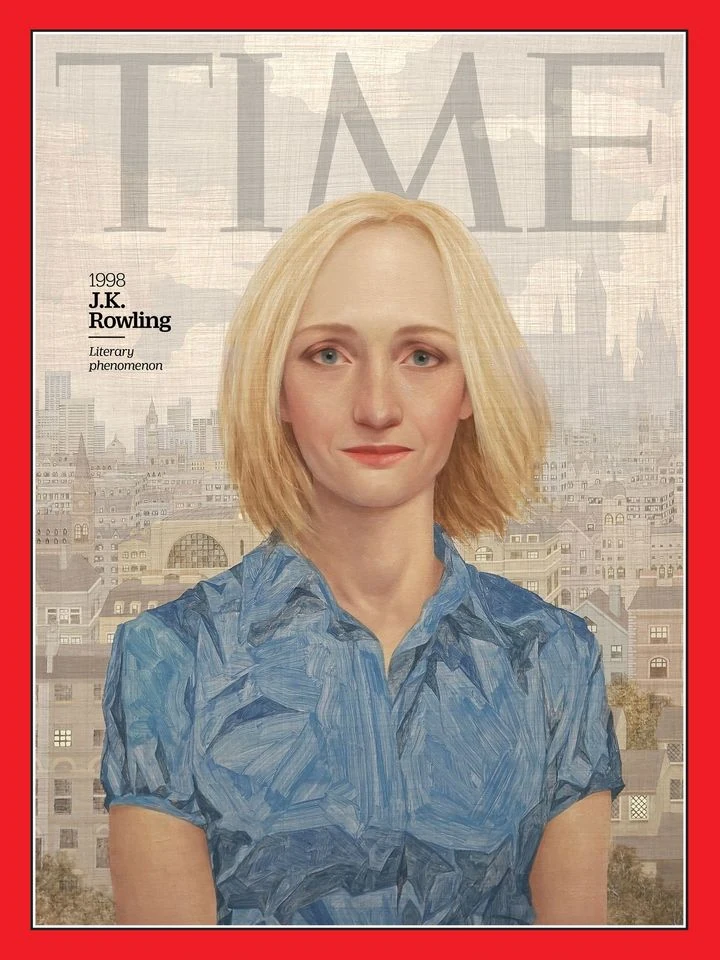
J. K. Rowling’s first Harry Potter novel appeared in 1997 with an initial print run of 5,650 copies. The series that began with it would sell more than 600 million copies, reach readers in 85 languages and grow into a global franchise. Its path from a debut children’s book to a cultural phenomenon is also the story of an author whose work ranges from fantasy to crime fiction, and whose public life has come to encompass philanthropy and fierce disputes over gender and transgender rights.
Writing through upheaval
Born Joanne Rowling in Yate, Gloucestershire, on 31 July 1965, she grew up in a family that valued books. Her first story, about a rabbit, was written when she was six. At school she enjoyed English and French, later studying French and the classics at the University of Exeter. She graduated in 1987 after a year in Paris. After university, she held temporary jobs in London, including work documenting human-rights issues in French-speaking Africa for Amnesty International.
Rowling conceived Harry Potter during a delayed train journey from Manchester to London in 1990. She began writing after she reached home. Her mother, Anne, died of multiple sclerosis later that year, a loss Rowling has said affected the writing. In 1991 she moved to Porto to teach English. She married Portuguese television journalist Jorge Arantes in 1992; their daughter, Jessica, was born in 1993. The marriage ended that year, and Rowling moved with Jessica to Edinburgh, where she completed the novel.
She has described that period as one of poverty and uncertainty, while also saying that becoming a single parent gave her the chance to concentrate on writing. She wrote in cafés and received a grant from the Scottish Arts Council to help with childcare and her finances. The first novel was completed in 1995. After Rowling’s agent submitted it to publishers, twelve rejected the manuscript before Bloomsbury acquired it. Rowling began teacher training at Moray House in Edinburgh in August 1995 and received her teaching certificate the following year.
A seven-book series and its readers
Harry Potter and the Philosopher’s Stone was published in Britain on 26 June 1997. Six sequels followed, ending with Harry Potter and the Deathly Hallows in 2007. The books follow Harry’s education at Hogwarts School of Witchcraft and Wizardry and his struggle against Lord Voldemort. Their combination of a school story, fantasy and an expanding conflict between good and evil brought younger and adult readers to the same series.
The books’ publication became an event in its own right. The final four set records as the fastest-selling books in the UK or United States at the time of release, while their audiences and fan communities grew across languages and borders. The series helped bring crossover fiction—children’s books read by adults as well as children—back into prominence. Its success also revived demand for children’s fantasy and helped make the genre a leading presence in the market. Rowling’s writing has been praised for the appeal of its characters and its accessible combination of adventure and familiar settings. Critics, however, have described the prose as conventional and have disagreed over the books’ treatment of gender, social hierarchies and magical creatures. The scale of the series’ readership did not settle those arguments; it made them part of a much wider conversation.
From page to screen, stage and other genres
The Harry Potter stories expanded beyond the novels into films, games, digital publishing and live performance. Warner Bros. released the first film, adapted from Harry Potter and the Philosopher’s Stone, in 2001; the screen series concluded with the two-part adaptation of Deathly Hallows in 2010 and 2011. Rowling had some involvement in the scripts and retained conditions over how the books could be adapted. The stage play Harry Potter and the Cursed Child, developed by Rowling with Jack Thorne and John Tiffany, opened in London in 2016. She also wrote the screenplays for the Fantastic Beasts films, which draw on the wider wizarding world.
Rowling’s work outside Harry Potter includes adult fiction and children’s stories. Her first novel for adults, The Casual Vacancy, appeared in 2012 and was later adapted for television. From 2013 she published the Cormoran Strike detective novels under the pen name Robert Galbraith. The identity behind the name was revealed later that year, and the series continued under it. Rowling has also published The Ickabog, first made available online for free during the UK’s 2020 COVID-19 lockdown, and The Christmas Pig in 2021. These projects show a career extending beyond the school, spells and conflict that made her best-known work.
Philanthropy and a contested public profile
Rowling has directed some of her wealth and public influence towards charitable work. She established the Volant Charitable Trust in 2000, named for her mother, to support work addressing social deprivation and to fund multiple-sclerosis research. In 2005 she co-founded the charity now known as Lumos, which works to improve the lives of children in institutions. She has also supported One Parent Families, now Gingerbread, and donated to medical causes, including research at the University of Edinburgh. The Harry Potter-related books Fantastic Beasts and Where to Find Them and Quidditch Through the Ages were published for Comic Relief, and proceeds from the sale of a deluxe copy of The Tales of Beedle the Bard went to Lumos.
Her public profile is also shaped by her views on transgender people. Since 2019, Rowling has argued against gender self-identification and against allowing transgender women into women-only spaces defined by sex. She has supported the campaign group For Women Scotland, including in its legal challenge over the meaning of sex in equality law. Rowling says her views are not transphobic; critics have described them as anti-trans or trans-exclusionary. Her comments have drawn condemnation from some Harry Potter readers, charities and performers associated with the adaptations, and have prompted public debate about women’s rights, transgender rights and freedom of expression. This controversy is an important part of her present-day public standing, alongside her writing and charitable work.
Why J. K. Rowling deserves a place in British Legacy
Rowling’s place in British cultural history rests first on the scale and reach of the Harry Potter books. Published by a British press and rooted in a recognisable British school-story tradition, the series brought children’s fantasy to an enormous international readership. It encouraged sustained reading across age groups, helped make crossover fiction commercially prominent and turned each new instalment into a shared cultural event. Its influence is visible not only in book sales but in the adaptations, stage production and lasting communities of readers that grew around it. The books’ critical reception is not uniformly favourable, and their contested social messages deserve to be acknowledged alongside their commercial and literary influence.
Her wider legacy is not confined to one fictional world. Rowling has published adult and crime fiction under different names, written for children beyond the Harry Potter series, and used proceeds and personal giving to support charities and medical research. Lumos’s work with children in institutions and the Volant Trust’s support for causes connected to social deprivation and multiple sclerosis give her philanthropy a concrete connection to the lives of others. At the same time, her public statements on transgender rights have made her a deeply divisive figure. A responsible British legacy therefore records both the creative achievement and the continuing arguments around it: a writer whose books altered the scale and standing of children’s fantasy, and whose influence extends well beyond the page.
Sources
Adapted in part from J. K. Rowling by Wikipedia contributors, under CC BY-SA 4.0. Text has been edited and combined with the existing article; this adapted text is shared under the same licence. Contributor history.