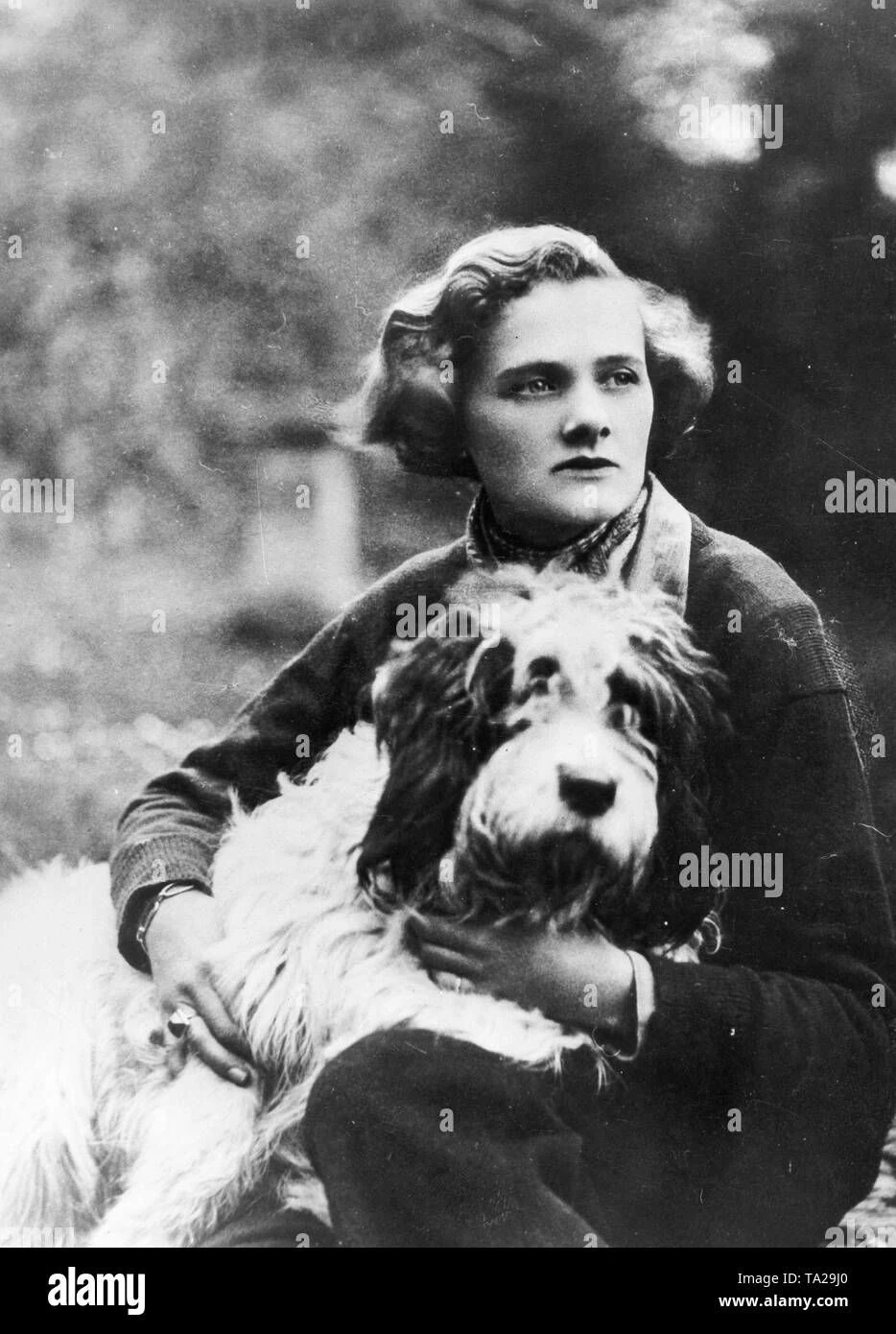
Daphne du Maurier made uncertainty a defining feature of her fiction. In Rebecca, a new wife enters a household still dominated by the memory of her husband’s first wife; in Jamaica Inn, a young woman discovers the dangers concealed behind an isolated Cornish inn. Du Maurier’s stories joined suspense to a powerful sense of place, particularly the Cornwall where she spent much of her life. Their repeated transformation into plays and films carried that combination far beyond the landscapes that inspired it.
A literary family, and an early career
Born in London on 13 May 1907, du Maurier was the middle of three daughters of the actor-manager Gerald du Maurier and the actress Muriel Beaumont. Her paternal grandfather, George du Maurier, was a writer and cartoonist; her uncle Guy was a playwright. Her elder sister, Angela, became an actress and writer, and her younger sister, Jeanne, a painter. The family lived at Cannon Hall in Hampstead and spent summers at their home in Fowey, Cornwall. During the war years they also lived there.
The theatre and literature were part of the world around her, but du Maurier established a writing career of her own. Her first novel, The Loving Spirit, appeared in 1931. Some early work was published in Bystander, a magazine edited by her great-uncle Comyns Beaumont. She went on to write novels, short stories, plays and non-fiction, including biographies of her father and of the du Maurier family. Her work ranged from historical settings to contemporary psychological unease, and she resisted being confined to the label of romantic novelist. Her plots often withhold resolution and leave readers with menace, ambiguity or a lingering question.
Cornwall as setting and subject
Du Maurier spent much of her life in Cornwall, and many of her works are set there. The landscape is not just scenery in her fiction: remote houses, rough coastlines and distances between people help create its atmosphere of isolation and threat. In Jamaica Inn (1936), Mary Yellan arrives at her uncle’s inn on the Cornish moors and becomes caught up in a smuggling operation. Its dangerous setting gives the story both its physical tension and its sense that respectable appearances can conceal violence.
In Rebecca (1938), the setting shifts to Manderley, an English country house. The unnamed narrator’s marriage to Maxim de Winter is overshadowed by the continuing presence of his first wife. The famous opening, “Last night I dreamt I went to Manderley again”, immediately makes memory and return part of the story’s design. Du Maurier’s interest in the house’s power over its inhabitants connects the novel’s suspense to questions of identity, status and the difficulty of escaping the past.
Her other fiction shows how widely she could vary that unsettling effect. Novels include Frenchman’s Creek (1941), My Cousin Rachel (1951), The Scapegoat (1957) and The House on the Strand (1969). The short stories “The Birds” (1952) and “Don’t Look Now” (1971) carry dread into different settings and forms. She also returned to Cornwall in non-fiction, notably Vanishing Cornwall (1967), which includes photographs by her son Christian.
Stories crossing into theatre and film
Du Maurier’s work attracted sustained interest from theatre and cinema, though adaptation did not mean that she welcomed every change. Alfred Hitchcock directed film versions of Jamaica Inn (1939) and Rebecca (1940), and later adapted “The Birds” (1963). Other filmmakers brought Frenchman’s Creek, My Cousin Rachel and “Don’t Look Now” to the screen. Across those adaptations, the original stories reached audiences who might never have encountered them in print, while each new version made the question of how to translate her particular atmosphere part of their continuing history.
She also adapted Rebecca for the stage. It opened in London in 1940, in a production directed by George Devine, and ran first at the Queen’s Theatre and then at the Strand. Her later plays included The Years Between, a drama about a woman who takes her husband’s place as a Member of Parliament while he is thought to have died in the war, and September Tide, about a middle-aged woman and her artist son-in-law. Both reached London audiences, and The Years Between became a long-running hit.
Her relationship with the screen was not simply one of approval. Du Maurier was critical of adaptations that she felt altered the character or effect of her writing. The 1939 Jamaica Inn, for example, changed the story’s ending; she also disliked Hitchcock’s move of “The Birds” from Cornwall to California. Yet she praised Nicolas Roeg’s 1973 film of “Don’t Look Now” after seeing the completed work. That distinction underlines an important part of her legacy: successful adaptation depended not merely on reproducing a plot, but on finding a way to preserve its psychological atmosphere.
Private life, recognition and later work
In 1932 du Maurier married Frederick “Boy” Browning, a military officer who later became a lieutenant-general. They had three children. Browning died in 1965; afterwards, du Maurier moved to Kilmarth, near Par, Cornwall, a place associated with The House on the Strand. She became an early member of Mebyon Kernow, a Cornish nationalist party. She was made a Dame Commander of the Order of the British Empire in 1969, though she did not use the title. Her writing continued into later life: her final novel, Rule Britannia, was published in 1972.
Du Maurier died at her home in Par on 19 April 1989, aged 81. She had requested a private cremation without a memorial service, and her ashes were scattered from the cliffs around Kilmarth and Menabilly. Her career had encompassed popular novels, short fiction, biography, plays and non-fiction; the enduring screen life of her stories is one measure of how readily different audiences have continued to encounter them.
Why Daphne du Maurier deserves a place in British Legacy
Du Maurier’s place in British literary history rests on more than the popularity of Rebecca. She developed a recognisable way of making setting shape suspense: a house can hold power over the people who live in it, while a stretch of coast or moor can turn isolation into immediate danger. Her fiction used these places to explore memory, identity and the uncertain motives people perceive in one another. Cornwall was central to that achievement. It was both a home and a recurring imaginative landscape, giving a distinctive local character to work read well beyond the county.
Her contribution also reaches across forms. She wrote for the stage as well as the page, and adaptations of her novels and stories brought her work to international cinema and television. The contrasting responses she had to those adaptations make the achievement clearer: the stories proved adaptable, but their force depended on preserving an elusive psychological tension, not just their events. From Jamaica Inn and Rebecca to “The Birds” and “Don’t Look Now”, her work has given readers, theatre audiences and film-goers a lasting body of British fiction rooted in place yet open to reinterpretation. That combination of Cornish setting, narrative control and cross-generational reach is a specific and substantial legacy.
Sources
Daphne du Maurier — Wikipedia revision 1378214388
Adapted in part from Daphne du Maurier by Wikipedia contributors, under CC BY-SA 4.0. Text has been edited and combined with the existing article; this adapted text is shared under the same licence. Contributor history.