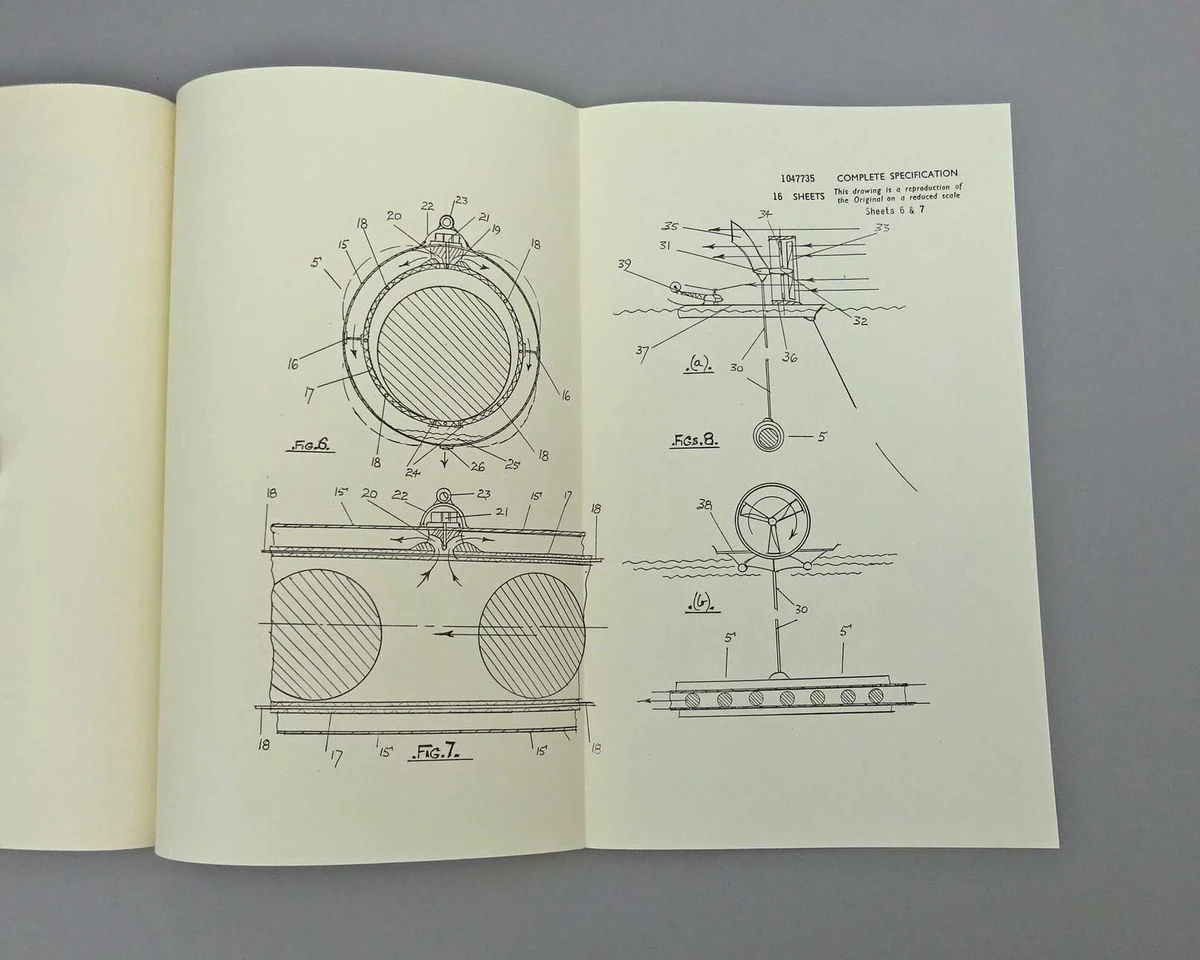
Arthur Paul Pedrick knew how a patent was supposed to sound. After working as an examiner in the United Kingdom Patent Office, he spent the years after his departure filing inventions of his own: 162 United Kingdom patent applications between 1962 and 1976. Some began with familiar engineering concerns, but many grew into schemes of startling scale, comic detail or doubtful practicality. A cat flap could share a patent with an orbital nuclear bomb; Antarctic snow might be compressed into projectiles and sent through pipelines towards the Australian interior. Pedrick used the language of technical invention to address, and sometimes lampoon, the problems of his age.
He was not simply an outsider guessing at engineering. He had studied it at City and Guilds College, served as an engineer officer in the Royal Naval Reserve and spent about fourteen years in the patent service. That experience gave his applications their distinctive contrast: extravagant ideas presented through the careful machinery of official specifications. His work offers a less conventional story of British invention, one in which the value lies not in a commercial product but in the peculiar intelligence, humour and anxieties preserved in the proposals themselves.
Education, war and the Patent Office
Pedrick was born on 3 September 1918, after the death of his father, Arthur Gordon Pedrick, a Royal Navy engineer officer who had served in K-class submarines. He attended Soberton Towers Preparatory School and won a scholarship to Sutton Valence School. At City and Guilds College, then part of Imperial College London, he studied engineering and earned a second-class honours BSc. He also completed a postgraduate year in aeronautics at Imperial, qualifying for its diploma. Vacation apprenticeships at Short Brothers in Rochester and Fairey Aviation in Hayes placed him among British aircraft manufacturers during his training.
After a short period in the Territorial Army, Pedrick received a commission in the Royal Naval Reserve as an engineer officer. In January 1941 he joined HMS Dido, which served in the Mediterranean. In May, the cruiser was involved in the evacuation of Australian and New Zealand troops from Crete. He later served aboard HMS Illustrious, HMS Resource and HMS Indomitable, as well as at the Golden Hind naval base in Sydney. His service put him close to machinery and the dangers of wartime operations. In a patent application years later, he recalled the bombing of HMS Dido during the evacuation and its lasting effect on him.
After returning to Britain, he worked as a draughtsman for Peter Brotherhood Limited in Peterborough from March to September 1947. In September that year he joined the United Kingdom Patent Office in London as an associate patent examiner. The office was dealing with a post-war shortage of examiners and a significant backlog; Pedrick was initially assigned brake applications. He progressed to examiner and then senior examiner.
His Patent Office career ended in 1961, when he was dismissed on grounds of inefficiency. In a later letter to his former school, he described having had a nervous breakdown and being forced out of what he called a “crazy Civil Service” job. That is his own account of the experience; the record also establishes the formal reason for his dismissal. For a short time afterwards he operated a printing machine for Britax in Chichester. He then lived in Selsey, Sussex, with his mother and aunts, in his aunt Alice Winifred’s house. There he began the sustained patent-filing career for which he became known.
From technical proposals to patent performances
Pedrick began filing applications in 1961. His first proposals were relatively technical, covering subjects such as ball bearings, hovercraft and vehicle safety. He also had a continuing interest in nuclear physics and energy, although he had no formal training in that field. He became a member of the Institution of Nuclear Engineers in 1963. From March 1964, the applications became more unusual and increasingly connected to current affairs: population growth, food, traffic, energy and social problems entered the specifications alongside the proposed mechanisms.
The patent form suited his purposes. It required an invention to be described in a systematic, technical register, with claims setting out what protection was sought. Pedrick retained that official manner even when his proposals stretched towards the fantastic. The result can read as engineering, social commentary and deadpan humour at once. His applications were not all alike, and their extraordinary titles can obscure the detail inside them; reading them as a body of work reveals a mind repeatedly using invention to respond to public concerns.
His addresses also acquired an extravagant institutional quality. From 1973, applications might list his residence as the “One-Man Photo-Electric Research Laboratories” or the “One Man Think Tank Nuclear Fusion Research Laboratories”. The names described work conducted by Pedrick himself, with a ginger-coloured cat sometimes appearing in the story of his inventions. The available account does not establish that the cat was actually named Ginger, despite the name often attached to it.
The subjects of the applications moved with the period. A rotating tower was filed around the opening of the Telecom Tower; a vehicle with motors in its wheels appeared during the Apollo era; and a proposal for a fire curtain for high-rise buildings came around the time the film The Towering Inferno was released in Britain. Such timing does not make the schemes practical, but it locates Pedrick’s work in the technological and cultural preoccupations of the 1960s and 1970s. His final application concerned the high-rise fire curtain.
A cat flap, a bomb and Antarctic snow
One application has become a shorthand for Pedrick’s peculiar range. Its full title was “Photon Push-Pull Radiation Detector For Use in Chromatically Selective Cat Flap Control And 1000 Megaton Earth-Orbital Peace-Keeping Bomb”. The detector was proposed for two very different uses. In the domestic version, it would allow a cat of one fur colour through a flap while excluding a cat of another colour. Pedrick explained that a black cat from next door kept trying to steal food intended for his ginger-coloured cat.
The same application also proposed using the detector in an automatic reprisal satellite carrying a 1,000-megaton bomb. In the described scheme, detection of a nuclear rocket attack would direct the bomb towards the place from which the attack originated. The juxtaposition is startling: a household nuisance and an imagined response to nuclear war treated within one patent specification. It is not evidence of a working weapon or a practical defence system. Its enduring force comes from the collision between the trivial domestic problem and the apocalyptic scale of the proposed response.
A different application addressed fresh water. Pedrick described a plan to transport Antarctic snow and ice through pipelines towards dry regions, particularly the Australian outback. Rather than rely on a continuous flow of water, the proposal compressed snow into hard balls to be propelled along the route. The specifications included detailed mathematical equations and presented the scheme as a means of irrigation and food production. The idea was vast and impracticable, but its stated concerns—water scarcity, agriculture and feeding a growing population—were not imaginary.
Other proposals ranged from a curtain intended to envelop a high-rise building during a fire to mortarless brickwork, golf devices, tea strainers, television systems and methods of energy production. The fire curtain was to be secured at roof level and released around the building, with openings positioned opposite assembly rooms. Such a design also raised serious questions: a curtain of that kind might obstruct escape or increase the risk of suffocation. The patent record therefore preserves both Pedrick’s attempt to imagine a solution and the hazards embedded in the proposal.
What the specifications reveal
Pedrick’s applications should not be mistaken for a catalogue of successful products. The supplied record describes their practical applicability as very limited, and there is no basis for presenting the more extravagant schemes as technologies that worked. Their importance lies elsewhere. They retain the personality of a former examiner who knew the conventions of patent writing and continued to use them, at considerable length, for ideas that conventional accounts of invention would leave out.
That formal knowledge helps explain why the applications are more than eccentric titles. Pedrick knew how to set out claims and describe a proposed mechanism. He placed unusual ideas inside the language of official technical procedure, rather than separating them from it. The method creates a dry comic effect, but it also makes the documents records of the subjects that occupied him: nuclear danger, fire safety, transport, housing, food and energy. The ideas may be unworkable; the concerns that prompted them are legible.
His career also complicates the usual story of invention as a direct route from a problem to a working design, then to manufacture and commercial success. Pedrick’s applications rarely belong to that arc. Instead, they show how speculation can be captured in a technical form and how a familiar procedure can be used in an unexpected way. His work may provoke laughter, but that response need not end the reading. The proposals also invite attention to the gap between a real problem and an imagined solution, and to the grand claims that technology can make when fear or ambition takes hold.
There is a clear British institutional thread in that story. Pedrick was educated at English schools and Imperial College, served in the Royal Naval Reserve, and worked inside the United Kingdom Patent Office before turning to the same filing system as an individual applicant. His intervention was not a public manifesto outside the system. It took the form of applications addressed to it. The contrast between official procedure and unrestrained invention gives his work its particular character.
Why Arthur Paul Pedrick deserves a place in British Legacy
Arthur Paul Pedrick deserves a place in British Legacy because his life broadens what a record of British invention can include. He had substantial technical training, wartime service as a naval engineer officer and years of experience examining patent applications. Those institutions did not produce a conventional inventor’s career: after leaving the Patent Office, he filed an exceptional number of applications of his own, many of them startlingly impractical. His contribution is not a celebrated manufactured device. It is a body of work that makes a case for remembering the imaginative and speculative sides of invention alongside its commercial successes.
The applications connect specific human concerns to the form of technical proposals. A colour-selective cat flap starts from a domestic nuisance; the same detector is imagined in a scheme for nuclear reprisal. A plan to propel compressed Antarctic snow through pipelines takes up water scarcity and food production. A high-rise fire curtain responds to public safety while also presenting the risk of obstructing escape. These examples do not establish that Pedrick solved such problems. They show how persistently he tried to address them, and how often his proposals expose the distance between an urgent concern and an extravagant technological answer.
His British connection is equally concrete: English education, Imperial engineering, Royal Naval Reserve service and a career in the national patent system shaped both the subject and the method. By returning those forms of expertise to the patent office as an independent applicant, Pedrick made procedure itself part of his creative medium. His specifications preserve a distinctive combination of technical language, eccentricity and anxiety about the modern world. That legacy benefits the story of British invention by making it less narrow: it includes not only what was built and sold, but also the ideas that reveal what people feared, hoped to control and thought technology might accomplish.
Sources
Arthur Paul Pedrick — Wikipedia revision 1342501359
Adapted in part from Arthur Paul Pedrick by Wikipedia contributors, under CC BY-SA 4.0. Text has been edited and combined with the existing article; this adapted text is shared under the same licence. Contributor history.