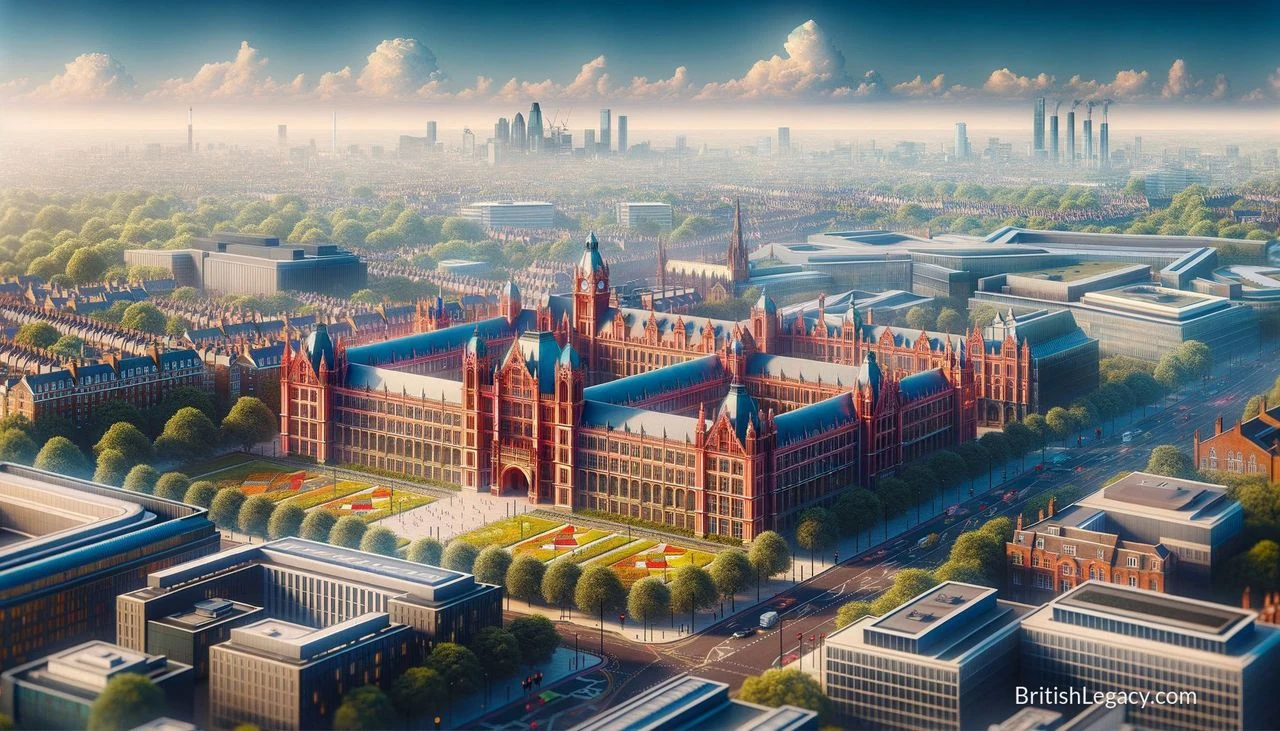
Imperial College London began with a plan for South Kensington as a place of science and culture. Its roots reach back to the Royal College of Chemistry, founded in 1845, and to the institutions that grew around the area after the Great Exhibition of 1851. The college created in 1907 brought together two of those institutions; the City and Guilds College joined three years later. That measured beginning matters: Imperial was assembled over time, and its later shape reflects successive decisions about scientific, technical and medical education.
A college built in South Kensington
The Royal College of Chemistry became part of what was known as the Royal School of Mines. In 1881, the Normal School of Science opened in South Kensington under Thomas Huxley; it became the Royal College of Science in 1890. The Central Institution of the City and Guilds of London Institute, a technical education school, opened on Exhibition Road in 1884. These institutions represented distinct strands of scientific and technical teaching.
On 8 July 1907, Edward VII granted a Royal Charter establishing the Imperial College of Science and Technology, incorporating the Royal College of Science and the Royal School of Mines. The charter made provision for the City and Guilds College to join when governance conditions were met. It became part of Imperial in 1910. The college joined the University of London in 1908, remaining a distinct institution within it.
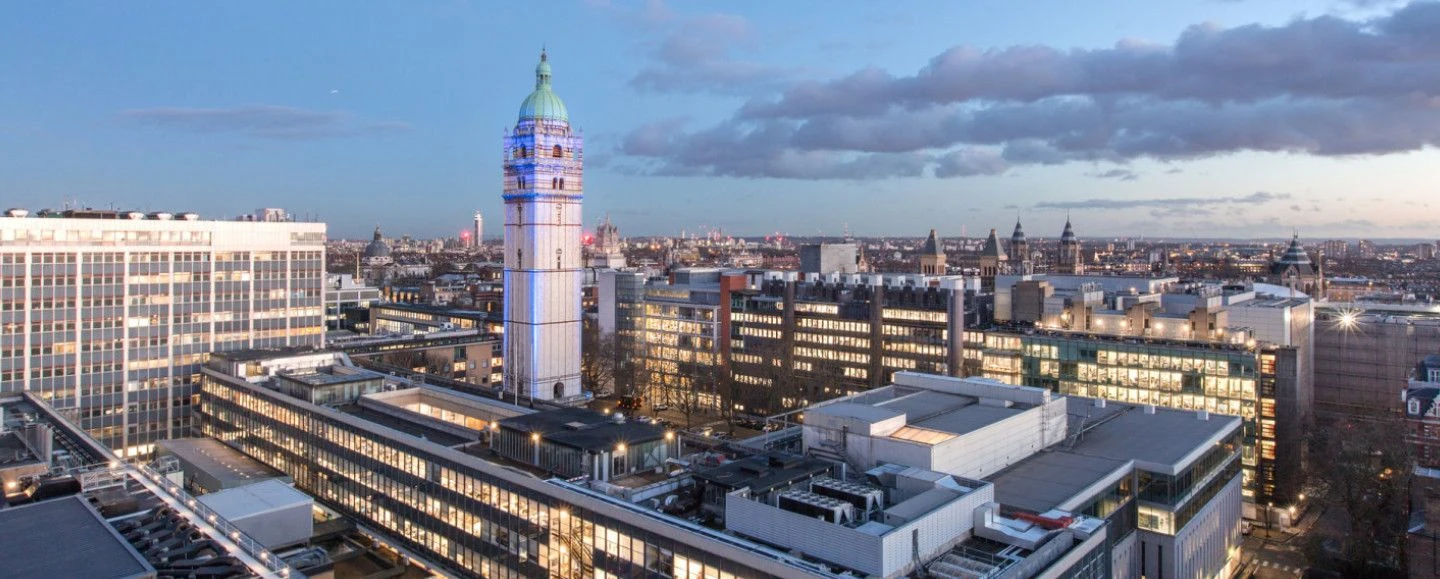
South Kensington’s surroundings were part of this history. The Great Exhibition’s success helped fund the development of a cultural and scientific district, where the Victoria and Albert Museum, the Science Museum and the Natural History Museum later opened. Imperial’s main campus grew beside the former Imperial Institute, in a neighbourhood shaped by the ambition to bring education, research and public culture together. Its Queen’s Tower, retained when the Imperial Institute’s buildings were largely demolished, remains a landmark at the centre of the campus.
From science and technology to a broader university
Imperial’s institutional character changed through expansion as well as consolidation. Its relationship with medicine developed through mergers: St Mary’s Hospital Medical School joined in 1988, followed by the National Heart and Lung Institute in 1995 and further medical schools and institutes in 1997. These changes helped form the Imperial College School of Medicine. The Imperial Business School opened in 2004, extending the college’s work into business education alongside its established scientific, engineering and medical fields.
In 2003, Imperial received degree-awarding powers in its own right. It became independent of the University of London in July 2007, a century after its Royal Charter. Today it is organised into four faculties: engineering, medicine, natural sciences and business. The Dyson School of Design Engineering sits within engineering. Across the institution, business and technical perspectives meet in teaching and research.
That combination is reflected in the college’s work on research commercialisation. Imperial Innovations, its technology-transfer company, has given rise to spin-out companies based on academic research. The college also provides enterprise facilities, including an enterprise lab, and a White City campus intended to support research and entrepreneurship. These are routes for taking academic work beyond the laboratory; they do not mean every idea becomes a successful company.
Research, medicine and public questions
Imperial’s research spans scientific and technical fields, as well as medicine and public health. In the 2021 Research Excellence Framework, 66 per cent of its research was assessed as world-leading and 30 per cent as internationally excellent. The college has also participated in national research partnerships, including the Francis Crick Institute, which opened in 2016, and the Alan Turing Institute. These collaborations place Imperial within a wider British research landscape rather than treating discovery as the work of one institution alone.
Its medical school developed through the joining of London institutions and maintains teaching and research links with hospitals. Imperial College Healthcare NHS Trust was formed in 2007 through the merger of two NHS trusts with the college’s Faculty of Medicine. The Trust manages five hospitals: Charing Cross, Hammersmith, Queen Charlotte’s and Chelsea, St Mary’s and the Western Eye. This connection between university and clinical settings is part of how medical education and research are organised in the capital.
Imperial researchers have also contributed to public debate. During the COVID-19 pandemic, a report by Neil Ferguson and colleagues on non-pharmaceutical interventions was widely discussed in relation to government responses. The episode illustrates how modelling and expert advice can inform public decisions, while those decisions remain the responsibility of public authorities.
At White City, Imperial has established research facilities, postgraduate accommodation and spaces intended for commercialisation and community outreach. Its wider network includes specialist institutes and national collaborations in areas such as climate change, infection, energy and data science. The college’s work therefore moves between laboratory research, teaching, partnerships and public-facing activity.
A London campus with an international community
South Kensington remains Imperial’s main campus, with most teaching and research based there. The area’s museums and cultural institutions are neighbours, not merely scenery: the college participates with nearby institutions in the Great Exhibition Road Festival, a public celebration of science and the arts. Its talks, exhibits and performances bring research to audiences beyond the university community.
Imperial also has a major campus at White City, a postgraduate campus at Silwood Park near Ascot, and teaching-hospital links across London. Silwood’s research and teaching include ecology, evolution and conservation, supported by a 100-hectare site used for ecological field experiments. Together, these locations extend the university beyond its historic South Kensington base while keeping its work tied to specific places and facilities.
Student life includes more than 350 clubs, societies and projects, alongside the student newspaper Felix and Imperial College Radio. The annual Commemoration Day takes its name from the 1945 visit by George VI and Queen Elizabeth to mark the centenary of the Royal College of Chemistry. Imperial’s graduates and staff include Nobel laureates, Fields medallists, scientists, engineers, business leaders and people in the arts. Their varied paths show how specialist education can lead into many parts of public and working life.
Why Imperial College London deserves a place in British Legacy
Imperial belongs in a record of British institutions because its history shows how educational ambitions were built into a particular place. The college grew from nineteenth-century chemistry, mining, natural science and technical education, joined under a Royal Charter in 1907 and expanded when City and Guilds joined in 1910. Its South Kensington home is part of a district shaped by the Great Exhibition and the development of museums and scientific institutions. That connection is more specific than a general claim to excellence: Imperial’s identity formed within London’s effort to bring science and culture into public life.
Its later development demonstrates the practical reach of that tradition. The college brought medical schools into its structure, established a business school, became an independent university and built partnerships with hospitals and national research institutes. Research commercialisation and enterprise facilities offer routes for some academic work to become new organisations and products, while teaching, festivals and expert contributions connect university activity with wider audiences. These achievements matter to Britain not because every discovery or enterprise belongs to one institution, but because Imperial has helped sustain a network of education, research and clinical work in London. Its legacy is institutional and collaborative: a university whose changing form reflects continuing investment in science, technology and medicine.
Sources
Imperial College London (revision 1379528685)
Adapted in part from Imperial College London by Wikipedia contributors, under CC BY-SA 4.0. Text has been edited and combined with the existing article; this adapted text is shared under the same licence. Contributor history.