Queen Mary University of London grew from a distinctly local ambition: to provide education and cultural facilities for people in London’s East End. Its story began not with a single university foundation date, but with several institutions, including medical colleges established in the eighteenth and nineteenth centuries, Westfield College and the People’s Palace. Their eventual union created a university whose history still connects teaching and research with east London.
A People’s Palace and a college take shape
The People’s Palace was established in the late Victorian period, amid growing concern about conditions in the East End. The Drapers’ Company supported the project, and Queen Victoria opened the palace’s Queen’s Hall in 1887. Technical schools opened the following year. The educational venture developed into East London College, which became a school of the University of London in 1907. Teaching in aeronautical engineering began that year; a dedicated department followed in 1909, with a wind tunnel that formed part of its early work.
The college’s identity changed as it developed. After a fire destroyed the Queen’s Hall in 1931, the college and People’s Palace moved towards separate institutional arrangements. Queen Mary College received its charter in 1934, presented by Queen Mary. During the Second World War, the college evacuated to Cambridge and shared premises with King’s College before returning to London.
Other strands of the university’s history reach further back. The London Hospital Medical College opened in 1785, and St Bartholomew’s Hospital Medical College dates to 1843. Westfield College was founded in 1882. In 1989 Queen Mary College merged with Westfield to form Queen Mary and Westfield College. The two historic medical colleges joined the institution in 1995, creating Barts and The London School of Medicine and Dentistry. The college adopted Queen Mary, University of London for general use in 2000 and changed its legal name to Queen Mary University of London in 2013. It began awarding its own degrees in 2014.
Campuses rooted in London
Mile End is Queen Mary’s largest campus and a substantial part of its identity: the university describes it as the largest self-contained campus of any London-based university. Other London sites include Whitechapel, Charterhouse Square, Lincoln’s Inn Fields and West Smithfield. The university also has an international presence, including a medical campus on Gozo in Malta.
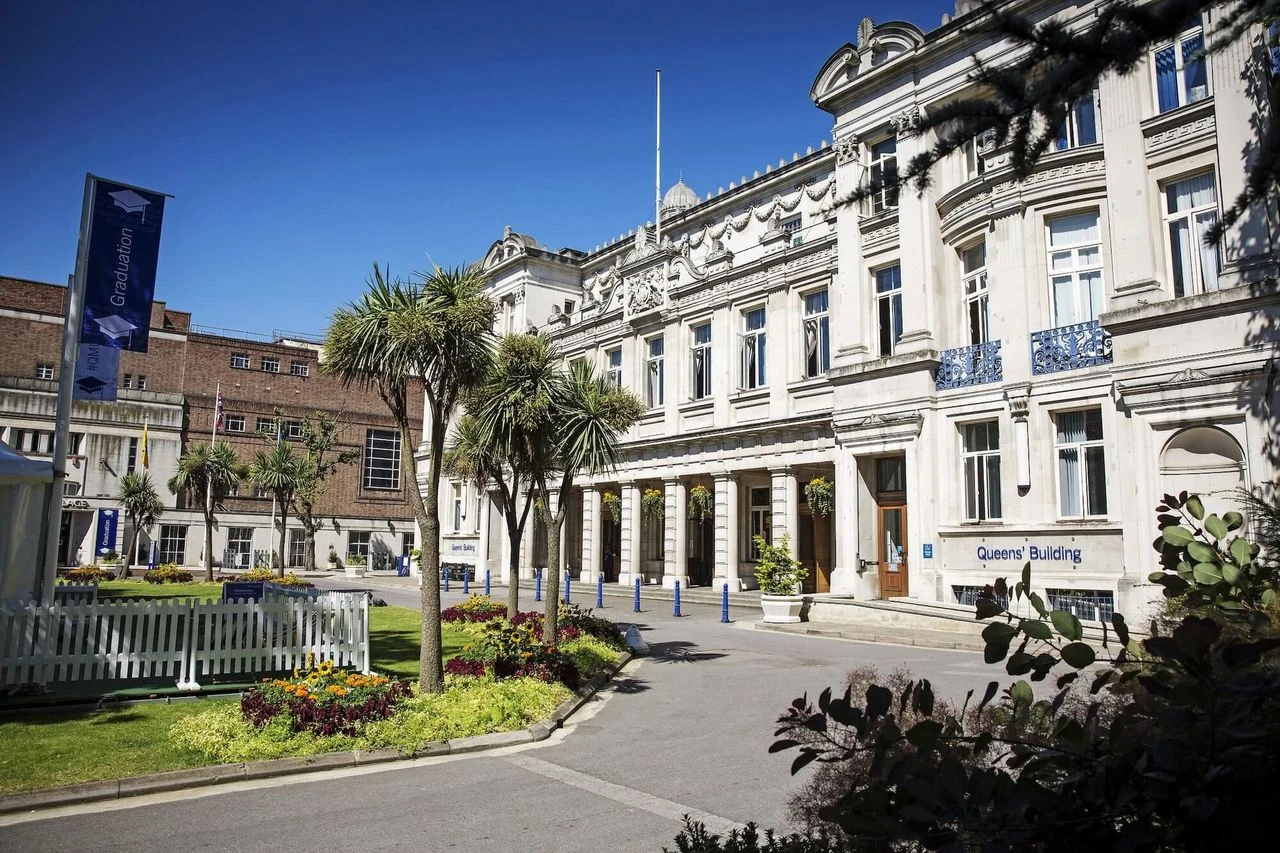
At Mile End, the listed Queens’ Building contains the Octagon, originally the People’s Palace library. The building and its setting preserve a visible link with the institution’s beginnings. The People’s Palace itself includes the Great Hall, an art deco performance and assembly space. At Whitechapel, the Blizard Institute is part of the medical campus. Its Blizard Building, opened in 2005, houses the Institute of Cell and Molecular Science and was designed by Will Alsop.
The university’s sites reflect an institutional history assembled from distinct colleges and specialisms. Barts and The London School of Medicine and Dentistry operates across medical campuses, including Whitechapel and West Smithfield; law teaching and research also have a base at Lincoln’s Inn Fields. Queen Mary joined UCLPartners, a London academic health science partnership, in 2011. Its medical work is therefore part of a wider network linking universities and healthcare.
Research across disciplines
Queen Mary is a public research university and a member of the Russell Group, the association of research-intensive British universities. Its three faculties cover humanities and social sciences, science and engineering, and medicine and dentistry. Research and teaching span fields from law and history to biological sciences, engineering and clinical medicine.
Examples from its research history show the range of that work. The university helped lead the consortium that conceived and developed the VISTA telescope, a wide-field instrument at the Paranal Observatory in Chile. In 2016, an international team led by Queen Mary astronomers announced the discovery of a planet orbiting Proxima Centauri, the nearest star to the Solar System. The university’s Centre for Digital Music has developed Sonic Visualiser, free, open-source software for analysing audio. In a different field, Queen Mary researchers took part in a project that reached its goal of sequencing 100,000 whole genomes from NHS patients in 2018.
Medical education is another longstanding element of the institution. The Royal London Hospital Medical College was the first medical school in England, opening in 1785; St Bartholomew’s Hospital Medical College was another important predecessor. Queen Mary’s present medical and dental school brings together those histories. Its research institutions include the Blizard Institute, the Barts Cancer Institute and the William Harvey Research Institute.
The institution’s academic history also connects it to major scientific and cultural achievements. Nine Nobel laureates have been students or academics at Queen Mary or its predecessor institutions. They include Ronald Ross, who received the 1902 Nobel Prize in Physiology or Medicine for work on the malarial parasite; Peter Mansfield, awarded the same prize in 2003 for pioneering work on magnetic resonance imaging; and Peter Ratcliffe, a 2019 laureate for research into how cells sense and adapt to oxygen availability.
Access, students and public life
Queen Mary’s East End origins were tied to education beyond a narrow academic elite. That history gives context to its present-day provision of bursaries and scholarships, including awards aimed at undergraduates from low-income households. The university has also developed degree apprenticeships and, in 2021, received a Platinum-level Engage Watermark from the National Co-ordinating Centre for Public Engagement.
Its student community is international as well as local. The university’s account of its 2024/25 student body lists 24,640 students, including undergraduates and postgraduates, and students from more than 170 nationalities. The Students’ Union represents students across the institution, while Barts and The London Students’ Association serves those in medicine and dentistry. Campus life, academic work and professional training meet across several London sites rather than at one enclosed university setting.
Queen Mary’s reach also extends through its partnerships and alumni. A joint programme with Beijing University of Posts and Telecommunications offers engineering degrees taught by both institutions, and the university has participated in University of London programmes in Paris. Among its alumni and former students are scientists, public figures and researchers, including Ronald Ross and Andrew Pollard, the chief investigator of the Oxford–AstraZeneca COVID-19 vaccine.
Why Queen Mary University of London deserves a place in British Legacy
Queen Mary belongs in British Legacy because its institutional history demonstrates how higher education in Britain has been built through local initiatives as well as through established colleges. The People’s Palace began with a practical ambition to provide educational and cultural facilities in the East End. East London College developed from that setting, while medical colleges with roots in 1785 and 1843, and Westfield College, later became part of the university. The resulting institution carries those different histories into a present-day university with campuses across London.
Its significance is also tangible in work that reaches beyond its own classrooms. Queen Mary’s medical teaching links back to some of England’s earliest medical education, while its researchers have contributed to fields ranging from astronomy and audio analysis to genomics and medical imaging. The VISTA telescope project and research into a planet orbiting Proxima Centauri illustrate its international scientific connections; its work on NHS genome sequencing connects research with British healthcare. Bursaries, degree apprenticeships and public engagement provide further evidence of an institution concerned with how education is accessed and used. This combination of East End beginnings, medical and scientific achievement, and continuing ties to London makes Queen Mary’s place in the country’s educational history specific and enduring.
Sources
Queen Mary University of London (revision 1375547168)
Adapted in part from Queen Mary University of London by Wikipedia contributors, under CC BY-SA 4.0. Text has been edited and combined with the existing article; this adapted text is shared under the same licence. Contributor history.