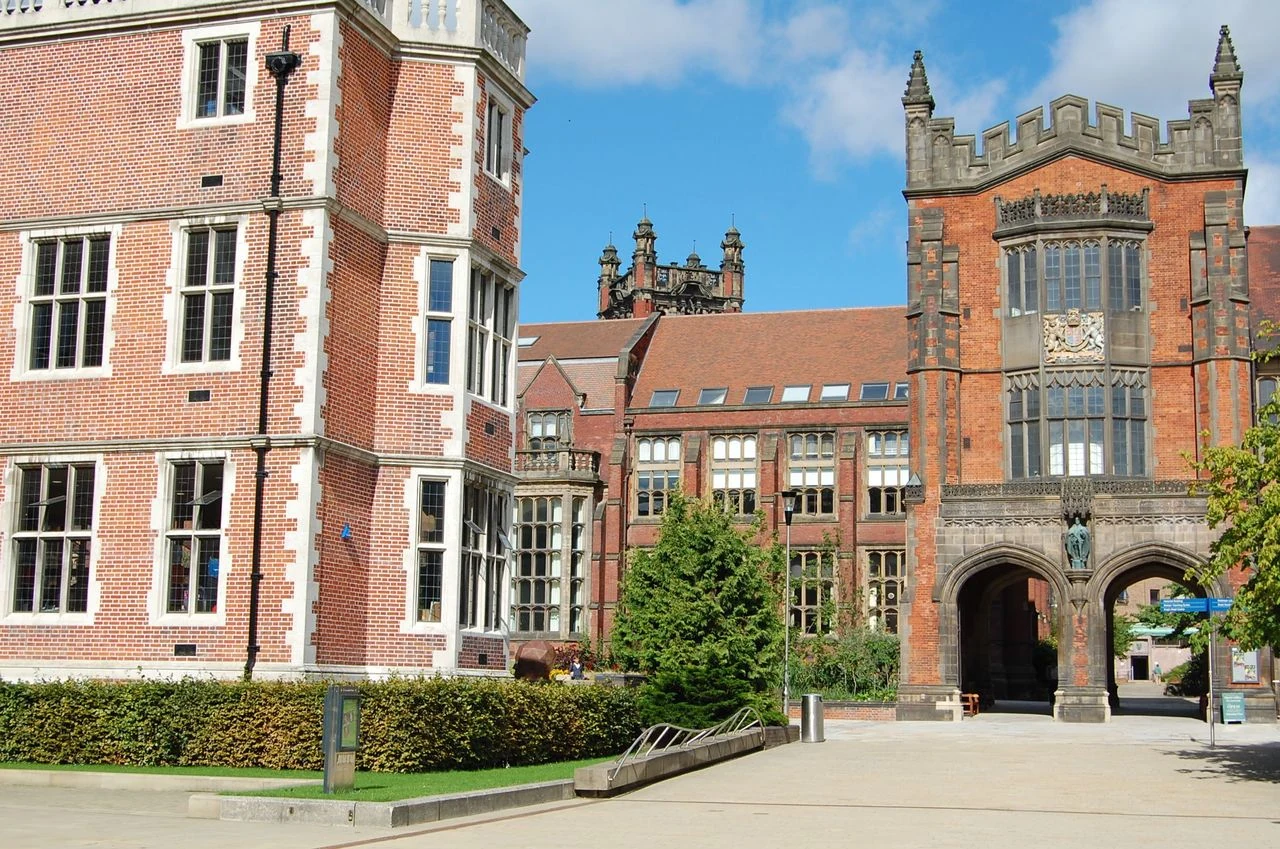
Newcastle University began with medical teaching in the city in 1832 and the formal establishment of a School of Medicine and Surgery two years later. A college devoted to physical science followed in 1871, reflecting the region’s need for training in subjects including mathematics, physics, chemistry and geology. Their eventual merger and Newcastle’s separation from the University of Durham in 1963 created an institution whose history is bound to the city and the wider North-east.
From medical school to independent university
The first medical lectures in Newcastle were intended to supplement the apprenticeship system. Physicians and surgeons taught in Bell’s Court, and the opening session in 1832 had eight or nine students. In 1834, the lectures and practical demonstrations moved to the Hall of the Company of Barber Surgeons to accommodate growing numbers, and the School of Medicine and Surgery was formally established.
The college’s development was not uninterrupted. A dispute among its teaching staff led to its dissolution in 1851 and the creation of two rival medical institutions. The majority formed the Newcastle College of Medicine; the other group established the Newcastle upon Tyne College of Medicine and Practical Science. The colleges amalgamated in 1857. In the intervening years, the majority college had become connected with the University of Durham, and its students were able to take Durham medical qualifications.
Scientific teaching developed along a second track. The College of Physical Science, founded in 1871, answered the growing needs of the mining industry with courses in mathematics, physics, chemistry and geology. It became Durham College of Physical Science in 1883 and Armstrong College in 1904. The medical and science colleges were both part of the federal University of Durham, whose Newcastle division taught medicine, arts and science, including agriculture and engineering.
In 1937, the Newcastle colleges merged as King’s College, Durham. On 1 August 1963, legislation separated the Newcastle and Durham divisions and established the University of Newcastle upon Tyne. The institution trades as Newcastle University and is a founding member of the Russell Group, an association of research-intensive UK universities.
A campus shaped by the city
The university’s main campus occupies an urban site near Haymarket, between Leazes Park and the Town Moor. Its buildings record earlier phases of the institution’s history. The Armstrong Building, first built for Armstrong College, was completed in stages between 1888 and 1906. Princess Louise opened its first wing; King Edward VII opened the completed building. During the First World War, it was requisitioned to become the first Northern General Hospital, treating military casualties through the Royal Army Medical Corps.
Other facilities connect the university with places beyond the city centre. The Dove Marine Laboratory is on Cullercoats Bay, and Cockle Park Farm is in Northumberland. The Philip Robinson Library, named for a local bookseller and benefactor, is the main university library; the Walton Library serves the Faculty of Medical Sciences. The university is also associated with regional museums and galleries, including the Great North Museum: Hancock and the Hatton Gallery.
Newcastle describes itself as a civic university, with a role in bringing research to bear on issues faced by local, national and international communities. In 2012, it opened the Newcastle Institute for Social Renewal to address social and economic change. Its public lectures and long-standing involvement with regional museums provide further ways for the institution to engage beyond its campus.
Teaching and research across three faculties
Teaching and research are organised across three faculties: Humanities and Social Sciences; Medical Sciences; and Science, Agriculture and Engineering. The range reflects the university’s origins in both medical education and scientific instruction, while extending well beyond those early specialisms. In the 2024–25 academic year, the university had 27,230 students: 21,245 undergraduates and 5,985 postgraduates.
The medical school is closely linked to the Royal Victoria Infirmary, a major teaching hospital. Newcastle also established an international branch of its medical school in Malaysia, which opened in 2011. Marine science is another strand of the university’s work. The Emerson Cavitation Tunnel, founded in 1950, is used to test propellers, water turbines and underwater coatings, and to study the interaction of propellers with ice. It has since been relocated to a new facility in Blyth.
The university’s research profile includes work across its faculties and institutes. In the 2021 Research Excellence Framework, which assesses research quality across UK higher education, Newcastle ranked joint 33rd by grade point average and 15th for research power. Those measures reflect both the assessed quality of research and, in the research-power measure, the number of full-time-equivalent researchers submitted.
International reach and institutional change
Newcastle’s international links include campuses in Singapore and Malaysia. Its first overseas branch opened in Singapore in 2008 as a marine campus. It later expanded beyond marine subjects and became Newcastle University Singapore, through its relationship with the Singapore Institute of Technology. A medical branch campus followed in Malaysia in 2011.
The university’s present scale developed through successive changes: local colleges became parts of a federal university, the Newcastle colleges joined as King’s College, and the institution then gained independence. That history sits alongside more recent pressures. The university’s account of 2024 records a fall in income, budget savings, cancelled academic promotions and the announcement of a voluntary redundancy scheme. These events form part of the institution’s continuing story as well as its academic development.
Why Newcastle University deserves a place in British Legacy
Newcastle University deserves a place in British Legacy because its development shows how a regional institution can grow from specific educational and civic needs. Medical teaching began in Newcastle as practitioners sought to extend learning beyond apprenticeship. The College of Physical Science was founded to teach disciplines relevant to the mining industry. Those distinct beginnings became part of a wider university, first within the federal structure of the University of Durham and then, from 1963, as an independent institution. Its history is not detached from place: it was shaped by Newcastle’s colleges, industries and civic life.
The university’s continuing connections with the North-east make that legacy concrete. Its teaching-hospital links, the marine laboratory at Cullercoats Bay, the cavitation facility in Blyth and Cockle Park Farm place education and research across the region. Its association with local museums and its stated civic role extend that relationship into public life. At the same time, the three faculties bring together medical sciences, engineering, agriculture, humanities and social sciences, while campuses in Singapore and Malaysia connect the institution to international education. These are specific contributions: teaching students, supporting research across disciplines and maintaining facilities tied to regional needs. Together, they explain Newcastle University’s place in British higher education without relying on generic claims of national prestige.
Sources
Newcastle University (revision 1375547131)
Adapted in part from Newcastle University by Wikipedia contributors, under CC BY-SA 4.0. Text has been edited and combined with the existing article; this adapted text is shared under the same licence. Contributor history.