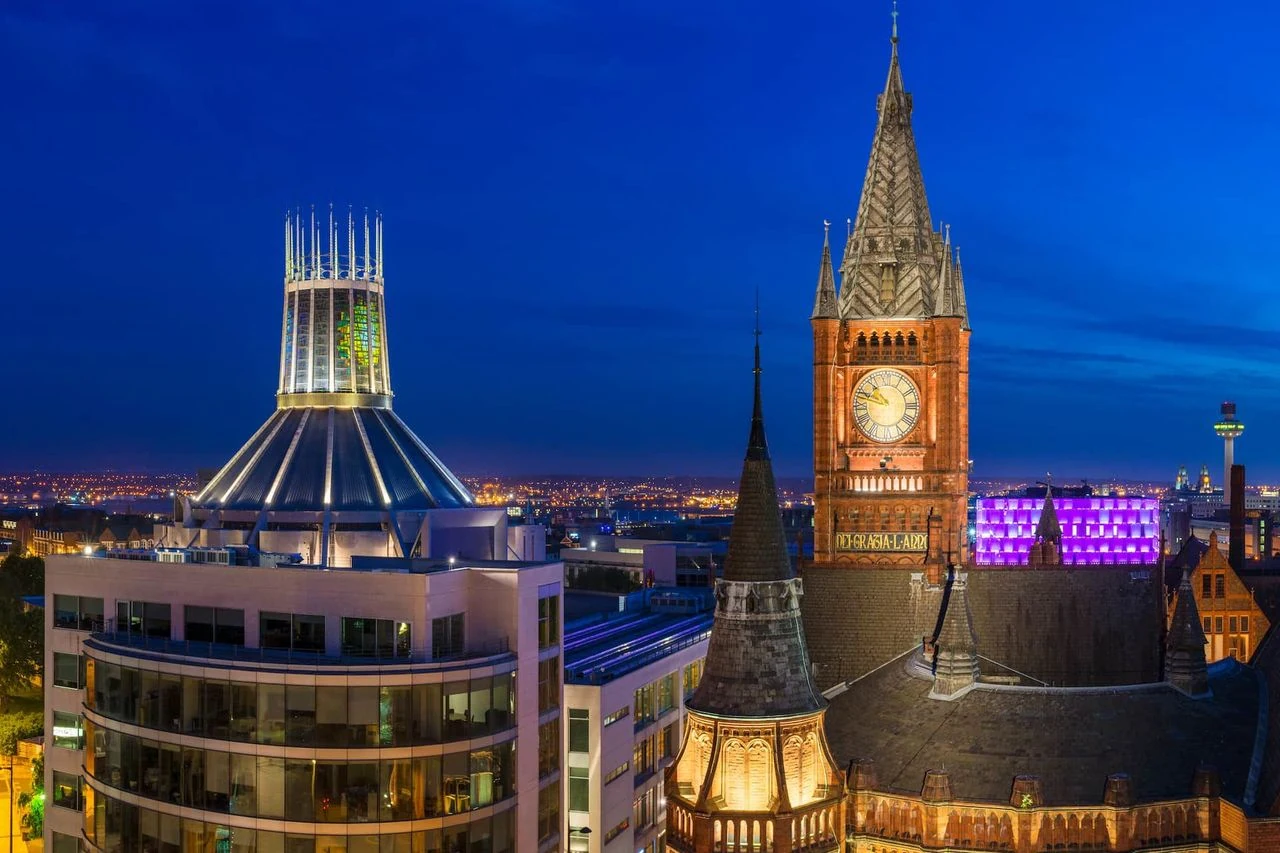
The University of Liverpool began as a college and became an independent university in 1903. In the intervening years, its teaching and research took root in a city shaped by industry and maritime trade. The institution’s history includes an early public radio transmission, the development of a distinctive red-brick identity and work by scientists who went on to win Nobel Prizes. Today it remains a public research university and a founding member of the Russell Group.
From University College to an independent university
Established in 1881 as University College Liverpool, the institution admitted its first students in 1882. It joined the federal Victoria University in 1884, with students receiving degrees from the University of London. A royal charter and an Act of Parliament in 1903 made Liverpool an independent university with the right to award its own degrees.
The years before independence were already marked by research and public demonstration. In 1894, Oliver Lodge, a professor at the college, made what the university history describes as the world’s first public radio transmission. Two years later, he took the first surgical X-ray in the United Kingdom. Liverpool University Press was founded in 1899; it is the third-oldest university press in England.
The institution’s architecture helped give a name to a wider idea. Its Victoria Building, opened in 1892 and now home to the Victoria Gallery and Museum, inspired the phrase “redbrick university”. Liverpool claims to be the original red-brick university and uses the term in its branding. The building’s later restoration created a place for a collection as well as a recognisable campus landmark.
Research with effects beyond the campus
Research at Liverpool has reached across medicine, the sciences and engineering. In the years after the university received its charter, Charles Sherrington’s work on the synapse and William Blair-Bell’s work on chemotherapy in cancer treatment became part of its scientific history. From 1943 to 1966, Professor of Bacteriology Allan Downie was involved in the eradication of smallpox.
The university’s record also includes contributions to physics and engineering. In the 1930s and 1940s, physicists James Chadwick and Joseph Rotblat made major contributions to the development of the atomic bomb. Decades later, University of Liverpool physicists, engineers and technicians helped construct the Large Hadron Collider at CERN, working on two of its four detectors. The projects differ sharply in purpose and context, but together show the reach of work conducted by its researchers and technical staff.
Liverpool describes its medical school, established in 1835, as one of the largest in the UK, and has close links with the neighbouring Royal Liverpool University Hospital. The university also became a founding member of the Russell Group in 1994 and the Northern England research-intensive N8 Group in 2004. These affiliations place it within networks that connect research institutions across the country.
A city campus and a wider academic network
The main campus is an urban site near Liverpool city centre, occupying about 100 acres. Its academic organisation brings together health and life sciences; humanities and social sciences; and science and engineering. The university also operates facilities beyond the central campus, including the Leahurst veterinary teaching hospital and Ness Botanic Gardens on the Wirral Peninsula.
Its development has included new forms of international partnership. In 2006, the university and Xi’an Jiaotong University established Xi’an Jiaotong–Liverpool University in Suzhou, China. The institution offers programmes in science, engineering and management, with teaching in English; students can receive degrees from both partner universities. Liverpool describes it as the first independent university established in China by a UK university and the first Sino-British university formed between research-led universities.
For a period, its international reach also included online programmes: Laureate became the worldwide partner for University of Liverpool online in 2004, and Kaplan Open Learning was announced as the new partner in 2019. The university has also founded the University of Liverpool Mathematics School, a specialist A-level school on campus. These initiatives extend its work beyond the traditional boundaries of a university campus, although they differ in form and purpose.
People, prizes and public life
Ten Nobel Prize laureates have been based at the university for a significant period of their careers. They include Ronald Ross, awarded the 1902 Nobel Prize in Medicine for his work on malaria; Charles Barkla, who received the 1917 Physics prize for research on X-rays; and Chadwick, awarded the 1935 Physics prize for discovering the neutron. Later laureates included Joseph Rotblat, whose work for nuclear disarmament was recognised with the 1995 Nobel Peace Prize, and physicist Martin Lewis Perl, awarded the 1995 Physics prize for discovering the tau lepton.
The university’s alumni and associates have also entered public life, the arts and professional work. Among the names highlighted in its history are Dame Stella Rimington, former Director-General of MI5, and poet Carol Ann Duffy, the first woman to hold the position of Poet Laureate of the United Kingdom. The breadth of these careers gives a human dimension to the university’s record: its influence is carried not only by research findings, but by people who take their education into public service, science and culture.
Its place in Liverpool is not confined to teaching and research. The campus’s buildings and museum are part of the city’s cultural landscape, while its academic and professional communities connect the institution to local and international networks. The original college’s growth into an independent university is, in that sense, part of the story of a city building institutions of its own.
Why University of Liverpool deserves a place in British Legacy
The University of Liverpool deserves a place in British Legacy because its history offers more than a list of academic distinctions. Founded in a major English port city, it grew from a college serving students who initially received degrees elsewhere into an independent university able to award its own. Its early scientific work included Oliver Lodge’s public radio transmission and the first surgical X-ray taken in the United Kingdom. The Victoria Building later gave the phrase “redbrick university” an enduring architectural association. These details connect the institution’s development to changes in British higher education, science and urban life.
Its legacy also rests on work whose consequences travelled well beyond Liverpool. University-associated researchers contributed to medicine, physics and the study of the natural world, while university staff and technicians took part in building detectors for the Large Hadron Collider. Ten Nobel laureates have been based there during significant periods of their careers. Internationally, the partnership that created Xi’an Jiaotong–Liverpool University extended that educational history into China. Taken together, these achievements show how a civic university can serve its home city while contributing to national research and international academic exchange. That combination of local roots and outward reach is a specific, evidenced reason for its place in British Legacy.
Sources
University of Liverpool — Wikipedia revision 1378303171
Adapted in part from University of Liverpool by Wikipedia contributors, under CC BY-SA 4.0. Text has been edited and combined with the existing article; this adapted text is shared under the same licence. Contributor history.