When the University of York opened in 1963, it had 216 undergraduates, 14 postgraduates and six departments. Its first premises included the historic King’s Manor in the city centre and Heslington Hall on the edge of York. From that compact beginning, it developed into a collegiate public research university with campuses at Heslington West and Heslington East, and a range of subjects extending well beyond its founding departments.
A university takes shape
The idea of establishing a university in York had a long history. Petitions were presented to James I in 1617 and again in the 1640s, but no institution followed. A proposal for a University of Yorkshire was advanced in 1903 by F. J. Munby and the Yorkshire Philosophical Society, among others. The modern campaign gathered force much later, with John Bowes Morrell a driving figure in the university’s establishment.
York began with Economics, Education, English, History, Mathematics and Politics. Its first vice-chancellor, Baron James of Rusholme, argued that the university should be collegiate, limit the number of subjects deliberately, and make extensive use of tutorials and seminars. Students’ involvement in university governance at every level was associated with the approach of Graeme Moodie, the founding head of Politics. These choices gave York an identifiable character as it joined the new wave of universities established in the 1960s.
Early growth brought new colleges and academic opportunities. Derwent and Langwith were founded in 1965, the year the university library opened; Alcuin and Vanbrugh followed in 1967, then Goodricke in 1968 and Wentworth in 1972. York became known for teaching that crossed conventional subject boundaries, including broad joint honours degrees such as history and biology. It also introduced a five-year social science degree.
Colleges, campuses and the city
York’s collegiate system remains central to how the university is organised. Its eleven colleges have equal status and their own constitutions and councils, with staff and elected student members. They bring together students and staff from different disciplines, combining residential and social life with student representation. The system is not simply a collection of buildings: it has provided a framework for community within a university that grew rapidly.
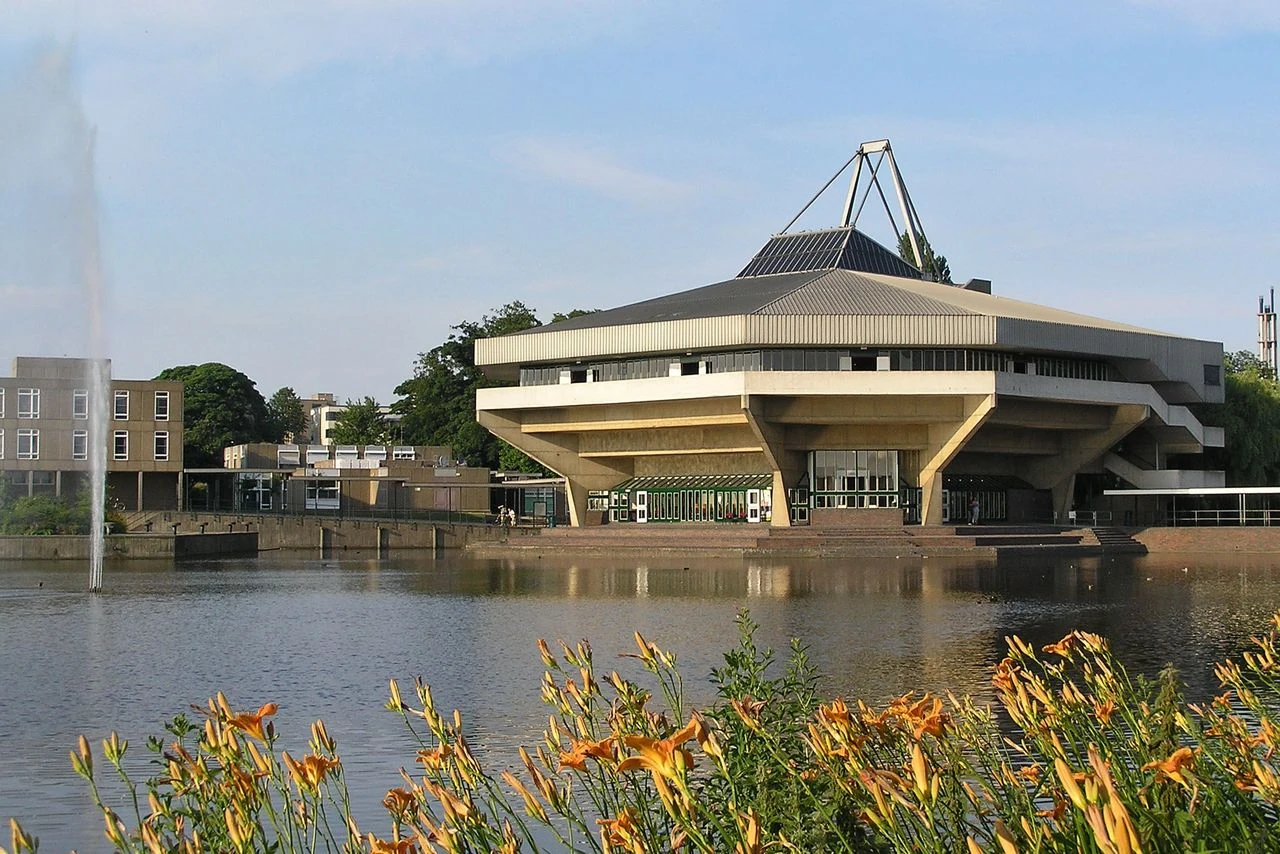
The original Heslington West campus was developed from 1964 in the grounds of Heslington Hall. Architects Sir Andrew Derbyshire and Sir Stirrat Johnson-Marshall designed its buildings, with contributions from university figures including Lord James. The use of prefabricated CLASP construction helped make York one of the universities associated with the “plate glass” generation. Covered walkways connect many of the buildings; a lake and landscaped grounds give the campus a distinctive physical centre.
Growth eventually required more space. Plans for an eastern extension were finalised in 2004, and permission followed in 2007 after consultation and a public inquiry. Campus East opened in 2009. Goodricke College moved there, followed by Langwith in 2012; new academic facilities and sports provision also developed on the campus. Constantine College was established in 2014, Anne Lister College in 2021 and David Kato College in 2022, bringing the collegiate total to eleven.
York’s relationship with the city is visible in its historic sites as well as its newer campus. Heslington Hall, a rebuilt manor house with Tudor foundations, became the university’s administrative headquarters. King’s Manor, formerly the Abbot’s House of St Mary’s Abbey and later the headquarters of the Council of the North, served the university for many years. The university announced in 2024 that it would stop using the building for teaching and research; research centres moved to Heslington Hall in 2025, while the Department of Archaeology was scheduled to move to the Berrick Saul Building in summer 2026. The lease was due to pass to York St John University in 2026.
Research, teaching and public life
York’s academic life now spans more than thirty departments and centres. Its research institutes and centres include the Borthwick Institute for Archives, the Institute for Effective Education, the Centre for Applied Human Rights and the Centre for Medieval Studies. The National Science Learning Centre, which opened on campus in 2006, was established as a hub in a national network intended to revitalise science teaching in schools. The university is also part of regional research groupings including the N8 Group and the White Rose University Consortium, and a member of the Russell Group.
Expansion has brought new fields alongside the six with which York began. Its academic provision includes archaeology, biology, computer science, education, environmental science, law, politics, psychology and the arts, among many others. In the 2024–25 academic year, the university had 22,345 students: 16,015 undergraduates and 6,330 postgraduates. These figures give a sense of the scale reached by an institution that began with a few hundred students.
Student activity has also formed part of the university’s public identity. York Student Television, founded in 1967, is described in the university’s history as England’s oldest student television station. University Radio York is identified as the oldest independent radio station in the United Kingdom. The student newspaper Nouse began in 1964. These organisations illustrate how university life has extended beyond formal teaching, giving successive generations of students opportunities to make and publish work.
The campus itself is both a place for study and a designed landscape. The lake at Heslington West was created as part of the original development, serving as a drainage basin as well as helping give the university a distinct setting. The university’s newer eastern campus added colleges, academic buildings and sports facilities. Together, the two sites reflect the practical challenge of expansion: preserving a recognisable institutional character while making room for new students, subjects and facilities.
Why University of York deserves a place in British Legacy
The University of York deserves a place in British Legacy because its history shows how a post-war generation of British universities could be new without being detached from place. It opened in a historic city, but its identity was not simply inherited from York’s medieval buildings. The institution was deliberately organised around colleges, tutorials and seminars, while its early teaching encouraged broad combinations of subjects. Those founding choices gave it a distinctive educational model as well as room to grow.
That growth is part of the story. From six departments and 230 students, York developed into a university of more than 22,000 students, with two campuses, eleven colleges and research activity across a wide range of disciplines. Its institutes and partnerships connect academic work with archives, education, human rights and regional research collaboration. Student media have added another strand of public life, with television, radio and journalism sustained on campus across generations. These are specific contributions to British higher education: new institutional capacity, varied routes through learning, and communities in which students can take part in academic and cultural activity. York’s legacy is therefore not a claim to timeless prestige, but the continuing influence of a university that combined deliberate educational design with expansion and civic roots.
Sources
University of York — revision 1377657754
Adapted in part from University of York by Wikipedia contributors, under CC BY-SA 4.0. Text has been edited and combined with the existing article; this adapted text is shared under the same licence. Contributor history.