The University of Sheffield began not as a single institution but as a meeting of three strands of the city’s educational life: medicine, technical training and Firth College. Their union brought a university to a city shaped by industry, and their different origins remain visible in Sheffield’s combination of scientific research, engineering and wider academic study.
Three institutions, one university
The oldest predecessor was the Sheffield Medical School, established in 1828. Firth College followed in 1879, funded by steel manufacturer and former mayor Mark Firth. Sheffield Technical School opened in 1886 after a fundraising effort led by former mayor Sir Frederick Mappin. Local steelmaking firms helped fund the school, whose research in turn contributed to new processes and products for industry.
In 1897, the medical school, Firth College and technical school joined by royal charter to form the University College of Sheffield. The college sought the power to award its own degrees and developed plans for a new site on Western Bank. Its campaign became a city-wide undertaking: in 1904, steelworkers, coal miners, factory workers and other residents contributed more than £50,000 through penny donations to help establish the university.
The royal charter was sealed on 31 May 1905, making the University of Sheffield. King Edward VII and Queen Alexandra opened Firth Court on 12 July that year. Sheffield’s foundation was therefore both a formal act of charter and the culmination of decades of local institution-building and public support. The new university opened with 363 students, 114 of them full-time, and 71 staff.
Learning shaped by an industrial city
Sheffield’s early links between education and industry continued after its foundation. The technical school had been supported by local manufacturers, and the university’s applied-science heritage developed alongside its arts, medicine and science teaching. In 1937, pharmacologist Hans Adolf Krebs and his postgraduate student discovered the citric acid cycle at Sheffield. Krebs later received the 1953 Nobel Prize in Physiology or Medicine. George Porter, appointed professor of physical chemistry in 1955, developed his Nobel Prize-winning work on flash photolysis at the university.
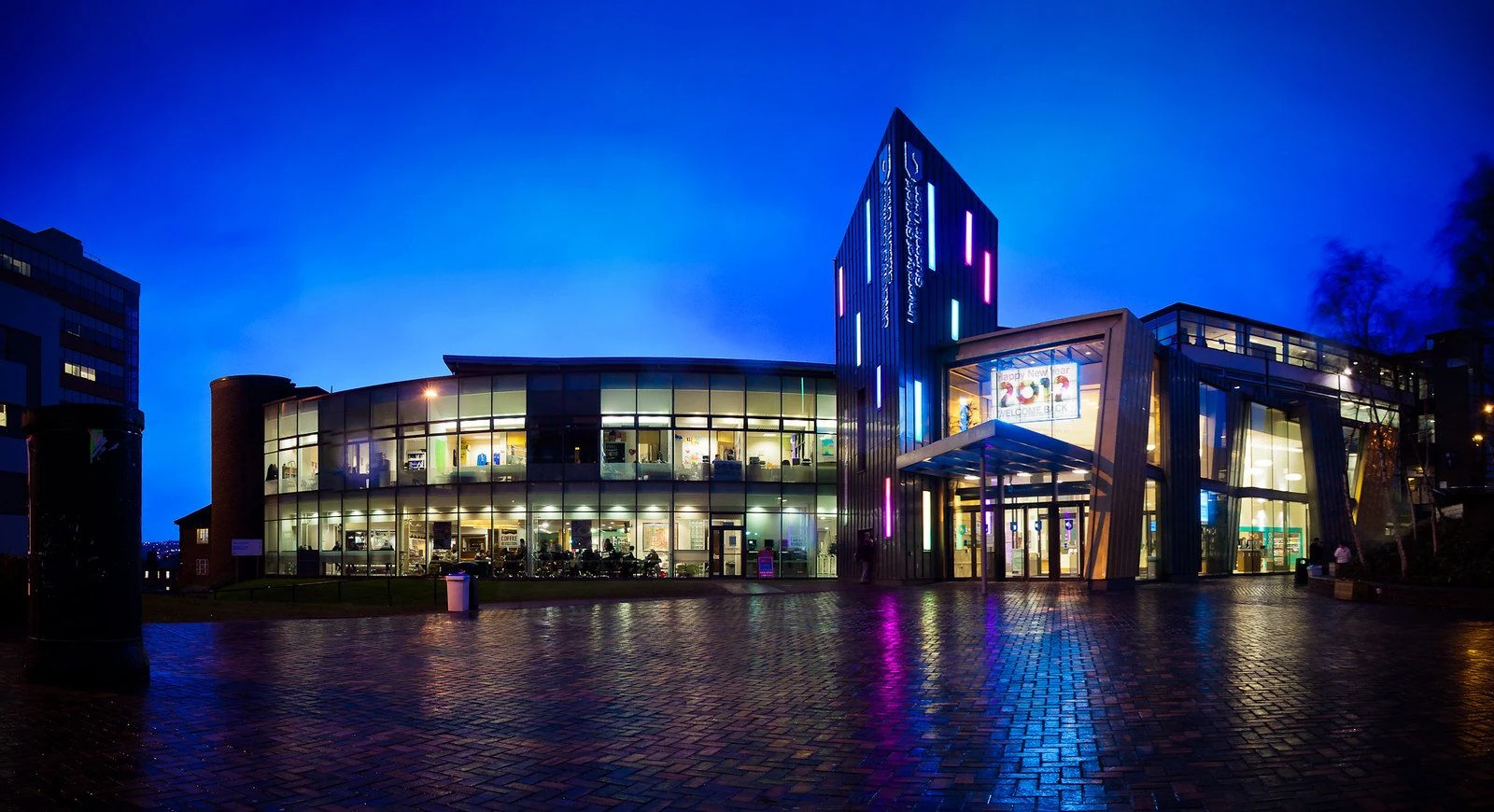
The campus also expanded as the institution grew. Firth Court, a red-brick Edwardian building on Western Bank, became a defining part of the university’s setting. The Western Bank Library opened in 1959, followed by the Arts Tower in 1965, then the tallest academic building in Europe. Today the university occupies a city-centre collection of buildings rather than a single enclosed campus, with its historic Western Bank and St George’s sites on opposite sides of Sheffield’s inner ring road.
That built history includes changes as well as additions. The Traditional Heritage Museum, opened to the public in 1985, displayed material including a reconstructed 1920s kitchen and recreated workshops and shops. The university closed it in 2011 because continued public access could not be afforded. Its collections were relocated in 2013 to public and charitable organisations, including Green Estate, Sheffield Galleries and Museums Trust, Sheffield Industrial Museums Trust and Ken Hawley Trust.
Research, industry and debate
Engineering remains one of Sheffield’s visible areas of activity. Its Advanced Manufacturing Research Centre is a network of centres developed in partnership with more than a hundred industrial companies. One of its facilities, Factory 2050, opened in 2015 for research into reconfigurable machining and assembly using digitally assisted robotics. The partnership model carries forward a feature of the university’s origins: research and technical education connected to the needs and capabilities of industry.
That relationship can also be contested. In 2008, the university partnered with BAE Systems to establish a research centre focused on active control and submarine stealth. In 2012, its students’ union voted in favour of ending all university links with the arms trade. In 2022, students occupied the Diamond building over the university’s alleged links with Rolls-Royce and arms manufacture; protests also addressed contracts with arms companies in 2023. These episodes show that the university’s industrial partnerships are not simply a story of innovation: they have also prompted questions on campus about the purposes and consequences of research.
Sheffield’s academic range extends well beyond engineering. Its five faculties bring together schools in arts and humanities, engineering, health, science and social sciences. The university has more than 180 specialist research centres or institutes, while its cross-faculty centres support work shared across disciplines. Its alumni include writers Hilary Mantel and Lee Child, athlete Jessica Ennis-Hill, pilot Amy Johnson and astronaut Helen Sharman. These varied careers illustrate the breadth of its teaching without reducing the institution’s contribution to a list of famous graduates.
A university in the life of Sheffield
The university’s local presence is evident in its buildings, research partnerships and student life. Its students’ union, founded in 1906, has more than 300 societies and 60 sports teams. It also supports student-run media including Forge Radio, Forge TV and Forge Press. The annual Sheffield Varsity, contested with Sheffield Hallam University, brings the city’s two universities into a shared sporting calendar.
Its museums and collections preserve another dimension of that civic role. The Alfred Denny Museum holds zoological specimens and is primarily used for teaching, with public tours usually held monthly. The Turner Museum of Glass includes work by European and American glassmakers alongside examples from ancient Egypt and Rome. The National Fairground and Circus Archive preserves material from those industries, including photographs, books, journals and printed and video ephemera. These collections connect university teaching and research with the city’s industrial, cultural and popular histories.
Environmental commitments form part of the institution’s current plans. Sheffield has committed to net-zero emissions for Scope 1 and 2 by 2038 and Scope 3 by 2045. Its 2023 gold accreditation from the Hedgehog Friendly Campus campaign and membership of the Nature Positive Universities and UN Race to Zero campaigns provide further evidence of environmental initiatives. These are commitments and affiliations, rather than proof that the targets have already been achieved.
Why University of Sheffield deserves a place in British Legacy
The University of Sheffield deserves a place in British Legacy because its history shows how a major institution can grow from a city’s practical needs and collective effort. Medical education began there in 1828; Firth College and the technical school followed as Sheffield expanded. Local businesses supported technical teaching, while workers and residents helped fund the university’s establishment through penny donations. This is a specifically Sheffield story: the university’s origins are tied to the civic and industrial life of South Yorkshire, not simply to a national roll-call of old institutions.
Its legacy also lies in the lasting connection between education, research and public life. Work by Krebs and Porter became part of internationally recognised science; manufacturing research continues through partnerships between the university and industry. Debate over arms-related links demonstrates that research choices carry responsibilities and can be challenged by students. Museums, archives, public-facing collections and a lively students’ union add cultural and community dimensions to that work. Together, these achievements give Sheffield a distinct place in Britain’s educational history: a university shaped by local support, developed alongside an industrial city and still negotiating how knowledge can serve its partners and the wider public.
Sources
University of Sheffield — revision 1375543162 · University of Sheffield
Adapted in part from University of Sheffield by Wikipedia contributors, under CC BY-SA 4.0. Text has been edited and combined with the existing article; this adapted text is shared under the same licence. Contributor history.