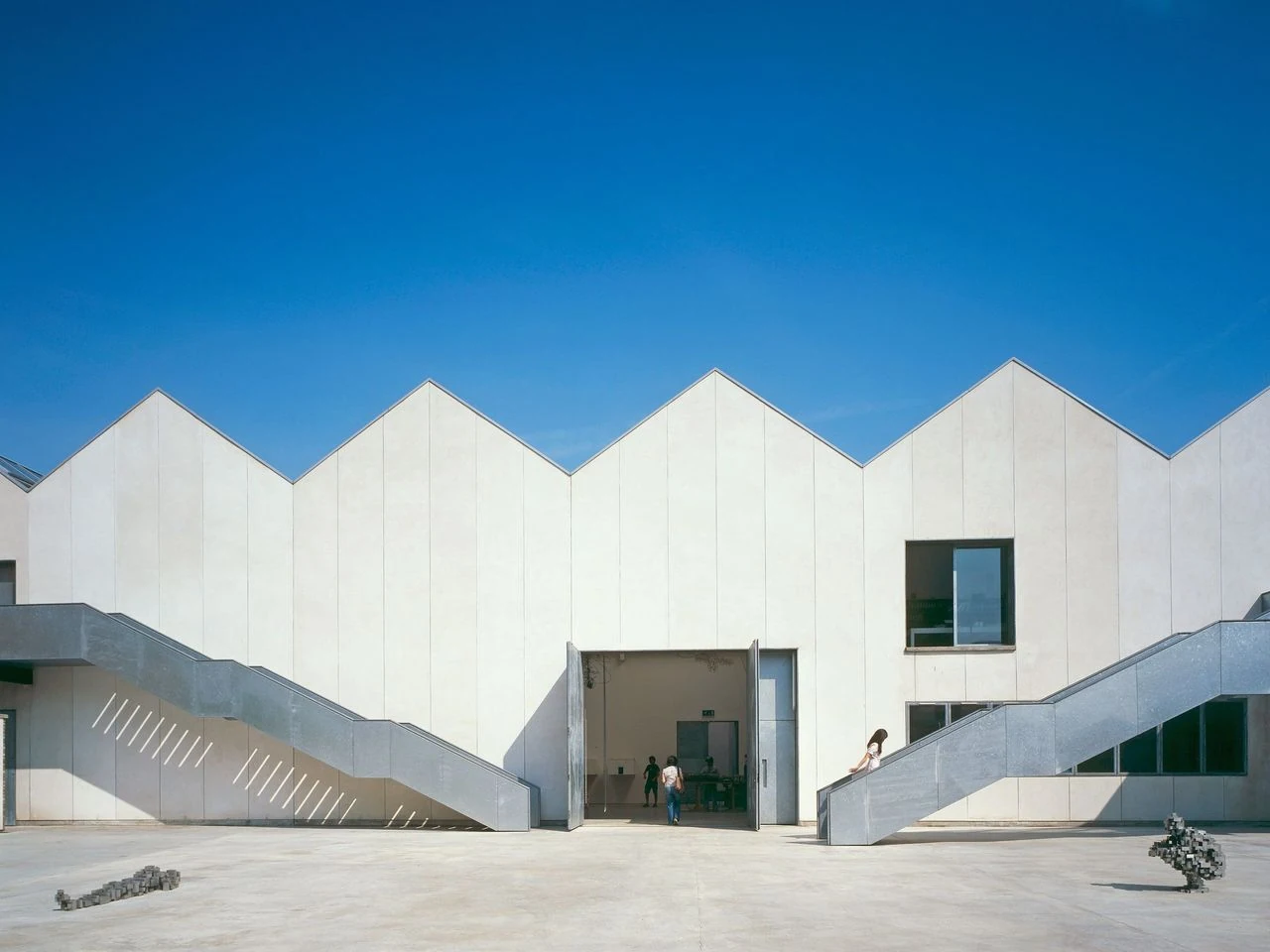
David Chipperfield’s buildings range from a riverside museum in Oxfordshire to the reconstruction of a war-damaged institution in Berlin. Their settings differ, but both projects show an architect working with what is already there: local forms and materials in Henley-on-Thames, and the surviving fabric of history in Berlin. Chipperfield established his own practice in 1985; it grew into an international firm, while his work continued to include significant public buildings in Britain.
Training and the start of a practice
Born in London on 18 December 1953, Chipperfield graduated from Kingston School of Art in 1976 and received his diploma in architecture from the Architectural Association in London the following year. Before setting up independently, he worked in the offices of Douglas Stephen, Norman Foster and Richard Rogers. He founded David Chipperfield Architects in 1985, establishing a practice that would go on to work in Britain and internationally.
Some of his early commissions were shop interiors in London and abroad. Work for the Japanese fashion designer Issey Miyake on Sloane Street was among his early London projects; commissions in Japan followed, including a Toyota store in Kyoto. The practice also designed the 1 Cobham Mews Studios, which served as its London office for more than 20 years. These projects formed part of a career that would move between interiors, museums, public institutions and large civic developments.
Chipperfield’s approach is not adequately described by a single label. He has said that architects should respond to the circumstances of each project rather than restrict their thinking to a style or material. He has also argued that building in a city carries a responsibility to understand its history and culture. The idea is visible in projects where a new building meets an existing structure or landscape, though the results have not always escaped criticism.
A museum beside the Thames
The River and Rowing Museum in Henley-on-Thames was one of Chipperfield’s early major British building projects. The project dates from 1989 to 1997. Its design draws on the forms of traditional boat sheds and Oxfordshire barns, giving it a recognisable relationship to the surrounding area without simply reproducing older buildings.
The 2,300-square-metre museum is raised on concrete pillars to help protect it from flooding. Untreated oak clads the exterior and parts of the interior; stainless steel is used for the roofs and sunshades. Glass walls at the entrance and natural light reaching the galleries help connect the interior with its setting. The museum is devoted particularly to rowing, a sport closely associated with Henley, and its architecture brings local building references into a contemporary public institution.
Two other British galleries, opened in 2011, demonstrate the breadth of the practice’s work. The Hepworth Wakefield, devoted to sculptor Barbara Hepworth, consists of ten trapezoidal blocks. Its galleries receive natural light through pitched roofs, and views take in the river, historic waterfront and city skyline. The building’s façade uses pigmented concrete made on site, described in the article as the first of its kind in the UK. The design has also drawn criticism: architecture critic Rowan Moore compared it to a bunker.
At Turner Contemporary in Margate, six glass galleries stand beside the coast. Designed for a site exposed to sea air and weather, the building is raised on pylons to address flood risk; its façades and shutters respond to the demands of the coastal setting. The gallery is devoted to J. M. W. Turner, his contemporaries and artists he influenced. Together, the Wakefield and Margate projects show how Chipperfield’s British work has taken different forms in response to the institutions and places it serves.
Working with the past in Berlin
In 1997, Chipperfield and architect Julian Harrap won the competition to reconstruct and restore Berlin’s Neues Museum, which had been severely damaged during the Second World War. Completed in 2009, the project did not attempt to make the building look untouched. It restored surviving spaces and introduced new ones while retaining visible evidence of the damage.
New galleries and a central staircase used reinforced concrete; recycled bricks were used in other areas, including the north wing and south dome. Marks left by the war remained part of the building. The aim, in Chipperfield’s words quoted in the article, was for the new work to reflect what had been lost without imitating it. The project received the European Union Prize for Contemporary Architecture in 2011. Chipperfield later completed the adjoining James Simon Gallery, conceived as a visitor gateway to Berlin’s Museum Island and opened to the public in 2019.
The Neues Museum is one example of a wider practice that has undertaken cultural projects in several countries. In Germany, the Museum of Modern Literature in Marbach received the 2007 RIBA Stirling Prize. Its design places reading rooms below an entrance pavilion and gives visitors terraces overlooking the surrounding countryside. Elsewhere, Chipperfield designed the Saint Louis Art Museum expansion in the United States, Museo Jumex in Mexico City and the Museum of Modern Literature in Germany. The variety of these commissions makes a single description such as “minimalist” inadequate: the work is better considered through the different demands of each site and institution.
Public buildings, recognition and teaching
Chipperfield’s British projects have included more than museums. His work in the UK includes BBC Pacific Quay in Glasgow, One Pancras Square in London and the Royal Academy of Arts masterplan, carried out with Julian Harrap Architects. The practice has also completed projects beyond Britain in Europe, Asia, North America and elsewhere. In Barcelona, for example, its City of Justice brought courtrooms and offices previously spread across 17 buildings into a complex of nine. That project, like some of his museum work, has prompted critical debate: Rowan Moore described the complex as uncomfortably prison-like.
Recognition followed both individual buildings and a wider career. Chipperfield was appointed a Commander of the Order of the British Empire in 2004 for services to architecture and was knighted in 2010. He received the RIBA Royal Gold Medal in 2011 and was appointed to the Order of the Companions of Honour in 2021. In 2023 he won the Pritzker Architecture Prize. His practice has also received numerous awards, including the Stirling Prize for the Museum of Modern Literature and the 2011 European Union prize for the Neues Museum reconstruction.
His contribution has included teaching and architectural debate as well as building. Chipperfield taught at the State Academy of Fine Arts Stuttgart from 1995 to 2001 and held teaching roles at institutions in Barcelona and Yale. In 2012 he became the first British architect to curate the Venice Architecture Biennale. Titled “Common Ground”, it addressed the collaborative and interconnected nature of architectural practice.
Why David Chipperfield deserves a place in British Legacy
David Chipperfield’s place in British architectural history rests on a substantial body of work in the UK and on his ability to bring a British practice into a genuinely international conversation. The River and Rowing Museum connects a contemporary cultural building with the forms and materials of its Oxfordshire setting. The Hepworth Wakefield and Turner Contemporary extend that record through public galleries shaped for their particular sites and purposes. These are not simply buildings to admire from outside: they provide places for collections, exhibitions and visitors, and form part of the cultural life of their towns.
The reconstruction of the Neues Museum adds another dimension to that legacy. Rather than erase the evidence of destruction, Chipperfield’s project made the relationship between old and new part of the building’s meaning. Its international recognition, alongside honours including the RIBA Royal Gold Medal, the Companions of Honour and the Pritzker Prize, reflects the reach of that work. His teaching and his curation of the Venice Architecture Biennale also show an engagement with how architecture is discussed and practised, not just with the finished object. For British Legacy, the significance lies in this combination: influential British projects, a practice working across borders, and an approach that asks how new architecture can respond to the histories and conditions of a place.
Sources
David Chipperfield — Wikipedia, revision 1376296912
Adapted in part from David Chipperfield by Wikipedia contributors, under CC BY-SA 4.0. Text has been edited and combined with the existing article; this adapted text is shared under the same licence. Contributor history.