
I. M. Pei built a career around a demanding architectural question: how can a modern building answer to its setting without simply imitating what came before? His answer took different forms, from a glass-and-steel pyramid in the historic courtyard of the Louvre to museums shaped by Chinese gardens and civic buildings designed around the life of a city. The Louvre commission brought him controversy before it brought acclaim. It also made the Chinese-American architect’s work a conspicuous part of international debate about architecture and heritage.
From Guangzhou to modern architecture
Ieoh Ming Pei was born in Guangzhou on 26 April 1917. His family moved to Hong Kong during his first year and later to Shanghai, where he attended St John’s Middle School. As a boy, he spent summers with relatives in Suzhou, visiting its gardens. Their arrangement of built forms and natural settings would remain important to his thinking.
In 1935, Pei travelled to the United States to study at the University of Pennsylvania. He soon transferred to the Massachusetts Institute of Technology, where he earned a degree in architecture in 1940. He later completed a master’s degree at Harvard’s Graduate School of Design, studying in a school shaped by modernist architects Walter Gropius and Marcel Breuer. Pei’s education brought together technical training, modern design and an enduring interest in how buildings meet their surroundings.
After working for the New York developer William Zeckendorf, Pei established his own practice in 1955. Early commissions included housing, shopping centres and urban redevelopment schemes. Projects such as Kips Bay Towers in Manhattan and Society Hill in Philadelphia helped develop an approach attentive not only to individual buildings but also to streets, public spaces and the larger city. His work on the National Center for Atmospheric Research in Colorado marked a shift towards a building conceived in close relation to its landscape.
Pei’s commissions grew in scale and prominence. He designed the John F. Kennedy Presidential Library and Museum in Massachusetts, Dallas City Hall and the East Building of the National Gallery of Art in Washington, DC. The East Building’s sharply defined geometric forms and generous central space demonstrated his interest in giving visitors a clear route through a public institution while making the building itself part of the experience.
The Louvre Pyramid and a difficult debate
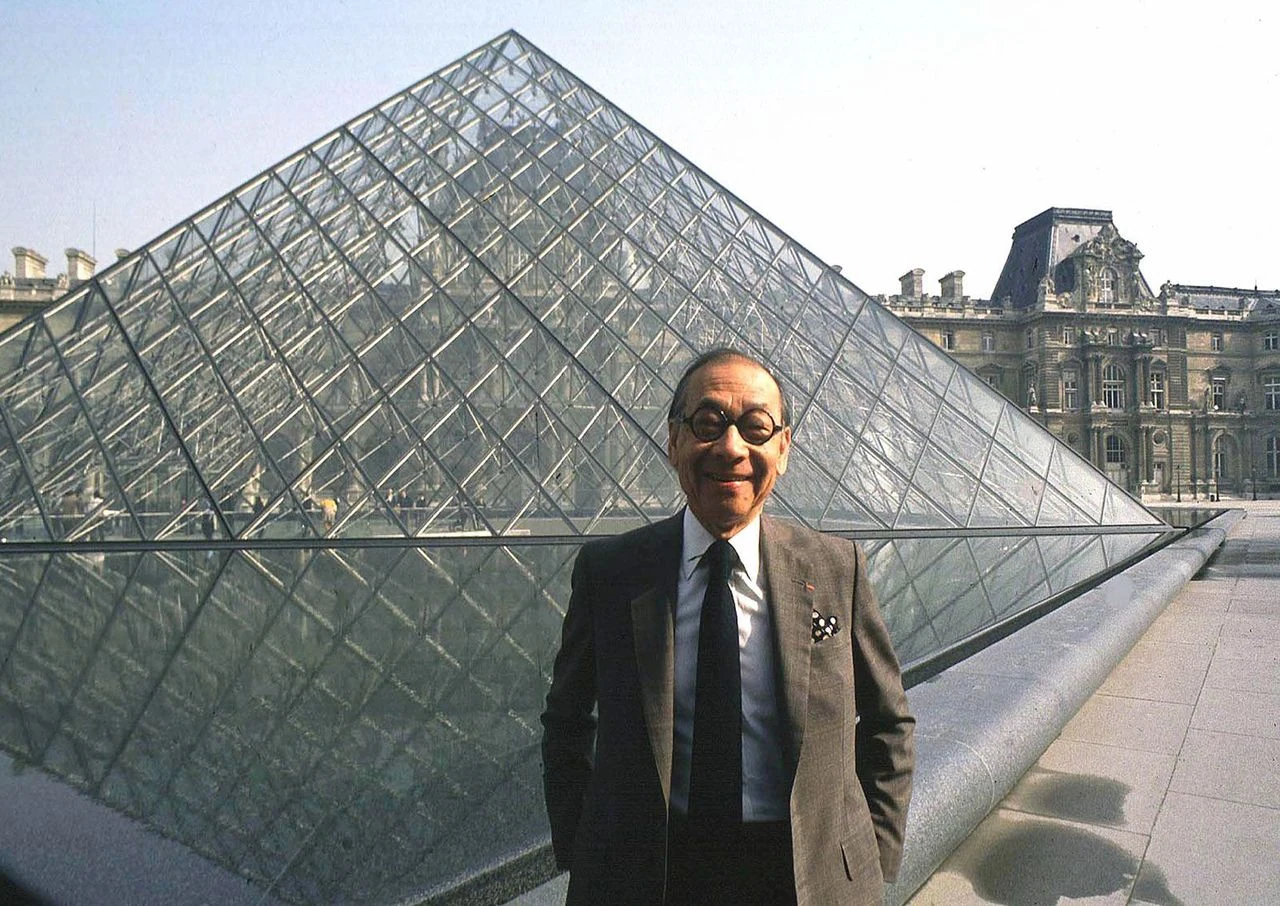
In the early 1980s, French President François Mitterrand asked Pei to help transform the Louvre. The project involved more than a new entrance: it reorganised the museum’s courtyard and created underground space connecting its principal wings. At the centre of Pei’s proposal was a glass-and-steel pyramid, intended to serve as an entrance and bring light into the spaces below.
The design met fierce opposition. Critics objected to placing a modern structure in the historic heart of Paris, and some attacks carried nationalistic overtones because the architect was Chinese-American. Pei and his team used a full-sized cable model in the courtyard to show the proposed pyramid’s scale. The project proceeded, and the new courtyard opened in 1988; the pyramid entrance followed in 1989. Public opinion shifted as people encountered the completed structure. The pyramid became Pei’s best-known work, its transparent geometry set among the Louvre’s historic façades.
The response reached beyond France. During a visit to the new site, the Prince of Wales, later King Charles III, called it “marvelous, very exciting”, according to the account of the project in Pei’s biography. That reaction offers a concrete British point of contact with a building whose reception had become an international argument about how new architecture can occupy an old setting.
A practice of context, geometry and public use
Pei’s buildings repeatedly use simple geometric forms, including triangles, squares and circles, but his work was not a single formula applied from commission to commission. He described his method as analytical: understanding a project’s time, place and purpose before seeking a balance among them. That principle can be seen in the contrast between the Louvre’s clear, angular entrance and the Fragrant Hill Hotel in China, where he drew on traditional residential architecture, gardens and the relationship between enclosed rooms and views of nature.
He also designed the Bank of China Tower in Hong Kong, whose rising triangular structure expressed, in his account, the aspirations of the Chinese people. In later decades, his work included the Miho Museum in Japan, built largely into a mountain, and the Museum of Islamic Art in Doha. For the latter, Pei travelled through the region and studied historic mosques before developing a design of pale, rectilinear forms around a large, light-filled interior. Across these projects, modern materials and geometric clarity were adapted to distinct landscapes and cultural contexts.
Pei’s work was not invariably welcomed, and his career included projects whose planning or execution proved difficult. The controversies around the Louvre, like the early opposition to the Kennedy Library’s location and design, make clear that public buildings are shaped by negotiation as well as by an architect’s intentions. Pei’s reputation rests not on a claim that every proposal was accepted, but on the range of major commissions he completed and the distinctive solutions he developed for them.
Recognition, influence and a British connection
Pei received the Pritzker Prize in 1983, the first Praemium Imperiale for architecture in 1989 and the American Institute of Architects Gold Medal in 1979. In 2010, the Royal Institute of British Architects awarded him its Royal Gold Medal. The British recognition came late in a long career, but affirmed the international significance of a body of work created principally outside Britain.
The earlier account of Pei’s British influence links his approach to Norman Foster’s Gherkin and to the British Museum’s Great Court. Those direct lines of influence are not established by the biographical evidence here, so they should not be presented as fact. The more careful comparison is that Pei’s Louvre project became a prominent example of modern construction placed beside historic architecture, a question relevant to British institutions and architects too. The Great Court’s glass roof and the Louvre’s transparent pyramid can be considered in that broad discussion without claiming that one caused the other.
Pei retired from full-time practice in 1990, later advising on projects through his sons’ firm. He died in Manhattan on 16 May 2019, aged 102. His career left a public record of architectural experiments in museums, civic buildings and urban settings, as well as a continuing debate over what it means to make contemporary work in places marked by history.
Why I. M. Pei deserves a place in British Legacy
Pei’s place in British Legacy is not based on British birth or a British-built landmark. It rests on a documented British honour and on the value of examining how architecture crosses national boundaries. In 2010, the Royal Institute of British Architects awarded him its Royal Gold Medal, recognising a career whose most visible achievements include the Louvre Pyramid, the National Gallery of Art’s East Building and the Bank of China Tower. His work gave British audiences and institutions a substantial example of modern architecture engaging with historic settings rather than treating them as obstacles.
The Louvre offers a particularly useful case. Its pyramid was contested because of its setting and its modern form; its eventual acceptance showed how public judgement can change when a project is experienced rather than imagined. The Prince of Wales’s praise during a visit is a specific British response, not proof that Pei directed the later work of British architects. That distinction matters. His British legacy is best understood as an international contribution recognised by a major British architectural institution and as a body of work that enriches discussion of heritage, design and public space. Remembering Pei in that way celebrates exchange without inventing a direct influence where the evidence does not establish one.
Sources
Adapted in part from I. M. Pei by Wikipedia contributors, under CC BY-SA 4.0. Text has been edited and combined with the existing article; this adapted text is shared under the same licence. Contributor history.
_(cropped).jpg)