John Vanbrugh made buildings that command attention and comedies that unsettle their audiences. Castle Howard and Blenheim Palace brought a bold new scale to English architecture; The Relapse and The Provoked Wife tested the rules of Restoration comedy, particularly its treatment of marriage and women. His life ranged from political imprisonment in France to the College of Arms and the building sites of some of the country’s most ambitious houses. He was knighted in 1714.
A political beginning, and years in prison
Vanbrugh was born in London in 1664 and baptised on 24 January that year. He grew up in Chester in a large family: his father, Giles, was a London cloth merchant of Flemish descent. The surviving account of his youth is incomplete, and suggestions that he studied architecture in France are not established. He did, however, serve briefly as an army officer in 1686.
As a committed Whig, Vanbrugh worked undercover in support of William of Orange’s effort to overthrow James II. In 1688, while returning from carrying messages to William at The Hague, he was arrested in Calais on suspicion of espionage. He spent four and a half years imprisoned in France, including time in the Bastille, and was released in November 1692 as part of an exchange of political prisoners. After returning to England in 1693, he joined the Navy and took part in an unsuccessful attack on Brest. His years in captivity mark a sharp divide in his adult life; they do not, by themselves, explain the creative choices he made afterwards.
Comedies about marriage and social rules
Vanbrugh entered the London theatre in the 1690s, when rival companies were competing for audiences and new plays. His first comedy, The Relapse (1696), takes up the story of Colley Cibber’s Love’s Last Shift and turns its neat moral resolution into a more complicated examination of desire and marriage. Alongside the returning husband, Vanbrugh gives Lord Foppington a memorable role as a self-regarding, elaborately dressed fop. The play succeeded with audiences despite the practical difficulties of mounting it.
The Provoked Wife (1697) turns from farce towards the predicament of a woman trapped in an abusive marriage. Its premise—that she might consider leaving her husband or taking a lover—provoked objections. Vanbrugh’s comedies were singled out by the clergyman Jeremy Collier in 1698 for sexual frankness and for failing to reward virtue and punish vice in the expected way. Vanbrugh answered Collier satirically, but public taste was shifting towards more morally instructive drama.
He continued to write and adapt for the stage, though he produced no further original plays after the change in audience taste. Other works included Aesop, The False Friend, Squire Trelooby, The Confederacy and The Mistake. After his death, a fragment of A Journey to London was completed by Cibber and staged as The Provoked Husband in 1728. Cibber supplied a reconciliatory ending, at odds with Vanbrugh’s stated intention to end the story with a marriage irreparably broken.
Building in a bold new style
Vanbrugh’s move into architecture was striking: he had no known formal training in the discipline. He worked closely on major projects with Nicholas Hawksmoor, whose experience as a former clerk to Christopher Wren complemented Vanbrugh’s eye for scale, perspective and theatrical effect. Their buildings used mass, silhouette and carefully staged approaches to make architecture felt from a distance as well as experienced inside.
Castle Howard, commissioned by the Earl of Carlisle in 1699, established Vanbrugh as a major architectural force. Often described as England’s first truly Baroque building, it organises long corridors and flanking wings around a central block crowned by a dome. Inside, the Great Hall rises to an 80-foot cupola. The design brings together a commanding exterior and dramatic interior rather than treating the house as a collection of decorated façades. Much of the building was occupied and complete by 1709, though work continued during Vanbrugh’s lifetime and the west wing was finished after his death to a changed design.
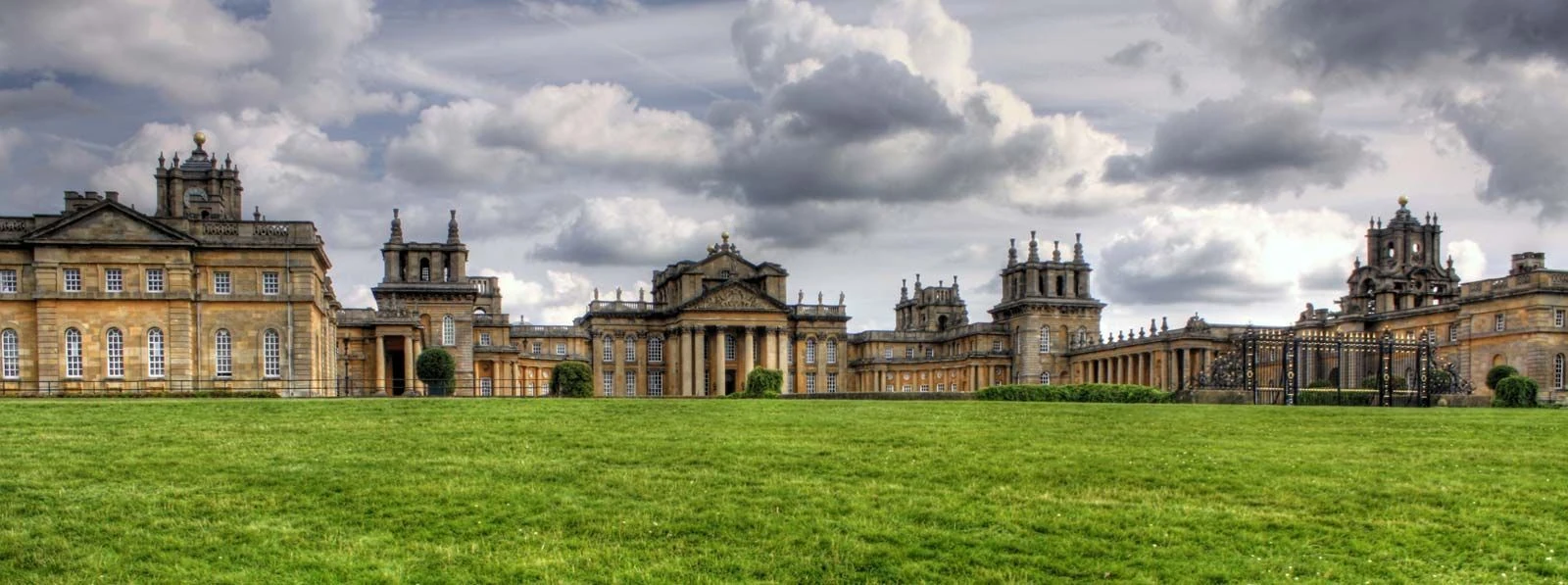
His next great commission was Blenheim Palace, begun in 1705 as a national reward for the Duke of Marlborough’s victory over the French at Blenheim in 1704. The house was conceived as a monument as well as a residence. Its strong, carefully massed forms differ from the more European character of Castle Howard: enormous gates, a monumental portico and a great hall create the impression of a citadel. Vanbrugh worked with Hawksmoor, but the project was repeatedly troubled by funding disputes and conflict with the Duchess of Marlborough, who wanted a more comfortable family home and objected to its cost and design. Vanbrugh left the building site in 1716; Hawksmoor completed the palace. The disputes damaged Vanbrugh’s reputation, although they do not erase the purpose the building was meant to serve: commemorating a military victory.
Public duties and later buildings
Vanbrugh’s work extended beyond private houses. In 1703 he became Surveyor of Greenwich Hospital, succeeding Wren in the post, and contributed changes to the nearly completed building. He also held appointments at the College of Arms, first as Carlisle Herald and then as Clarenceux King of Arms. These ceremonial and administrative roles sat alongside his work as a playwright, theatre manager and architect. In 1703 he also began developing the Queen’s Theatre in Haymarket with Thomas Betterton and William Congreve. The venture proved financially difficult, and he sold the business in 1708.
Among his later houses, Kings Weston in Bristol, built for Edward Southwell between 1712 and 1719, shows how he could achieve dramatic effect with a smaller and more restrained design. Its roofline arcade of grouped chimneys gives the house a distinctive silhouette. Seaton Delaval Hall in Northumberland, begun in 1718 for Admiral George Delaval, was his final major work. Vanbrugh designed it without Hawksmoor’s assistance. Its severe stone façades, strong proportions and play of light and shadow show a more restrained development of the Baroque style.
Vanbrugh married Henrietta Maria Yarburgh in York in 1719. He died in Westminster on 26 March 1726, aged 62. His architectural reputation was contested: some observers objected to the weight and ornament of his buildings, while others admired their invention and imaginative force. That disagreement is part of the history of his work, not a reason to reduce it to a single verdict.
Why John Vanbrugh deserves a place in British Legacy
Vanbrugh deserves a place in British Legacy for making architecture and theatre answer, in different ways, to questions of power and public life. Blenheim Palace was designed as a national monument to a military victory, not simply as a comfortable country house. Its imposing forms and carefully composed approach gave that purpose a physical presence. Castle Howard, meanwhile, helped establish a distinctive English Baroque, turning the arrangement of masses, corridors and a domed centre into a dramatic experience. In houses from the grandeur of Blenheim to the severity of Seaton Delaval, Vanbrugh showed how buildings could make meaning through their shape, setting and scale.
His plays add a different kind of challenge to his legacy. The Relapse and The Provoked Wife use comedy to expose the pressures and inequalities within marriage, and their frankness brought criticism as well as theatrical success. The two careers are not merely a colourful pairing: both show Vanbrugh testing accepted forms, whether the expected moral ending of a comedy or the conventional scale and composition of a house. His continued presence in Britain’s architectural landscape, alongside the enduring stage life of his comedies, gives his work a reach beyond his own lifetime. Together, the buildings and plays make him a distinctive figure in the history of British design and drama.
Sources
Adapted in part from John Vanbrugh by Wikipedia contributors, under CC BY-SA 4.0. Text has been edited and combined with the existing article; this adapted text is shared under the same licence. Contributor history.