Blenheim Palace was conceived as both a home for John Churchill, 1st Duke of Marlborough, and a monument to military victory. Construction began in 1705, after his triumph at the Battle of Blenheim the previous year, but the grand house was never simply a straightforward gift from a grateful nation: public funding faltered, political disputes interrupted the work, and the Marlborough family had to take on the cost of completing it. That complicated beginning is written into the palace itself, whose immense scale serves a public story as well as a private one.
Set in a large park at Woodstock in Oxfordshire, Blenheim is among England’s largest houses. It is the seat of the Dukes of Marlborough and the birthplace of Winston Churchill. Since 1987, the palace has been a UNESCO World Heritage Site. Its history brings together architecture, contested finance, family fortunes and national commemoration.
A reward with a disputed price tag
The palace takes its name from the Battle of Blenheim, fought in 1704 during the War of the Spanish Succession. The victory over French and Bavarian forces secured Marlborough’s reputation as a military commander. The Crown granted him the royal manor of Hensington, at Woodstock, as the site for a new house, and Parliament voted money towards its construction. Queen Anne also contributed, but the project’s funding was never as simple or secure as the idea of a national reward suggests.
Work began in 1705 under the architect John Vanbrugh, who usually worked with the trained architect Nicholas Hawksmoor. The design was ambitious, and the costs and character of the building became sources of dispute. The Duchess of Marlborough, Sarah Churchill, wanted a comfortable family residence and challenged Vanbrugh’s expenditure and plans; the architect was trying to create a monumental tribute. Political tensions also mattered. After a final quarrel between the Queen and the Duchess in 1711, state funds stopped. By 1712, work had halted, with money owed to the workmen.
The Marlboroughs went into exile on the Continent and returned after Queen Anne’s death in 1714. The Duke resumed the project at his own expense in 1716, but his severe stroke the following year left the Duchess in charge. Vanbrugh eventually left the site after further conflict over the work and its cost. Hawksmoor returned to help complete the house, and construction continued after the Duke’s death in 1722. The palace was built between 1705 and 1722, although finishing work continued into the following years.
Architecture designed to overwhelm
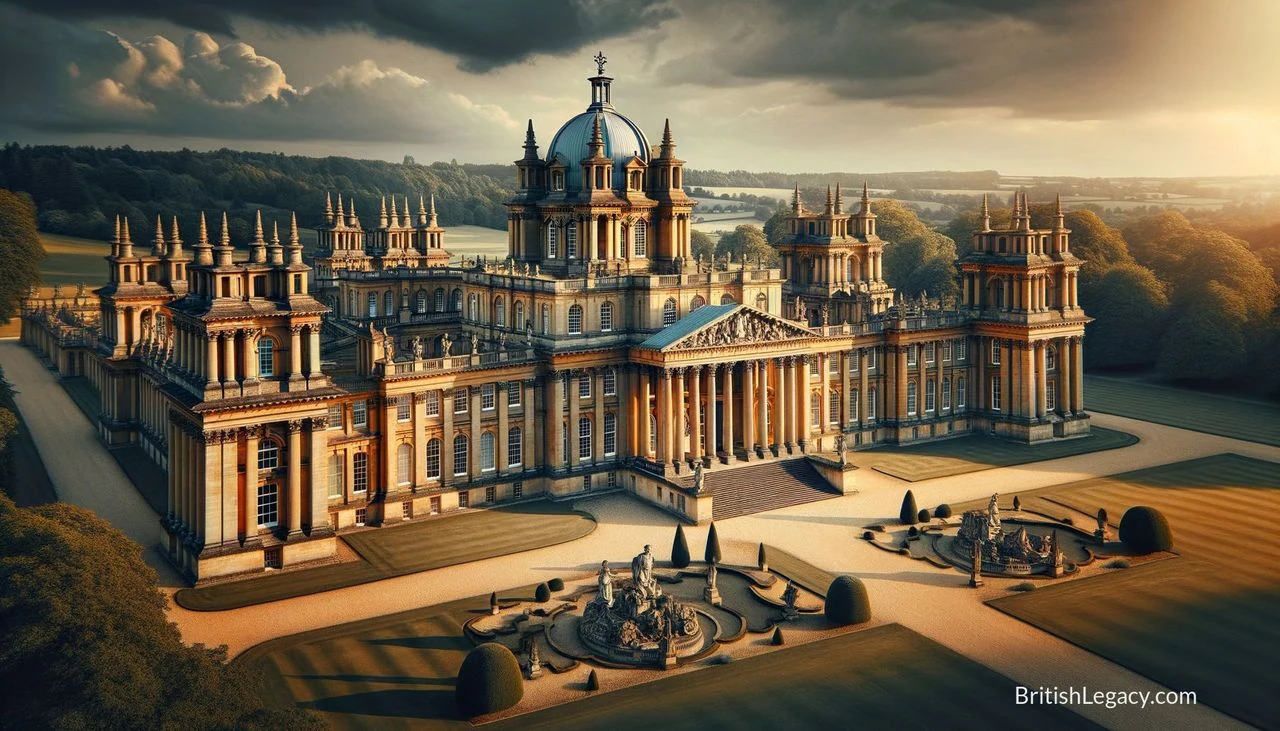
Vanbrugh designed Blenheim to be seen at a distance and to impress on arrival. Its principal block and two service blocks enclose a Great Court, while monumental gateways and a profusion of stonework give the complex the aspect of a fortress or citadel. The approach through the East Gate frames a view into the court and onwards towards the main entrance. The effect is deliberately imposing: this was not just a country residence, but a building intended to proclaim the Duke’s status and victories.
The palace is an unusually grand example of English Baroque, a style that soon gave way to the revival of Palladian design. Its monumental character was not universally admired, even in Vanbrugh’s lifetime. The arguments around its design reflected the tension at the heart of the commission: a national monument was expected to express power and magnificence, while the family also needed a workable home. At Blenheim, grandeur often took precedence over comfort.
The interior follows a similarly formal plan. State rooms were arranged to lead towards the central saloon, with more private apartments to either side. The long library, designed by Hawksmoor, was originally intended as a picture gallery. The Great Hall’s painted ceiling shows Marlborough presenting the plan of the Battle of Blenheim to Britannia; other decorative schemes celebrate the Duke’s military reputation. The palace chapel became the family mausoleum after the Duke’s death. His tomb, commissioned by the Duchess and designed by William Kent, occupies a dominant position in the chapel.
Parkland shaped over generations
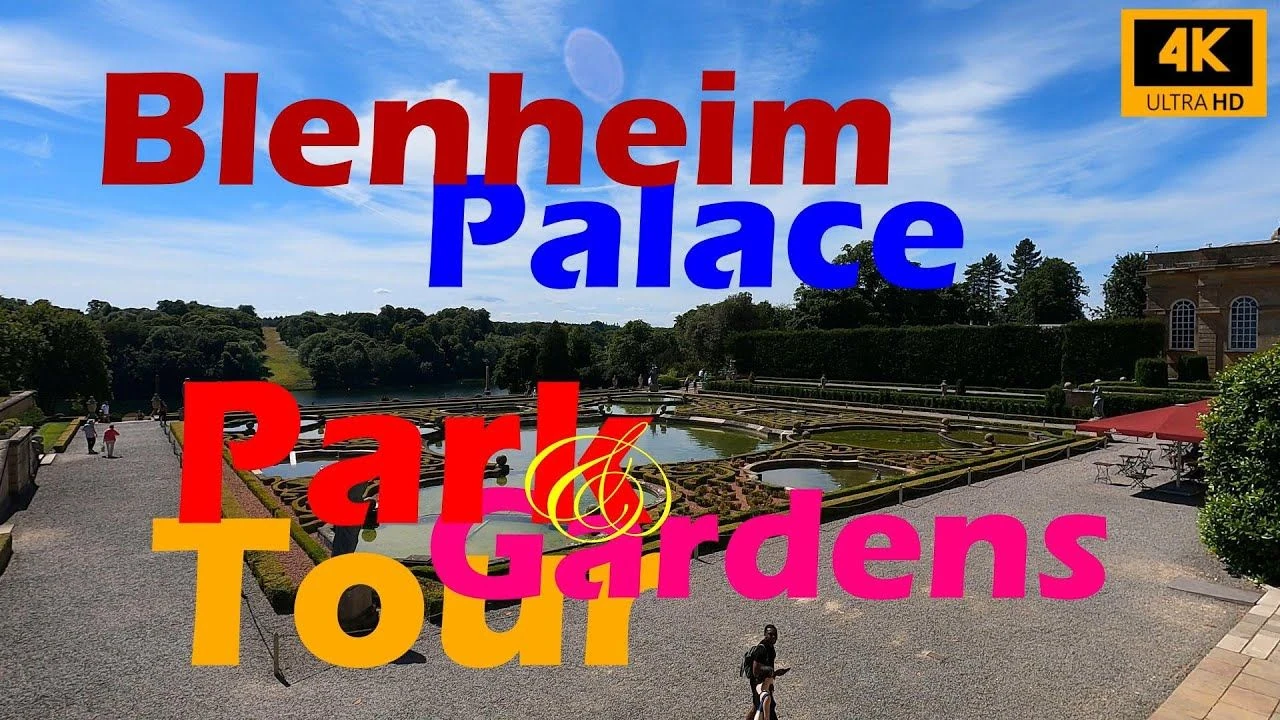
The landscape, like the house, developed in stages. Vanbrugh’s early plans included a vast bridge across the River Glyme and a long parterre. After the 1st Duke’s death, the park remained relatively unchanged for several decades. In 1764, the 4th Duke employed Lancelot ‘Capability’ Brown, who reshaped the grounds as an English landscape garden. Brown dammed the river to form a great lake and altered the setting around Vanbrugh’s bridge, submerging its lower rooms beneath the water. The change transformed the relationship between house, water and park.
The grounds also carry their own markers of Marlborough’s military story. The Column of Victory, completed after the 1st Duke’s death, stands at the end of an avenue of elms planted in the positions of his troops at the Battle of Blenheim. The landscaped park, woodlands and formal gardens are listed as a historic landscape, and Blenheim Park is a Site of Special Scientific Interest.
Another chapter belongs to Winston Churchill. He was born at Blenheim on 30 November 1874, and his life is commemorated by a permanent exhibition in the rooms where he was born. In 1908, he proposed to Clementine Hozier at the Temple of Diana, a lakeside summerhouse in the grounds. The connection is personal, but it sits within a much longer history: Blenheim’s role as a family home, a monument and a place of public memory.
From private estate to public landmark
The Marlboroughs’ fortunes later placed the house at risk. By the late 19th century, family debts and the expense of maintaining the estate had led to the sale of important parts of its collections. When the 9th Duke inherited in 1892, the family’s financial position was precarious. His marriage in 1895 to Consuelo Vanderbilt, an American railway heiress, brought resources that helped save the palace and fund restoration and redecoration. Their marriage later ended in divorce; the financial rescue remains part of the building’s history, alongside the human cost of a union entered into under intense family pressure.
In the 20th century, the house’s use widened further. During the Second World War, Malvern College boys were evacuated there, and the Security Service used the palace as its base from 1940 until the end of the war. Later, the 11th Duke opened it to visitors and used it as a film location, seeking ways to meet the costs of maintaining the house. Today the palace remains the home of the Dukes of Marlborough and is open to the public. Its gardens and parkland, contemporary art exhibitions and appearances on screen add new uses to the historic estate.
In 1987, UNESCO inscribed Blenheim Palace as a World Heritage Site. That status recognises its architectural and landscape significance, while its continuing life as a family home and visitor destination makes preservation a practical, ongoing responsibility. The estate has also hosted events of contemporary public significance: in July 2024, it was the venue for the fourth summit of the European Political Community.
Why Blenheim Palace deserves a place in British Legacy
Blenheim deserves a place in British Legacy because its significance rests on more than a famous façade or a connection to one celebrated birthplace. The palace makes visible the political and financial conditions behind a national monument. It was begun as a reward for Marlborough’s victory, supported by public money and royal favour, then shaped by disputes over cost, design and power. When that support failed, the family had to continue the work. The result is a landmark whose history includes both public ambition and private burden.
Its architecture and landscape also record distinct phases of British design. Vanbrugh and Hawksmoor created an unusually forceful English Baroque composition; Capability Brown later reshaped the park around a lake and a more naturalistic landscape. The palace’s Churchill connection adds a further, specific strand: it is where Winston Churchill was born, and where he later proposed to Clementine Hozier. Since becoming a World Heritage Site in 1987, Blenheim has been recognised beyond its local setting, while its use as a home, public attraction and cultural venue keeps the estate active. Together, these histories show how a British landmark can embody military commemoration, architectural change, family fortunes and public stewardship without being reduced to a single story.
Sources
Blenheim Palace — Wikipedia, revision 1376767014
Adapted in part from Blenheim Palace by Wikipedia contributors, under CC BY-SA 4.0. Text has been edited and combined with the existing article; this adapted text is shared under the same licence. Contributor history.