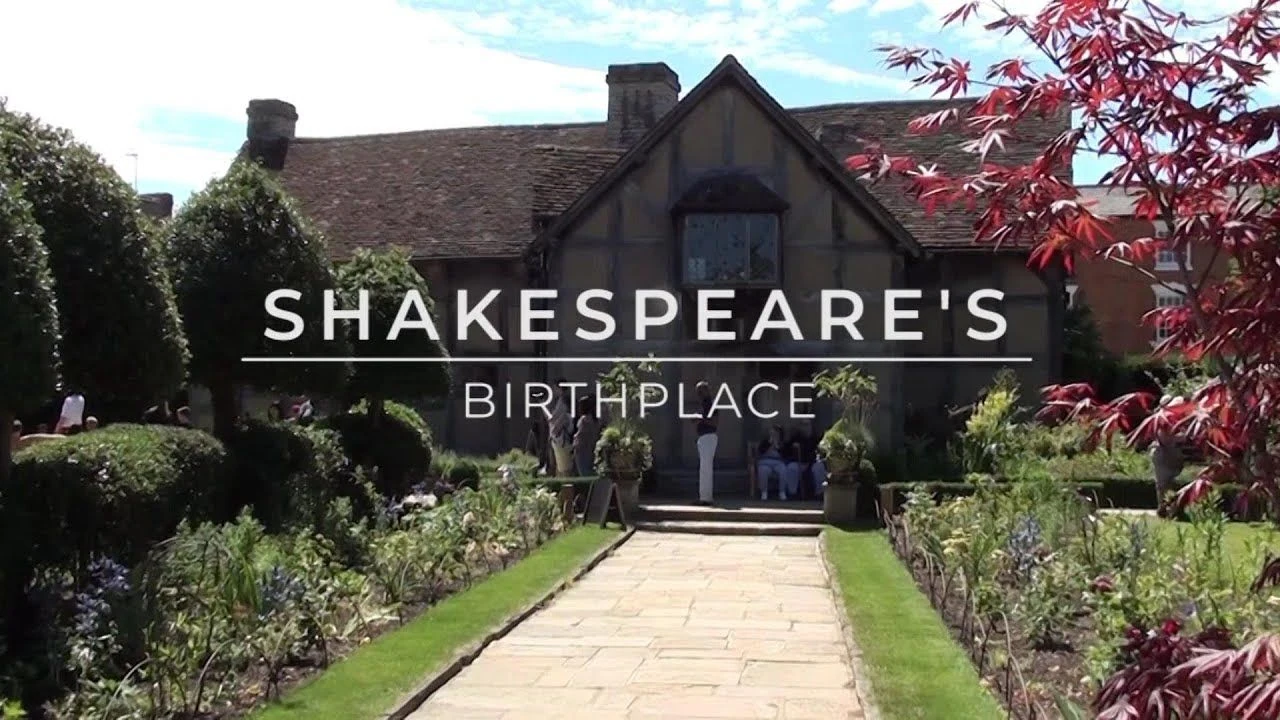
In 1846, when William Shakespeare’s birthplace came up for sale, the American showman P. T. Barnum proposed buying it and shipping it to the United States, brick by brick. A group formed to keep the house in Britain instead. With donations including money from Charles Dickens, the Shakespeare Birthplace Committee raised £3,000 and bought the property in 1847. That campaign became the origin of the Shakespeare Birthplace Trust, an organisation whose work now reaches far beyond one house on Henley Street.
A birthplace saved for the nation
The Trust’s story began with a threatened building and a practical act of preservation. Shakespeare’s Birthplace had served many purposes since the playwright’s time: it was a family home, a workshop, an inn, a butcher’s shop and, eventually, a literary shrine and visitor attraction. Today, its rooms and domestic furnishings evoke family life in Shakespeare’s period, while displays trace the changing uses of the building. A reconstruction of John Shakespeare’s glove-making workshop recalls the work carried on there during the playwright’s childhood.
The organisation came into existence with the purchase in 1847. Its formal legal history developed later: an 1891 local Act of Parliament incorporated the trustees and guardians and made provision for the property, a library and a museum. The legislation was amended in 1930 and replaced by a further Act in 1961. The Trust is an independent registered educational charity based in Stratford-upon-Avon. It receives no government funding or public subsidy, depending instead on public support, donations and income from visitors.
Its headquarters, the Shakespeare Centre, stands beside the Birthplace. Opened in 1964, the centre was developed under the direction of Levi Fox, who led the Trust from 1945 to 1989, to house its library, documents and collections. The work of preserving the sites is therefore connected with research: the Trust cares not only for historic buildings but also for materials that help scholars and visitors study Shakespeare, his family and the town in which he grew up.
Houses, farms and changing evidence
Several Trust properties illuminate different parts of Shakespeare’s family history. Hall’s Croft is believed to have been the home of his daughter Susanna and her husband, the physician Dr John Hall, around 1613–16. Its collections include paintings and furniture from the sixteenth and seventeenth centuries, alongside an exhibition about Hall and the period’s medical practices. The evidence is presented through a family house and its objects, rather than through a claim that the building can tell the whole story of Shakespeare’s life.
Anne Hathaway’s Cottage lies about a mile west of Stratford. Though conventionally called a cottage, it is a twelve-room farmhouse with several bedrooms. Known in Shakespeare’s day as Newlands Farm, it remained in the Hathaway family for generations before the Trust acquired it in 1892. The building offers a place to consider Anne Hathaway’s family and the landscape around Stratford, without treating conjecture about Shakespeare’s courtship or the influence of the setting on particular plays as established fact.
The history of Mary Arden’s Farm shows why heritage interpretation must change when evidence changes. The Trust bought Palmer’s Farm in Wilmcote in 1930, believing it to be the childhood home of Shakespeare’s mother. In 2000, research established that the property had belonged to a neighbour, Adam Palmer. The name Mary Arden’s House was then transferred to nearby Glebe Farm, which dates from 1514 and had been acquired by the Trust in 1968 when threatened by development. It is Glebe Farm that is now identified as Mary Arden’s childhood home. Together, Glebe and Palmer’s farms form the Shakespeare Countryside Museum.
New Place, where Shakespeare’s family home once stood and where he spent the final years of his life, is now interpreted through gardens and contemporary artworks. Nash’s House, beside the site, contains an exhibition in a restored and extended Tudor building. The setting combines the remains of a historic landscape with present-day interpretation, rather than presenting the original house as if it still survived.
The Trust also cares for Palmer’s Farm and Harvard House. Built by Thomas Rogers, Harvard House was the home of the mother of John Harvard, the benefactor of Harvard University. It previously housed the Museum of British Pewter and has since been presented as a Tudor home with period artefacts and used as a teaching venue for schools and colleges.
Collections, study and public learning
The Shakespeare Centre Library and Archive brings together Shakespeare and local collections. The Shakespeare holdings include the Trust’s printed books, material from the Royal Shakespeare Company and records of the Shakespeare Memorial Theatre and the RSC. The library contains translations of Shakespeare in more than 70 languages, as well as documents relating to Shakespeare and his family. Local records, books, photographs and maps place that material in the history of Stratford-upon-Avon and its surrounding area.
The Trust’s museum and conservation work covers a wide range of objects. Its holdings include local archaeological finds, art connected with Shakespeare and Stratford, domestic furniture and furnishings, coins and tokens, pewter, textiles and objects associated with Shakespeare. The collections also document the town’s social, economic and working life. Taken together, they give visitors and researchers ways to examine both the Shakespearean story and the wider history of the place in which it developed.
Education forms another part of the Trust’s work. It offers talks, lectures and courses for the public and for learners from primary school to university level, as well as international programmes concerning Shakespeare’s writing. Its events have included the Stratford-upon-Avon Poetry Festival and a Shakespeare Film Festival introduced in 2012. The Trust has also hosted artists in residence since 2015, beginning with Roger Hartley of the Bureau of Silly Ideas; Thor McIntyre and Carrie Reichardt are among those who have held the role.
Why The Shakespeare Birthplace Trust deserves a place in British Legacy
The Shakespeare Birthplace Trust deserves a place in British Legacy because its history shows how a cultural landmark can be preserved through collective action. The 1847 purchase prevented Shakespeare’s birthplace from being removed from Stratford, and the organisation that grew from that campaign has continued to care for buildings, collections and records tied to the playwright and his family. Its work makes these places accessible as more than picturesque historic houses: the Birthplace’s changing uses, Hall’s Croft’s medical history and the archive’s documents all help visitors and scholars encounter different kinds of evidence.
The Trust’s British significance also lies in its willingness to revise what it presents. The change from Palmer’s Farm to Glebe Farm as the identified home of Mary Arden illustrates that preservation is not simply keeping old buildings standing; it also means updating interpretation when research changes the account. Its library, local collections, educational programmes and historic sites connect Shakespeare’s international readership with the specific homes, work and records of Stratford-upon-Avon. Sustained without government subsidy, the Trust depends on public support to maintain that connection. Its contribution is therefore both material and educational: protecting places and objects, while giving new generations ways to study and question the history they represent.
Sources
Shakespeare Birthplace Trust (revision 1339105146)
Adapted in part from Shakespeare Birthplace Trust by Wikipedia contributors, under CC BY-SA 4.0. Text has been edited and combined with the existing article; this adapted text is shared under the same licence. Contributor history.