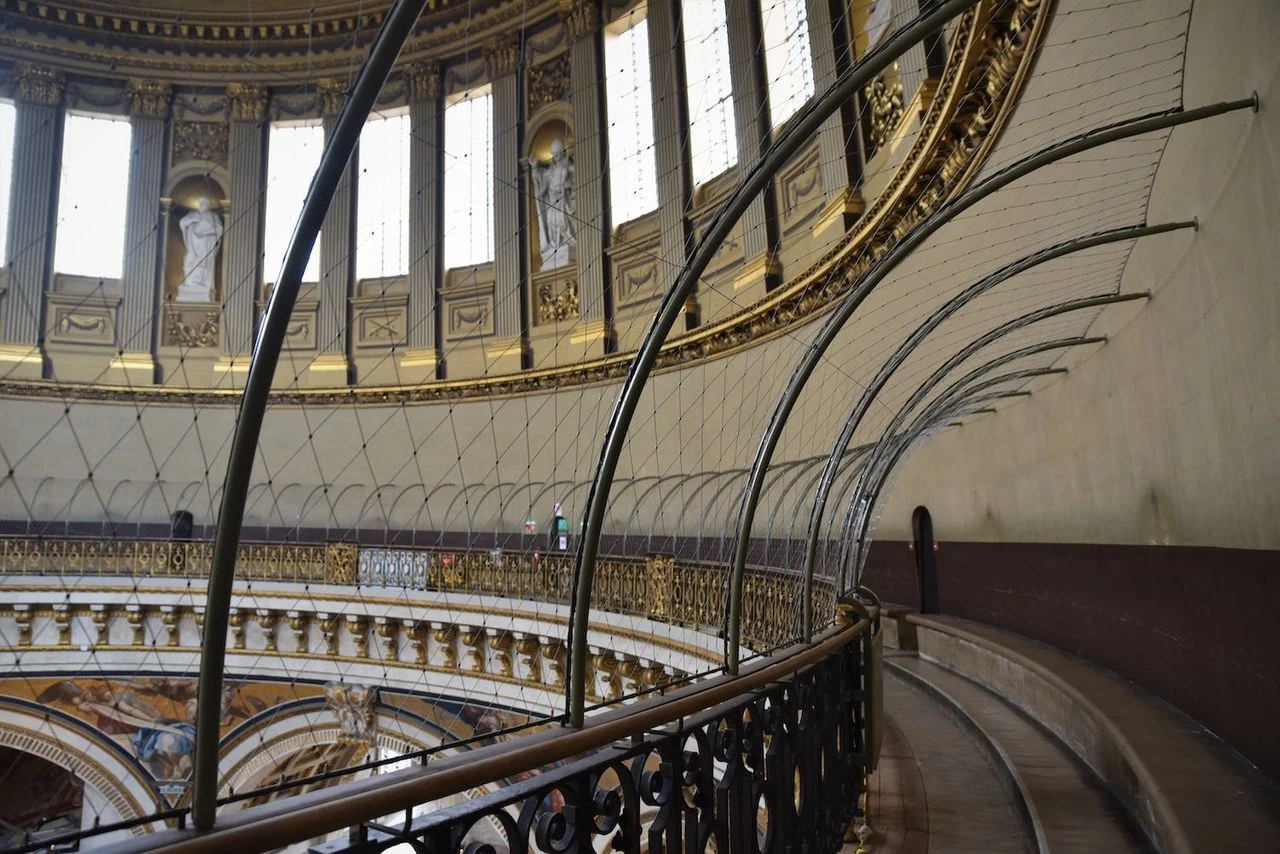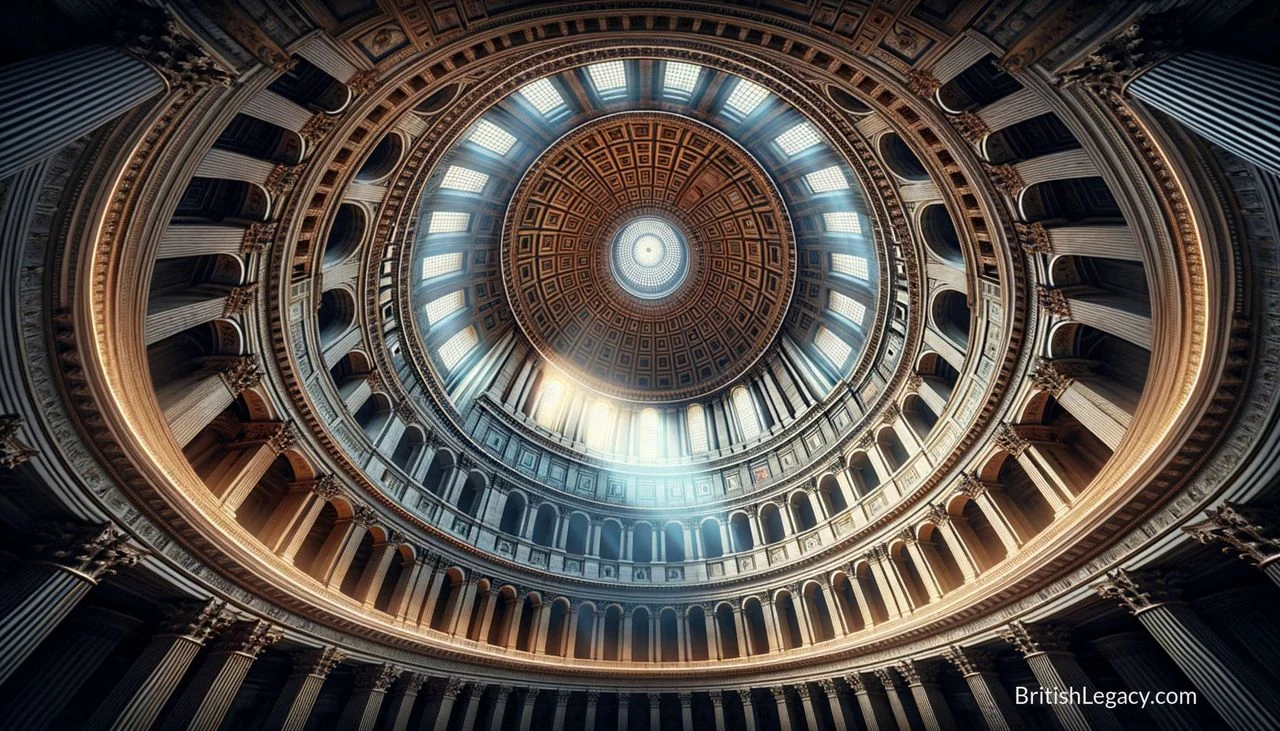
At St Paul’s Cathedral, a whisper spoken against the wall of the dome’s gallery can travel around its curve and be heard on the far side. The effect is both simple to try and striking to experience: a quiet voice, apparently carried through the building, reaches someone standing opposite. The Whispering Gallery is an acoustic feature of one of London’s best-known landmarks, where the shape of the architecture gives visitors an immediate encounter with sound in motion.
A gallery within the dome
St Paul’s Cathedral was built after the Great Fire of London in 1666 and is the work of the architect Sir Christopher Wren. Its dome rises about 111 metres, or 365 feet. The Whispering Gallery runs around the dome, roughly 30 metres above the cathedral floor. Reaching it involves climbing 257 steps, a route that also gives visitors views of the cathedral’s interior.
The gallery’s position and curved wall are central to the experience. A person standing close to the wall whispers towards it; someone elsewhere around the circumference can hear the sound. The source account gives the distance between opposite points as 33 metres. Rather than requiring special equipment, the effect can be experienced directly by visitors, making the building itself the setting for a small acoustic demonstration.
How the whisper travels
The gallery’s name describes the encounter: a quiet voice reaches a listener around the curve. The dome’s shape provides a path for sound along the wall, allowing it to be heard across the gallery. The source account describes the dome as hemispherical and says the sound travels without significant loss of volume or clarity. To the listener, the voice may seem unusually close, even though the speaker is some distance away.
That combination of architecture and audible effect helps explain the gallery’s enduring appeal. Its acoustic quality is not separate from the structure: it depends on the curved surface and the way the space carries sound. Visitors can test the phenomenon for themselves, turning a feature of the dome into an experience shared between two people standing apart. The result is a memorable point of contact between the cathedral’s design and the senses of those who enter it.
Part of a larger cathedral story
St Paul’s has also been the setting for important public occasions. The source account names Sir Winston Churchill’s funeral in 1965 and the wedding of Charles, Prince of Wales, and Lady Diana Spencer in 1981. These events took place within the cathedral; they are part of the story of the building as a whole, rather than evidence that ceremonies were held in the Whispering Gallery itself.
The gallery offers a different kind of encounter with the cathedral’s history. It is not a memorial to one event, but a working architectural space in which visitors can hear how the dome shapes sound. Its position high above the floor and its encircling wall distinguish it from the larger ceremonial spaces below, while linking the visitor’s experience to the construction of the cathedral as a whole.
Architecture experienced at close quarters
The account of the gallery presents it as a meeting of architectural form and scientific curiosity. Wren is described as having a background in astronomy and physics, and the dome’s acoustic effect demonstrates how a structure can be appreciated not only for its appearance but also for what it does. The gallery makes that relationship tangible: a visitor can hear the consequences of the curved design rather than merely look up at it.
St Paul’s is identified in the source account as a Grade I listed building, maintained by the St Paul’s Cathedral Foundation. The Whispering Gallery is one of its distinctive features. Its appeal lies in the combination of location, form and experience: reached by a stair climb, set within the dome, and capable of carrying a whispered voice to a listener across the gallery.
Why St Paul’s Whispering Gallery deserves a place in British Legacy
The Whispering Gallery deserves a place in British Legacy because it offers a specific, accessible example of how architecture can shape everyday experience. Its curved wall and position within the dome allow a whisper to travel around the gallery, making an acoustic effect understandable through direct observation. Visitors do not need specialist knowledge to take part: one person speaks quietly, another listens, and the building connects them across the space. That encounter gives the cathedral’s design a practical dimension alongside its visual presence.
The gallery also belongs to the wider history of St Paul’s, a London cathedral rebuilt after the Great Fire and designed by Christopher Wren. Its acoustic character adds another way to understand the building, alongside the dome’s scale and the cathedral’s role as a setting for significant public occasions. The connection to British heritage rests on these tangible details, not on a general claim of national ingenuity: a particular architectural space, within a major London landmark, continues to let visitors experience how its form carries sound.