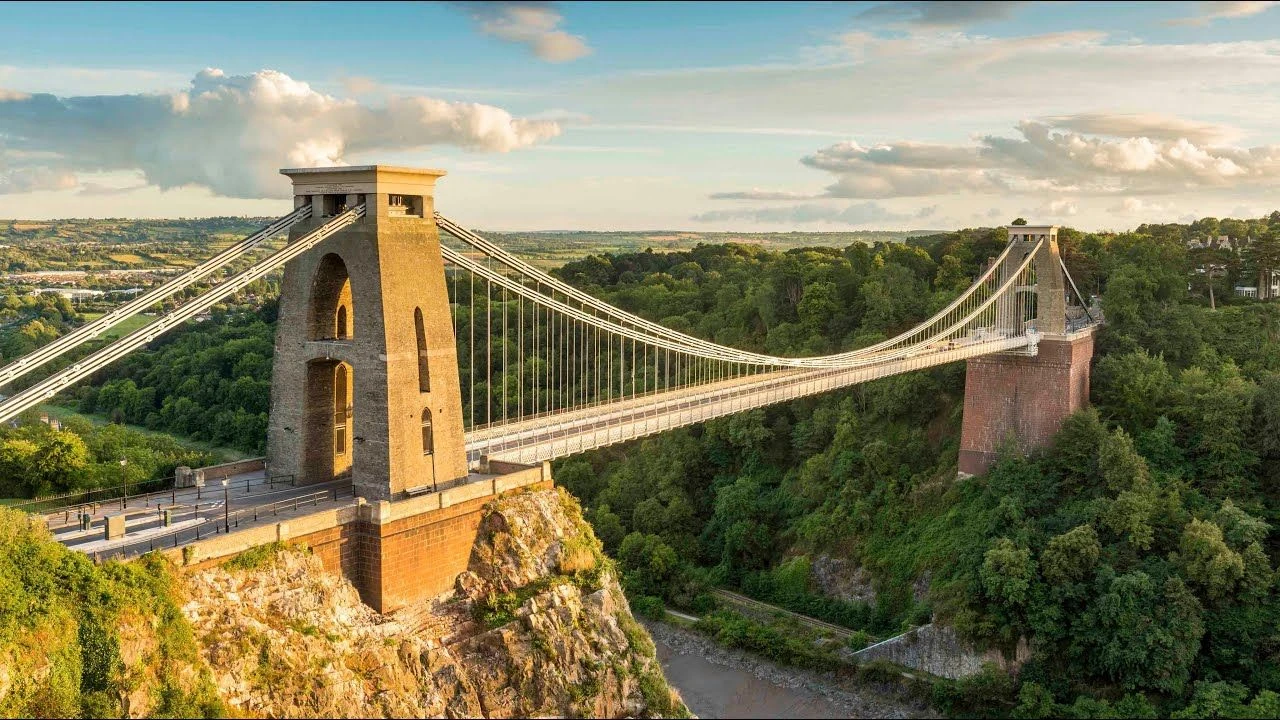
Across the Avon Gorge, the Clifton Suspension Bridge connects Bristol’s Clifton with Leigh Woods in North Somerset. Isambard Kingdom Brunel designed it, but died before it was finished. Its eventual completion by engineer William Henry Barlow and architect John Hawkshaw turned an interrupted project into a public crossing and a defining Bristol landmark. The bridge’s story belongs not only to its original design, but also to the long pause in construction and the work that brought it to completion.
A design shaped by competition
The proposal began with a competition in 1829 to design a bridge across the gorge. Brunel, then 24, submitted a design featuring Egyptian-style towers. The first competition produced no winning design. In a subsequent contest in 1831, Brunel’s proposal was selected after he revised it towards a more classical form. The change in the design and the repeated contests mark the early stages of a project that would take decades to reach its opening.
Finance repeatedly interrupted the undertaking. Work resumed in 1836, then was suspended again by 1843. Brunel died in 1859 without seeing the bridge realised. These delays meant that the proposed crossing was not simply built to its original timetable: the project had to be carried forward after its designer’s death, and the finished structure reflected the contributions of other engineers.
From proposal to public crossing
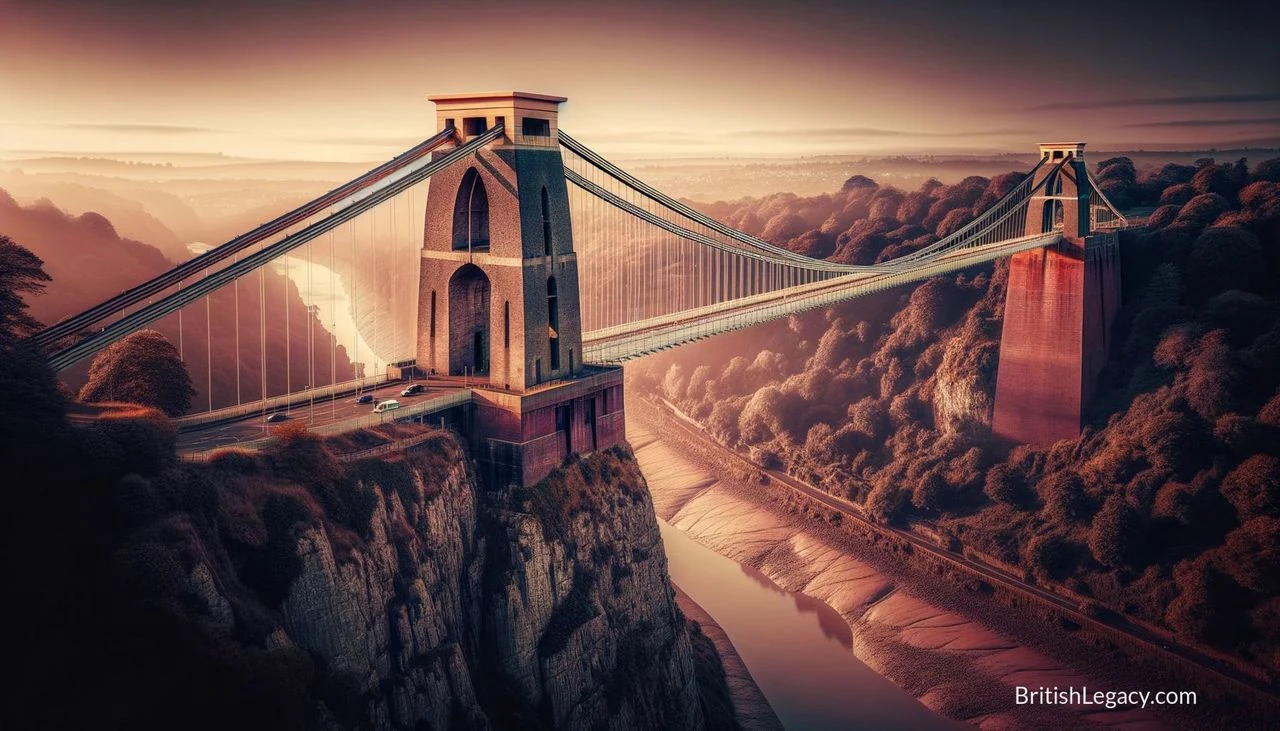
Barlow and Hawkshaw completed the bridge after Brunel’s death, modifying the design as they did so. It opened to the public on 8 December 1864. The central span measures 214 metres, and the road deck is 75 metres above the river. Wrought iron is used in the chains and deck; stone towers and ironwork give the crossing its distinctive appearance. These features make the bridge both a route across the gorge and a prominent structure in the landscape.
Brunel’s design is central to the bridge’s history, but it is not the whole account of the finished crossing. Its financial difficulties, periods of suspended work and eventual completion by Barlow and Hawkshaw are part of the same story. The opening in 1864 brought a project begun in competition into public use, after its designer had been dead for five years.
A landmark in Bristol
The bridge links Clifton and Leigh Woods and serves as a transport route as well as a landmark associated with Bristol. Its position over the Avon Gorge gives it a prominent place in the city’s setting. The crossing has also been used as a venue for public events and challenges. In 1979, motorcyclist Eddie Kidd crossed it. That episode adds a specific moment to the bridge’s later public history without obscuring its primary role as a crossing.
The bridge has a practical purpose and an identifiable form: a long span above the gorge, supported by stone towers and ironwork. Its public opening followed a protracted history of design, interrupted construction and completion by engineers other than Brunel. Seen together, those details explain why the bridge is more than a picturesque feature of the Bristol landscape: it is a working link whose construction records the changing fortunes of an ambitious engineering project.
Why the Clifton Suspension Bridge deserves a place in British Legacy
The Clifton Suspension Bridge deserves a place in British Legacy because its history brings together a specific design challenge, a long construction story and a lasting public function. Brunel’s competition design set the project in motion, but finance and pauses in construction delayed its realisation. Barlow and Hawkshaw then completed and modified the bridge after Brunel’s death. Keeping each contribution in view offers a more accurate account than attributing the whole finished structure to one person.
The bridge continues to connect Clifton with Leigh Woods, while its 214-metre span, elevated road deck, wrought-iron elements and stone towers make its engineering visible in the landscape. Its British legacy is grounded in those particular achievements: a proposed crossing over the Avon Gorge became a public route and a Bristol landmark. The project’s interruptions and eventual completion also show how engineering works can depend on more than the initial idea: they require resources, sustained work and the efforts of those who carry a design through to use.