In Noël Coward’s Blithe Spirit, a novelist invites a medium to his home for research and gets rather more than he bargained for: the ghost of his first wife appears, invisible to everyone but him, and sets about disrupting his second marriage. First staged in Manchester in June 1941, the comedy moved to London the following month. Its run of 1,997 performances set a West End record for a non-musical play, and its repeated revivals and adaptations have carried its characters well beyond their original stage.
Introduction
Coward had been considering a comedy about ghosts before 1941. An early idea involved an old house in Paris haunted by spirits from different centuries, but he could not make its plot work. After his London office and flat were destroyed in the Blitz, he went to Portmeirion in Wales with the actress Joyce Carey. They discussed his ghost story there; by the time they parted, the title, characters and a rough plot outline had emerged.
Coward began writing the next morning and completed the play on 9 May 1941, after six days of work. He described it as “an improbable farce in three acts”. Its supernatural premise is treated with a deliberately unsentimental comic touch. Coward later explained that the story had to be heartless: with a heart, it would be sad. That choice gave the play a distinctive wartime setting. Ghosts and mortality enter the action, but the characters’ quarrels, vanities and romantic entanglements drive the comedy.
Synopsis
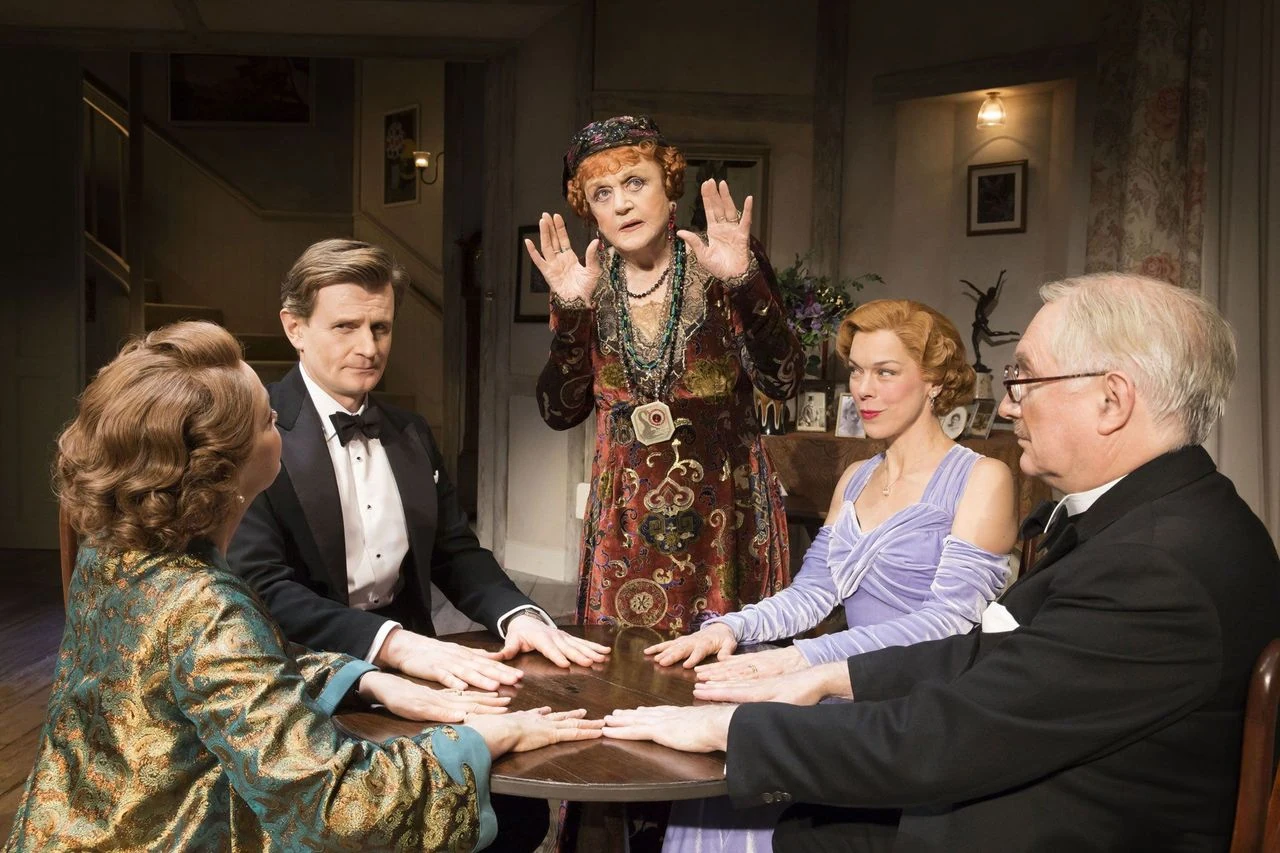
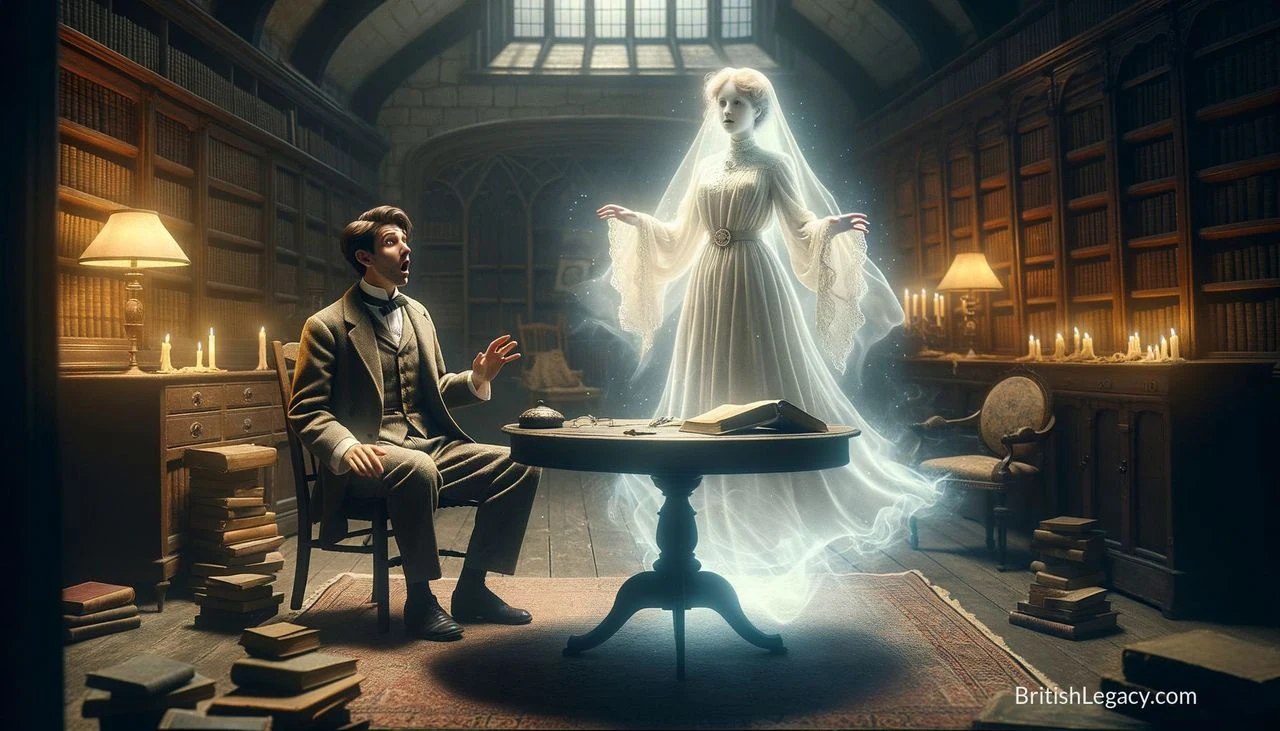
Charles Condomine is a successful novelist. He invites the eccentric medium Madame Arcati to conduct a séance after dinner, hoping to gather material about the occult for a book. During the ceremony, Elvira, his first wife, is inadvertently summoned. She died young, seven years earlier. At first, only Charles can see or hear her; his second wife, Ruth, doubts that the ghost exists.
Elvira sets out to disturb Charles and Ruth’s marriage. The attempt becomes dangerous when she sabotages Charles’s car in the hope that he will die and join her in the spirit world. Ruth takes the car instead and is killed. Her ghost returns bent on revenge, though Charles cannot initially see her. When Madame Arcati comes back to deal with the haunting, her efforts make Ruth visible too. She eventually works out that Edith, the maid, had unknowingly been the conduit through which Elvira was summoned, and succeeds in dematerialising both spirits.
Charles appears to be left in peace, but Arcati warns him that the ghosts may still be present unseen. He says farewell and leaves; the unseen spirits begin throwing things and wrecking the room. The farcical mechanics keep the supernatural mischief in motion, while the three central characters’ conflicting attitudes to marriage and memory give their disputes their bite. Arcati, whose earnest attempts to manage the haunting repeatedly complicate it, is more than a convenient plot device: her distinctive role has helped attract generations of performers.
The Playwright and Initial Run
Blithe Spirit was first produced at the Manchester Opera House on 16 June 1941, then opened at the Piccadilly Theatre in London’s West End on 2 July. Coward directed the production; Gladys Calthrop designed its sets and costumes. During its long London run, it transferred to the St James’s Theatre on 23 March 1942 and the Duchess Theatre on 6 October 1942. It closed on 9 March 1946, having played 1,997 performances.
The run set a record for a non-musical play in the West End. It was not surpassed until September 1957, when The Mousetrap exceeded it. The first-night cast included Cecil Parker as Charles, Fay Compton as Ruth, Kay Hammond as Elvira and Margaret Rutherford as Madame Arcati. Many performers changed during the years of the London run, and companies also took the comedy on tour in Britain.
Its wartime life extended beyond London. From February 1944, an ENSA company toured the Middle East and continental Europe; another company took the play, alongside Hamlet, to armed forces in India and Burma from October 1945. These tours put Coward’s comedy in front of audiences far from the West End while the original London production was still part of the play’s history.
Across the Atlantic, the Broadway production opened at the Morosco Theatre on 5 November 1941, later transferring to the Booth Theatre. It ran for 657 performances and won the New York Drama Critics’ Circle Award for Best Foreign Play for the 1941–42 season. The early success in both London and New York showed how readily the play’s compact domestic setting and spirit of farce could travel.
Revivals, responses and adaptations
The first response was not unanimous. After the Manchester performance, a reviewer described the mixture of farce and impending tragedy as an odd one, touched by genius. Ivor Brown praised the skill of the London production and Margaret Rutherford’s performance as Arcati. Other critics objected to its irreverence: James Agate called the play “common”, and Graham Greene described it as “a weary exhibition of bad taste”. The disagreement reflects the comedy’s willingness to treat death without solemnity.
British theatre continued to return to the play. London revivals included productions at the Globe in 1970, the National Theatre in 1976 and the Vaudeville in 1986. A 2004 production at the Savoy was directed by Thea Sharrock; she later directed a revival that reached the Apollo in 2011. A production directed by Michael Blakemore opened at the Gielgud in 2014, with Angela Lansbury as Arcati. In 2019, Richard Eyre’s production began at the Theatre Royal Bath before touring and transferring to the Duke of York’s Theatre in 2020. Its London run was interrupted after 12 performances by the COVID-19 pandemic and resumed at the Harold Pinter Theatre in 2021.
International productions added further versions of the play. It returned to Broadway in 1987 and again in 2009, the latter production directed by Blakemore and featuring Lansbury as Arcati. Productions also took place in Australia and France. The role of Arcati has been played by performers including Rutherford, Lansbury, Beryl Reid, Jennifer Saunders and Judi Dench, in different stage productions and adaptations.
David Lean directed the 1945 film, with Rex Harrison as Charles, Constance Cummings as Ruth, Kay Hammond as Elvira and Rutherford as Arcati. Edward Hall directed a second film adaptation in 2020, with Dan Stevens, Isla Fisher, Leslie Mann and Judi Dench in those roles. Radio adaptations have been broadcast in Britain and the United States since the 1940s; British versions include BBC productions for radio and television. Coward also directed High Spirits, a musical adaptation with book, music and lyrics by Hugh Martin and Timothy Gray. It played on Broadway and in the West End in 1964.
Contribution to British Legacy and Worldwide Theatre
Blithe Spirit holds a particular place in British theatre through the combination of its wartime beginnings, its record-setting West End run and its continuing return to British stages. The play began in Manchester before moving to London, where it remained in performance for nearly five years. Its touring history included companies performing for British audiences and for armed forces overseas. Later productions at the National Theatre and in the West End kept it within the country’s theatrical repertoire.
The play’s reach has not been confined to Britain. Its Broadway run began in the same year as its London production, and subsequent performances in the United States, Australia and France carried Coward’s farce into different theatrical settings. Film, radio, television and musical versions extended its life across media. Those adaptations did not replace the stage play: revivals continued in Britain and elsewhere, giving new casts the chance to reinterpret the same closely constructed domestic chaos.
Arcati’s place in that history is especially visible. Margaret Rutherford played her in the original production and the 1945 film; later performers included Angela Lansbury, Jennifer Saunders and Judi Dench. The role’s continued presence in productions and adaptations is one concrete measure of the play’s durability. Rather than relying on broad claims about influence, its legacy can be seen in its documented journey from wartime Manchester to the West End and beyond, and in the generations of performers and audiences who have returned to its characters.
Conclusion
From its first production in Manchester to a long West End run, tours for armed forces, international stages and screen and broadcast adaptations, Blithe Spirit has had an unusually varied life. Its record-setting London success gave Coward’s farce a prominent place in theatre history, while the later revivals show that its combination of domestic conflict and supernatural disorder has remained available to new performers.
The comedy’s British legacy is rooted in those specific achievements: a play written and first staged in wartime Britain, a West End record that stood until 1957, and an enduring sequence of British productions alongside a wide international afterlife. Its ghosts may vanish and reappear, but the play itself has continued to find its way back to the stage.
Why Blithe Spirit deserves a place in British Legacy
Blithe Spirit deserves a place in British Legacy because its story is closely tied to the development and continued life of British theatre. Noël Coward wrote it in 1941, after discussing the idea at Portmeirion in Wales, and it was first staged at Manchester Opera House before opening in London. Its 1,997-performance West End run set a record for non-musical plays that remained unbroken until The Mousetrap surpassed it in 1957. Those milestones give the comedy a clear place in the history of British stage performance, beyond general praise for its wit or popularity.
The play also carried British theatre to audiences in varied settings. Touring companies performed it around Britain, while ENSA productions took it to armed forces overseas during the war. Subsequent revivals at the National Theatre and in the West End kept it active in the British repertoire; international productions, broadcasts and film adaptations widened its reach. The recurring casting of Madame Arcati, from Margaret Rutherford to later performers including Angela Lansbury, Jennifer Saunders and Judi Dench, shows how the play’s characters have invited reinterpretation across productions and media. Its legacy is therefore both local and expansive: a work shaped in wartime Britain whose stages, performers and audiences have repeatedly given it a new life.
Sources
Blithe Spirit (play), revision 1378602940 · Blithe Spirit (play)
Adapted in part from Blithe Spirit (play) by Wikipedia contributors, under CC BY-SA 4.0. Text has been edited and combined with the existing article; this adapted text is shared under the same licence. Contributor history.