In AD 60 or 61, Boudica led the Iceni and other British tribes in a revolt that destroyed three Roman settlements and threatened Roman control of Britain. The rebellion ended in defeat, and Boudica died soon afterwards. Yet the story survived its Roman chroniclers: later generations recast her as a British heroine, a symbol of resistance and, in the twentieth century, an emblem adopted by campaigners for women’s suffrage. Her life is known through accounts written after the events, so the historical queen and the figure fashioned in her name are not always easy to separate.
A kingdom under Roman rule
Boudica was the consort of Prasutagus, king of the Iceni, whose territory included what is now Norfolk and parts of neighbouring counties. The Iceni had rebelled against Roman authority in AD 47. After the uprising was suppressed, Rome allowed their kingdom to retain its independence as a client kingdom: a nominally self-governing ally within the empire.
When Prasutagus died, probably in AD 60 or 61, his will named both his daughters and the emperor Nero as heirs. Rome did not honour the arrangement. The kingdom was absorbed into the province of Britannia, and the Roman procurator Catus Decianus was sent to take control. Tacitus describes the ransacking of Prasutagus’s household and says Boudica was flogged and her daughters raped. Cassius Dio, whose account gives different causes for the revolt, does not mention those abuses. He instead points to the seizure of property, the calling in of loans and Boudica’s appeals to her people. These Roman accounts were written after the rebellion, and their differences matter: the precise causes cannot be reduced to one uncontested version.
The revolt arose amid grievances extending beyond the royal household. Dio’s account describes Britons burdened by demands for money and possessions, including loans they believed had been repaid through gifts. His dramatic speech for Boudica contrasts Roman rule with the freedom the Britons had lost. Such speeches were a convention of ancient historical writing, not transcripts of words recorded at the time; the historians’ portrayal is evidence for how they told the story, not a verbatim record of what Boudica said.
The revolt and its defeat
Boudica led the Iceni and the Trinovantes in the uprising. Their first major target was Camulodunum, now Colchester, a colony for retired Roman soldiers. Resentment there had been sharpened by the demands made on local people and by the costly temple to the emperor Claudius. The rebels captured the town. A Roman force sent to relieve it was defeated, and the procurator Catus Decianus fled to Gaul.
Suetonius Paulinus, the governor, was campaigning on the island of Mona, now Anglesey, when news reached him. He hurried to Londinium, a young commercial settlement, but judged that he could not defend it and abandoned the town. Boudica’s forces burned Londinium and then attacked Verulamium, near modern St Albans. Tacitus and Dio report that around 80,000 people were killed in the revolt, a figure that belongs to ancient accounts rather than a modern count.
Suetonius regrouped his troops and faced the rebels at a location that has not been identified. The Romans used the terrain to their advantage and defeated the British forces despite being heavily outnumbered, according to the ancient narratives. Boudica died shortly afterwards. Tacitus says she poisoned herself; Dio says she fell ill and was given a lavish burial. The accounts do not establish a single certain explanation for her death. The rebellion’s failure helped secure Roman control of the province; it was serious enough that, according to the surviving account, Nero considered withdrawing imperial forces from Britain.
From ancient account to national figure
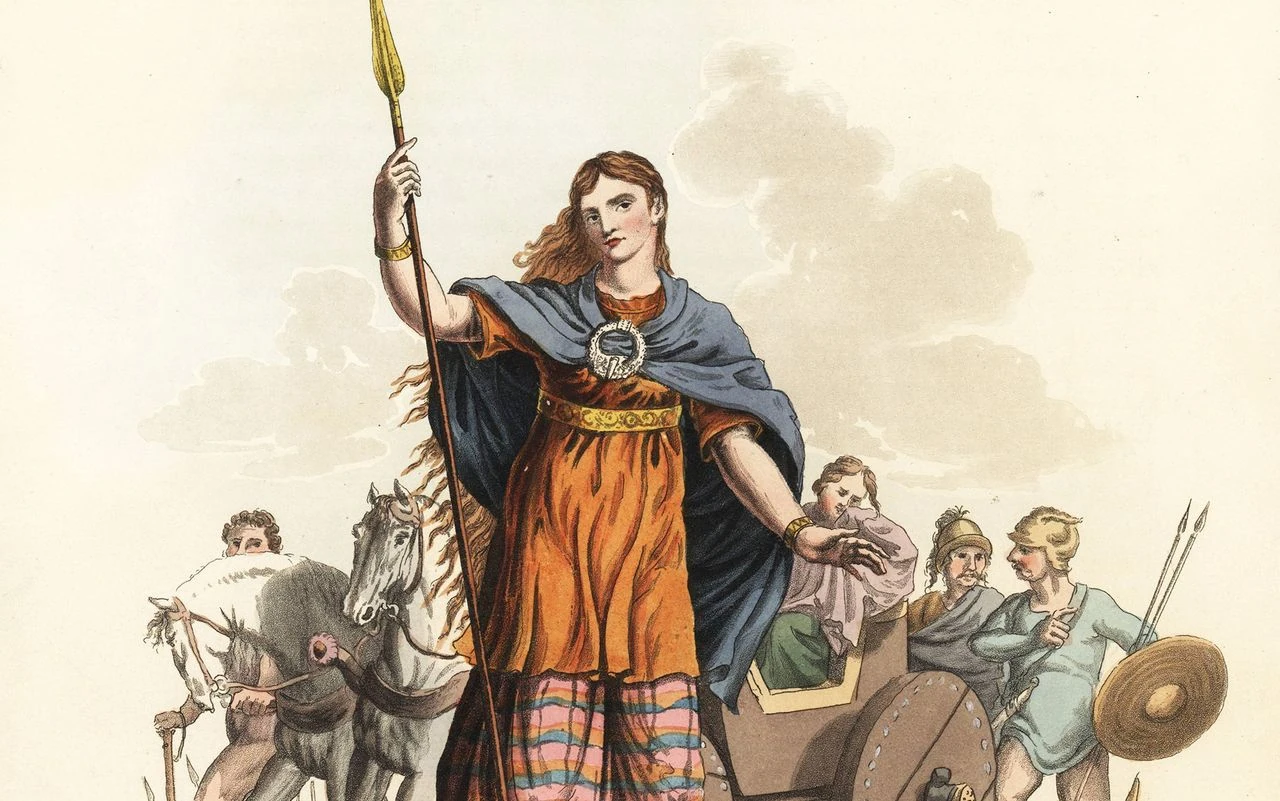
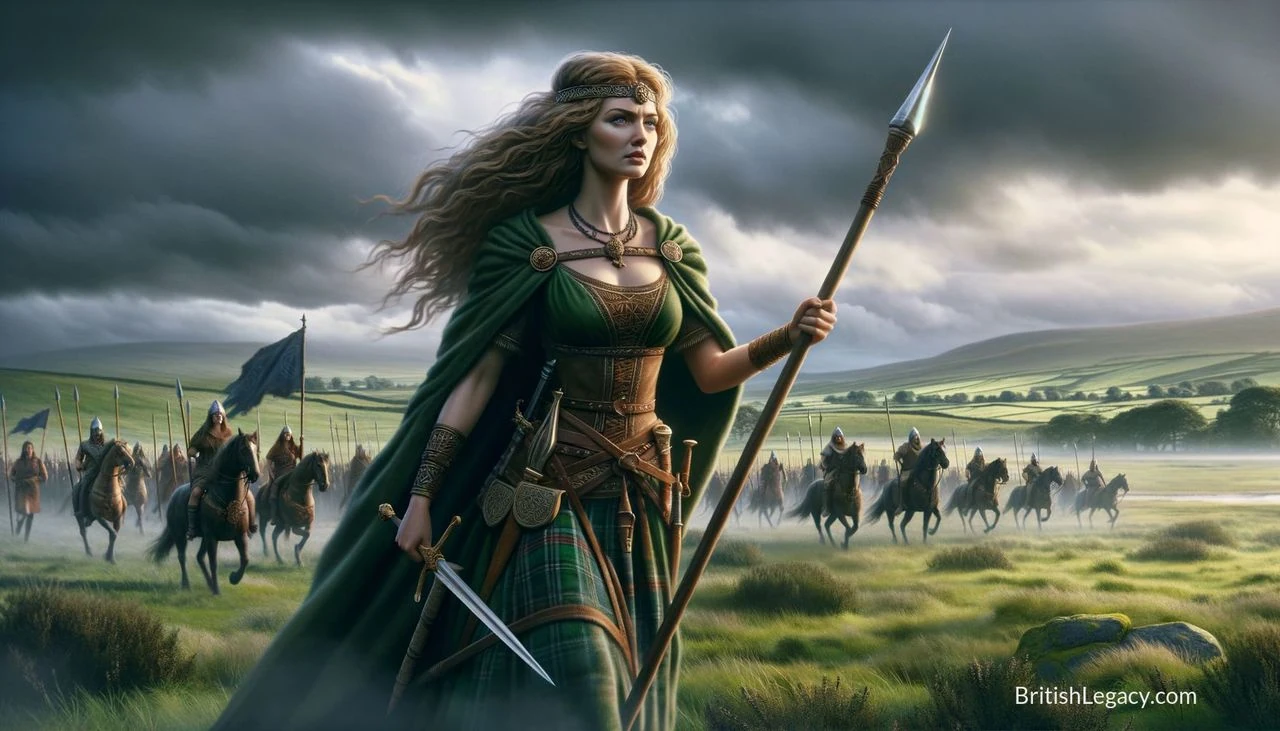
The surviving histories of the revolt were written well after it happened. Tacitus wrote in the late first or early second century; Cassius Dio wrote in the early third century, and his account survives through a later epitome. Both historians attribute speeches to Boudica, but these were composed as part of their narratives. No contemporary description of her survives. Dio’s later portrait of a tall, fierce-looking queen with tawny hair and a golden necklace is therefore an account written long after her lifetime, not an eyewitness record.
Her name also travelled through copying and translation. The form Boudica is associated with a Celtic word for victory; Boudicca, Boadicea and other spellings emerged over time. The familiar form Boadicea gained ground through a chain of textual errors and became especially prominent in later British writing. In the Renaissance, the renewed availability of Tacitus and Dio brought the revolt into histories, poems and plays. John Fletcher’s play Bonduca, published in 1612, and Henry Purcell’s musical version, Bonduca, or the British Heroine, of 1695 helped carry the story into the theatre. The chorus “Britons, Strike Home!” became a popular patriotic song.
In the eighteenth and nineteenth centuries, writers and artists repeatedly reshaped Boudica for their own times. William Cowper’s 1782 poem presented the revolt as a story of British resistance, while Alfred, Lord Tennyson’s later poem linked the warrior queen to the growth of the British Empire. Victorian depictions made her a national heroine, although they were not straightforward reconstructions of the ancient past.
The statue of Boudica and her daughters in a chariot beside Westminster Bridge became one of the most visible expressions of that tradition. Thomas Thornycroft began the sculpture in the nineteenth century; it was cast in 1896 and placed on the Victoria Embankment in 1902. The family’s papers indicate that other Thornycroft artists, including Mary, Hamo, Alyce, Helen and Theresa, also took part in its production. The monument’s familiar warrior image is itself a later artistic creation, not a contemporary likeness.
A symbol claimed by campaigners
Boudica’s reputation was not confined to imperial patriotism. Suffragettes and suffragists adopted her as a symbol in their campaign for women’s votes, making the statue a meeting point for demonstrations. In March 1906, a small delegation of Women’s Social and Political Union members gathered there; a larger demonstration followed in May. Boudica also appeared in campaign imagery and on suffrage brooches. The figure of a woman leading resistance could be repurposed to support a political demand far removed from the conflicts of Roman Britain.
Her modern presence is visible elsewhere, too. Colchester has a statue of Boudica on its town hall and a stained-glass depiction in the council chamber. Museums in London, Colchester and St Albans interpret the revolt, while Boudica’s Way is a long-distance path through Norfolk. A monument to her was also installed at Cardiff City Hall in 1916, although the choice attracted little support in a public vote. Such memorials show that her meaning has never been entirely fixed: she has been claimed as a national heroine, a figure of local history and a symbol of women’s resistance.
Why Boudica deserves a place in British Legacy
Boudica’s place in British Legacy rests first on the historical significance of the revolt she led. In AD 60 or 61, forces under her leadership destroyed Camulodunum, Londinium and Verulamium and inflicted a major crisis on Roman rule in Britain. The uprising was defeated, but it demonstrates that Roman control was contested and that local communities could unite in armed resistance. The surviving accounts also require careful reading: Tacitus and Dio differ over the causes, and their speeches and descriptions cannot be treated as direct records. That tension between an important event and the limits of the evidence is part of her story, not a reason to flatten it into a legend.
Her afterlife is equally consequential. Renaissance writers, poets and composers made the revolt part of British cultural memory; Victorian artists turned Boudica into a national emblem; and suffrage campaigners later used her image to support women’s political rights. The statue beside Westminster Bridge, the suffrage demonstrations around it and memorials in places including Colchester and Cardiff show how historical figures acquire new meanings in public life. Boudica’s legacy therefore connects ancient Britain to later debates about power, identity and political participation. Remembering her in British Legacy means recognising both the resistance attributed to the Iceni queen and the changing purposes for which generations have told her story.
Sources
Boudica — Wikipedia revision 1379755278
Adapted in part from Boudica by Wikipedia contributors, under CC BY-SA 4.0. Text has been edited and combined with the existing article; this adapted text is shared under the same licence. Contributor history.