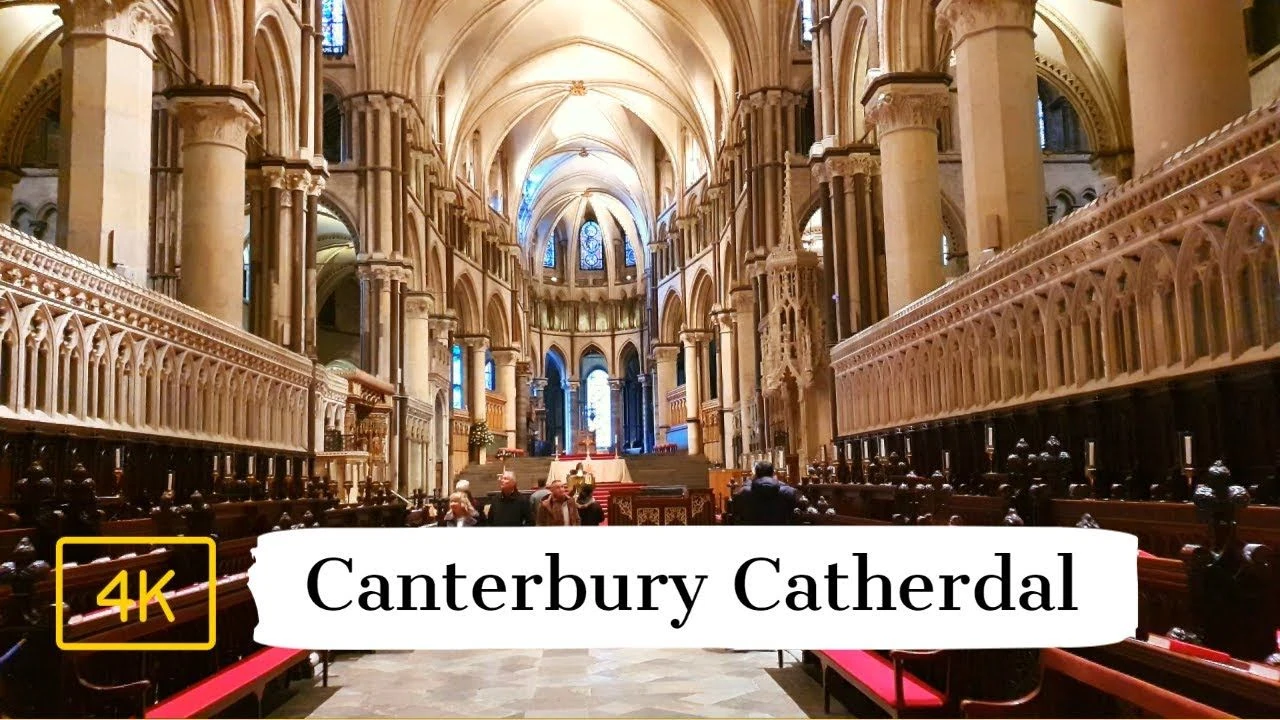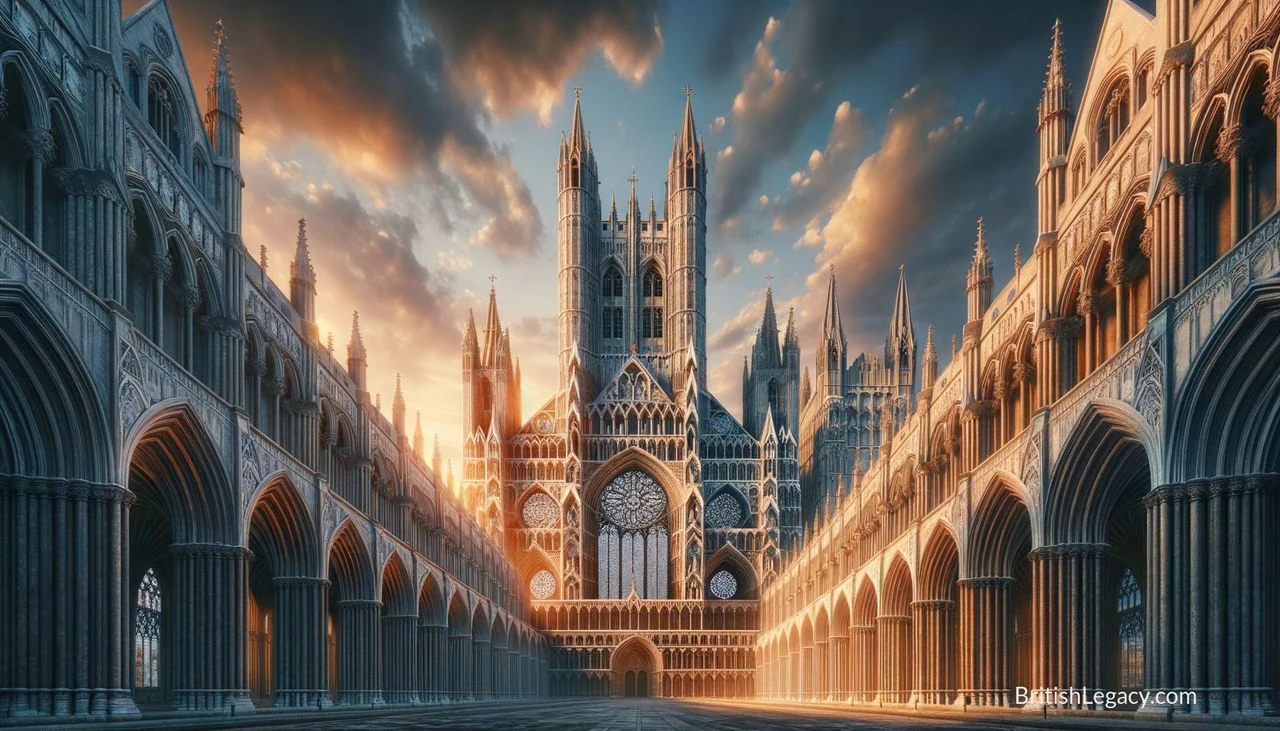
Canterbury Cathedral is at once a place of worship, the seat of the Archbishop of Canterbury and a record of changing English religious life. Founded in 597, it was rebuilt after the Norman Conquest and reshaped by fire, pilgrimage, the Reformation and centuries of repair. Its architecture is not the product of one moment: Romanesque and Gothic work sit within a building whose history includes monastic life, royal power and the continuing responsibilities of conservation.
A foundation and a Norman rebuilding
In 596, Pope Gregory I sent Augustine, abbot of a monastery in Rome, to lead a mission to convert the Anglo-Saxons. The following year, Augustine founded a cathedral at Canterbury and dedicated it to Jesus Christ. He became the first Archbishop of Canterbury. A monastery outside the city walls, later known as St Augustine’s Abbey, was also part of the early Christian community established there. The cathedral, the abbey and the ancient Church of St Martin now make up the Canterbury World Heritage Site.
The building visible today is not simply the original church preserved through time. After the cathedral was destroyed by fire in 1067, rebuilding began in 1070 under Lanfranc, the first Norman archbishop. The new church, modelled closely on the abbey at Caen where Lanfranc had previously served, was dedicated in 1077. Its Norman structure established the scale and form of a building that later generations would alter substantially.
Work on the eastern end expanded the cathedral again. In the early twelfth century, Priors Ernulf and Conrad replaced Lanfranc’s short east end with a much longer quire, raised above a large crypt. That work was itself transformed after another fire, in 1174, severely damaged the quire. The crypt survived, but the reconstruction above it introduced Gothic forms, including pointed arches, rib vaulting and flying buttresses. The rebuilding extended eastwards, making room for the stream of pilgrims drawn to Thomas Becket’s shrine.
Becket, the shrine and the pilgrims
Thomas Becket was murdered in the cathedral’s north-west transept on 29 December 1170 by four knights of Henry II. The archbishop’s conflict with the king preceded the killing, but the enduring consequence for the cathedral was the growth of Becket’s cult and the pilgrimage it attracted. His remains were moved in 1220 to a shrine in the Trinity Chapel, an eastern extension built to accommodate devotion to the martyr.
Pilgrims’ visits brought income as well as people. Revenues associated with the shrine helped fund the cathedral’s later rebuilding, while the shrine itself became a destination known well beyond Canterbury. Geoffrey Chaucer made the journey to Becket’s shrine the framing premise of The Canterbury Tales, giving the pilgrimage a lasting place in English literature. The shrine was destroyed in 1538 during the Reformation, on the orders of Henry VIII, and its treasures were confiscated.
The cathedral’s past as a pilgrimage centre also helps explain why its architecture changed. The rebuilding after 1174 provided a larger eastern setting for the shrine and the crowds it drew. Later medieval work brought further change: from the late fourteenth century, the nave and transepts were rebuilt in the Perpendicular style under the direction of master mason Henry Yevele. The central crossing tower, known as Bell Harry, was begun in 1433.
Change, damage and repair
Canterbury’s history includes both religious change and physical damage. Before the English Reformation, the cathedral belonged to the Benedictine community of Christ Church Priory as well as serving as the archbishop’s seat. The monastery was surrendered to the Crown in 1539 and the cathedral returned to the status of a college of secular canons. In 1642–43, Puritan iconoclasts damaged parts of the building, including the statue of Christ at the west gate. Repairs began after the gates were restored in 1660 and continued into the early eighteenth century.
Later alterations continued to shape the cathedral’s outline. The north-west tower was demolished in 1834 because of structural concerns and replaced with a Perpendicular-style counterpart to the south-west tower. This was the last major structural alteration recorded in the article. During the Second World War, the library was destroyed in bombing raids, although the cathedral itself escaped extensive bomb damage; local fire wardens put out flames on the wooden roof.
Conservation remains part of the building’s story. Roofs and stained glass have required particular attention. A major restoration of the lead roof over a transept was completed in 2008, and the nave roof was replaced in 2018 as part of a wider programme that also addressed landscaping, accessibility, visitor facilities and exterior repair. A project to study and conserve eight twelfth-century windows in the Trinity Chapel began in 2018. Such work connects the visible fabric of the cathedral with the skilled labour needed to keep it in use.
The cathedral is Grade I listed. The cathedral, St Augustine’s Abbey and St Martin’s Church were designated together as a UNESCO World Heritage Site in 1988. That recognition reflects not only the cathedral’s architecture but the linked history of the three places in the development of Christianity in England.
A church with an international reach
Canterbury Cathedral is the cathedral of the Archbishop of Canterbury, who leads the Church of England and is the symbolic leader of the worldwide Anglican Communion. The Communion is a global fellowship of churches that developed from the Church of England. Canterbury’s place within it gives the cathedral an international religious significance, while its location in Kent and its long institutional history root that role in England.
The cathedral is also a working church rather than only a historic monument. Its daily worship continues within a building whose functions have changed repeatedly. Its music has a long history: polyphonic works written for the monks survive from the thirteenth century, and records name organists from the early fifteenth. The cathedral choir includes boys and girls as well as lay clerks and choral scholars. Its present organ, restored and enlarged in work completed in 2020, is another example of an old institution maintaining active musical practice.
Use of the building extends beyond services. The cathedral is the regimental church of the Princess of Wales’s Royal Regiment and serves as a graduation venue for the University of Kent and Canterbury Christ Church University. These roles sit alongside the work of worship, conservation and welcoming visitors, making the cathedral part of the life of the city as well as a destination for people from elsewhere.
Why Canterbury Cathedral deserves a place in British Legacy
Canterbury Cathedral deserves a place in British Legacy because its story makes the history of religious and civic life tangible. Augustine’s foundation in 597 connects it with the early mission to the Anglo-Saxons; the Norman rebuilding records the transformation of the church after the Conquest; and the Gothic quire, built after the fire of 1174, shows how Becket’s murder and the pilgrimage that followed altered both the building and its finances. These are not separate episodes gathered around a static monument. They are connected changes that can still be read in the cathedral’s fabric and setting.
Its significance also reaches beyond its walls. Chaucer’s treatment of the pilgrimage to Becket’s shrine made Canterbury a lasting reference point in English literature. As the seat of the Archbishop of Canterbury and a symbolic centre for the worldwide Anglican Communion, the cathedral links an English city to a global religious community. At the same time, its continuing worship, music, university ceremonies and conservation work show how historic buildings can remain active institutions. The joint World Heritage designation of the cathedral, St Augustine’s Abbey and St Martin’s Church recognises a shared landscape of religious history. Canterbury’s British legacy lies in this combination: a place whose architecture preserves successive chapters of English history, and whose present use keeps those chapters connected to living communities.
Sources
Canterbury Cathedral — revision 1377006772 · Canterbury Cathedral
Adapted in part from Canterbury Cathedral by Wikipedia contributors, under CC BY-SA 4.0. Text has been edited and combined with the existing article; this adapted text is shared under the same licence. Contributor history.