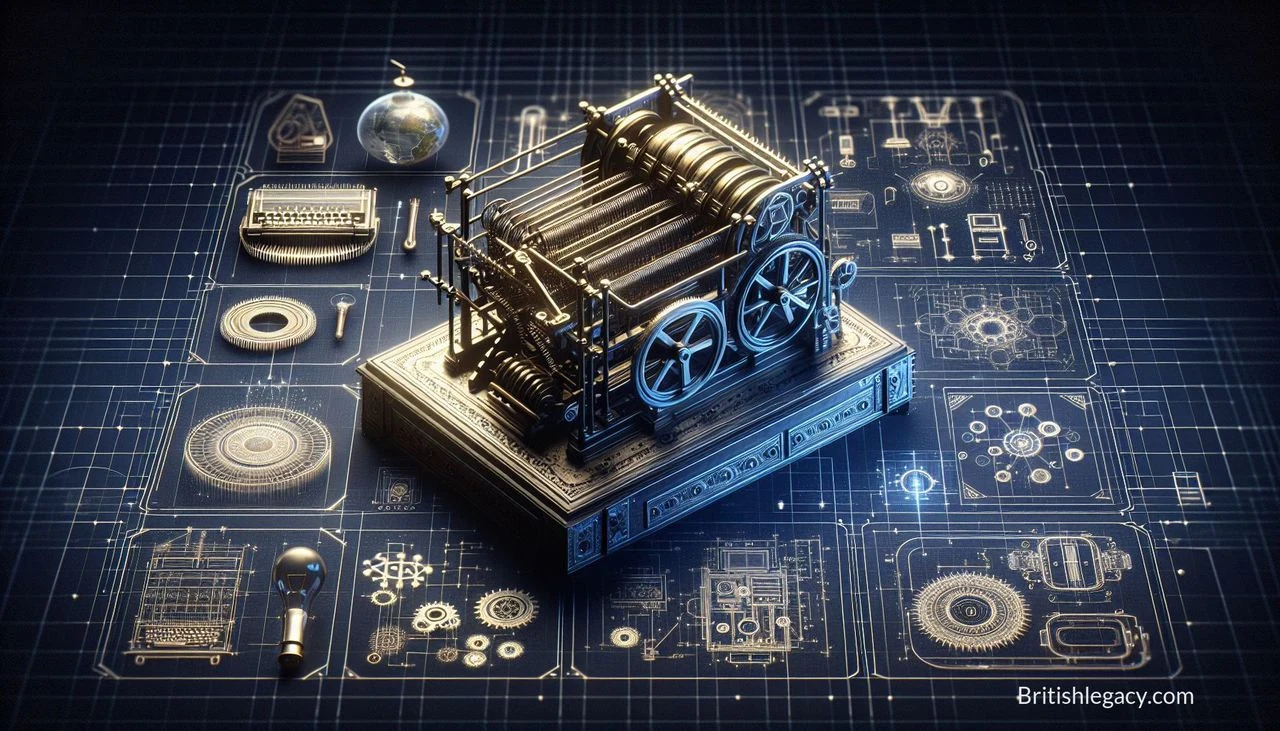
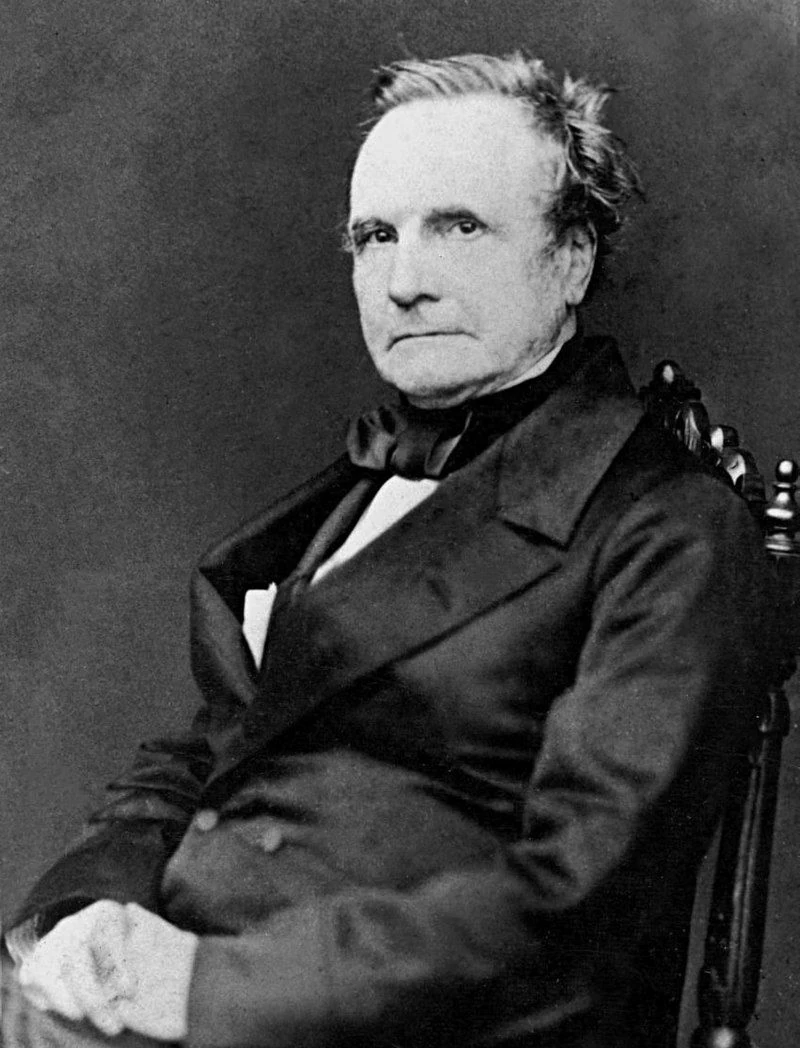
Charles Babbage’s engines began with a problem that was both technical and practical: the printed mathematical tables used by navigators, astronomers and engineers contained errors. Tables calculated and copied by hand could be wrong at either stage. Babbage wanted machinery to carry out calculations and, through printing, reduce the risk of mistakes in transcription. His Difference Engine was designed for a particular class of calculations; his later Analytical Engine proposed something more ambitious, a machine directed by instructions and able to perform different procedures. Neither great project was completed in his lifetime, but together they made Babbage a defining figure in the early history of computing.
Cambridge and the case for better methods
Babbage was born in London on 26 December 1791. He arrived at Trinity College, Cambridge, in 1810, already having taught himself parts of contemporary mathematics. He found the teaching unsatisfactory and, with John Herschel, George Peacock and other friends, formed the Analytical Society in 1812. The group promoted modern mathematical analysis and notation associated with continental work, including the calculus of Leibniz. This reforming campaign was an early expression of a conviction that better methods and standards could make difficult work more reliable.
In 1812 Babbage transferred to Peterhouse, where he was regarded as a leading mathematician. He received his degree in 1814. His academic career did not proceed smoothly: he applied unsuccessfully for several posts before becoming Lucasian Professor of Mathematics at Cambridge in 1828. He held the professorship until 1839, but did not give the lectures expected of him. His proposals for university reform also met resistance. Babbage could be forceful in pursuing change, but he was not always effective at winning over the institutions and colleagues whose support he needed.
He was elected a Fellow of the Royal Society in 1816 and became active in the expanding network of British scientific organisations. In 1820 he was instrumental in founding the Astronomical Society of London, later the Royal Astronomical Society. Its interest in standardising astronomical calculations and circulating data aligned closely with his own concern for dependable results. The Society awarded him its first Gold Medal in 1824 for his calculating engine.
The Difference Engine: making tables by machine
The Difference Engine was Babbage’s response to the hazards of producing mathematical tables by hand. Proposed in 1822, it was intended to calculate values of polynomial functions using finite differences. The method turns the calculation of a sequence of values into repeated addition, which was more straightforward to mechanise than multiplication or division. Babbage also envisaged a printing apparatus, so that the calculated results could be recorded without being copied by hand.
The plan attracted funding from the British government. Babbage worked with engineer Joseph Clement on the construction, which demanded a high degree of precision across a large mechanism. The working relationship broke down amid disputes over costs, workmanship and responsibility. The full Difference Engine No. 1 was never finished, but the project was not merely theoretical: a small experimental engine was completed in 1822, and a working portion of the larger machine had been assembled by 1832.
The Engine was specialised, not a general-purpose computer. Its importance was that it was intended to embody a mathematical procedure in machinery and carry it out automatically. That would change who—or what—performed calculation, and how the resulting figures could be made consistent. The project also exposed the practical conditions that could determine whether an ambitious design reached completion: precision engineering, sustained funding and a stable working relationship between its designer and contractor. Babbage’s difficulties were not proof that mechanical calculation was impossible; they were part of the challenge of making it real in the Britain of his time.
The Analytical Engine and the idea of instructions
After work on the Difference Engine stalled, Babbage turned to a more general design. The Analytical Engine was not one completed machine but a succession of plans that he continued to develop. It was to use punched cards, drawing on the principle of the Jacquard loom, to direct its operations. A “store” would hold numbers; a “mill” would process them; and printing was among the intended ways of producing an output.
The crucial advance was not simply a larger range of calculations. Babbage’s design envisaged a machine controlled by instructions, with operations arranged in sequence and the ability to repeat steps or branch according to a result. In plain terms, it could be directed to follow different routes rather than carry out one fixed task. That conception moves beyond a specialised calculator towards programmable computing. Although the machine was never built, the division between storing numbers and processing them, and the use of instructions to control operations, remain central to understanding its significance.
Babbage presented the Analytical Engine at lectures in Turin in 1840. Ada Lovelace’s work helped make its possibilities clearer to readers. In 1843 she translated Luigi Menabrea’s account of Babbage’s lectures and added extensive notes, including a worked method for calculating Bernoulli numbers. She discussed how the Engine might manipulate symbols according to rules, rather than being confined to arithmetic alone. The exact division of credit for particular programming ideas has been debated; what is clear from the supplied account is that Lovelace’s notes became an important contemporary explanation of the proposed machine.
Statistics, manufacturing and public science
Babbage’s interest in reliable calculation belonged to a wider effort to organise scientific knowledge. The Astronomical Society of London sought to improve the form and circulation of astronomical data. In 1834 Babbage was among the founders of the Statistical Society of London, serving as a public advocate for statistical inquiry. These efforts linked measurement and calculation with the collection of information: a society could make better use of evidence when its figures were gathered and handled systematically.
He also studied industry. In 1832 he published On the Economy of Machinery and Manufactures, a book informed by observations of factories and manufacturing practice. It examined machinery, the organisation of production and the division of labour. Babbage argued that work could be assigned according to the skills required for each task, rather than having highly trained workers perform every operation. Later writers called this the “Babbage principle”. It has a clear economic logic, though it also reflects an approach to labour focused on organising tasks and costs. The book shows that his interest in machinery extended from inventing mechanisms to analysing the systems in which people and machines worked.
His other concerns included standards and measurement, postal reform and railway engineering. In 1838 he devised a locomotive pilot, the frame fitted to the front of a locomotive to clear obstacles from the track, and he also constructed a dynamometer car. Babbage took a serious interest in cryptography, too. The supplied account records his work on forms of the Vigenère cipher, some of which remained unpublished for many years. These pursuits did not all have the same practical outcome, but they reveal a mind drawn to problems where careful method might improve how information or machinery was handled.
Babbage’s public life could be combative. His Reflections on the Decline of Science in England (1830) attacked the direction of British science and the management of its institutions. The book did not achieve the Royal Society reform he sought, but it helped prompt debate about the organisation of science. He hosted well-attended Saturday evening gatherings in London, bringing together scientists, writers and other public figures. He combined scientific sociability with campaigning, criticism and a readiness to challenge established practice—a combination that could attract attention as readily as opposition.
What the later reconstruction established
Babbage died in Marylebone, London, on 18 October 1871, aged 79. Neither the Difference Engine nor the Analytical Engine had been completed. The gap between his designs and finished machines left open a question about whether the engineering was achievable in practice. In 1991 the Science Museum constructed a functioning Difference Engine No. 2 using Babbage’s drawings and manufacturing tolerances that could have been achieved in the nineteenth century. Its successful operation demonstrated that the design was mechanically workable.
That reconstruction was a test of the Difference Engine No. 2, not proof that Babbage had built a modern computer in every sense, or that the Analytical Engine had been completed. His machines were mechanical and belonged to a different technological world. Their importance lies in the problems they addressed and in the possibilities their designs set out: automatic calculation, reliable output, stored numbers and operations directed by instructions. Modern computing did not emerge gear by gear from Babbage’s workshop, but his work gave a concrete form to ideas that later became fundamental to programmable machines.
Why Charles Babbage deserves a place in British Legacy
Charles Babbage deserves a place in British Legacy because he brought mathematical thought into contact with practical demands in British science and industry. Printed tables supported navigation, astronomy and engineering; their errors were not abstract defects but weaknesses in tools on which people relied. Babbage designed the Difference Engine to automate a defined class of calculations and sought to connect it to printing. He then pursued a broader possibility in the Analytical Engine: a machine that could store numbers, follow instructions and alter its sequence of operations. The first project was only partly built in his lifetime, while the second remained a design. The Science Museum’s working reconstruction of Difference Engine No. 2 in 1991 nevertheless showed that one of his central mechanical designs could be made to work.
His contribution to Britain’s history of knowledge also reaches beyond computing. Babbage helped establish scientific and statistical societies concerned with reliable calculation and the circulation of information. His writing on manufacturing examined how machinery, skills and labour were organised during an industrial age. These were connected interests: accurate figures, organised inquiry and efficient production all depended on making systems work more consistently. The limits of his career matter too. Funding, engineering difficulties and disputes prevented the completion of his most ambitious machines, and his confrontational methods sometimes made collaboration harder. Remembering those realities avoids turning him into a simple prophet of modern electronics. Babbage’s British legacy is more specific and more substantial: he designed workable mechanisms, articulated an early architecture for programmable computing and took part in the institutions and arguments through which nineteenth-century Britain organised science and industry.
Sources
Charles Babbage — Wikipedia revision 1371979131
Adapted in part from Charles Babbage by Wikipedia contributors, under CC BY-SA 4.0. Text has been edited and combined with the existing article; this adapted text is shared under the same licence. Contributor history.