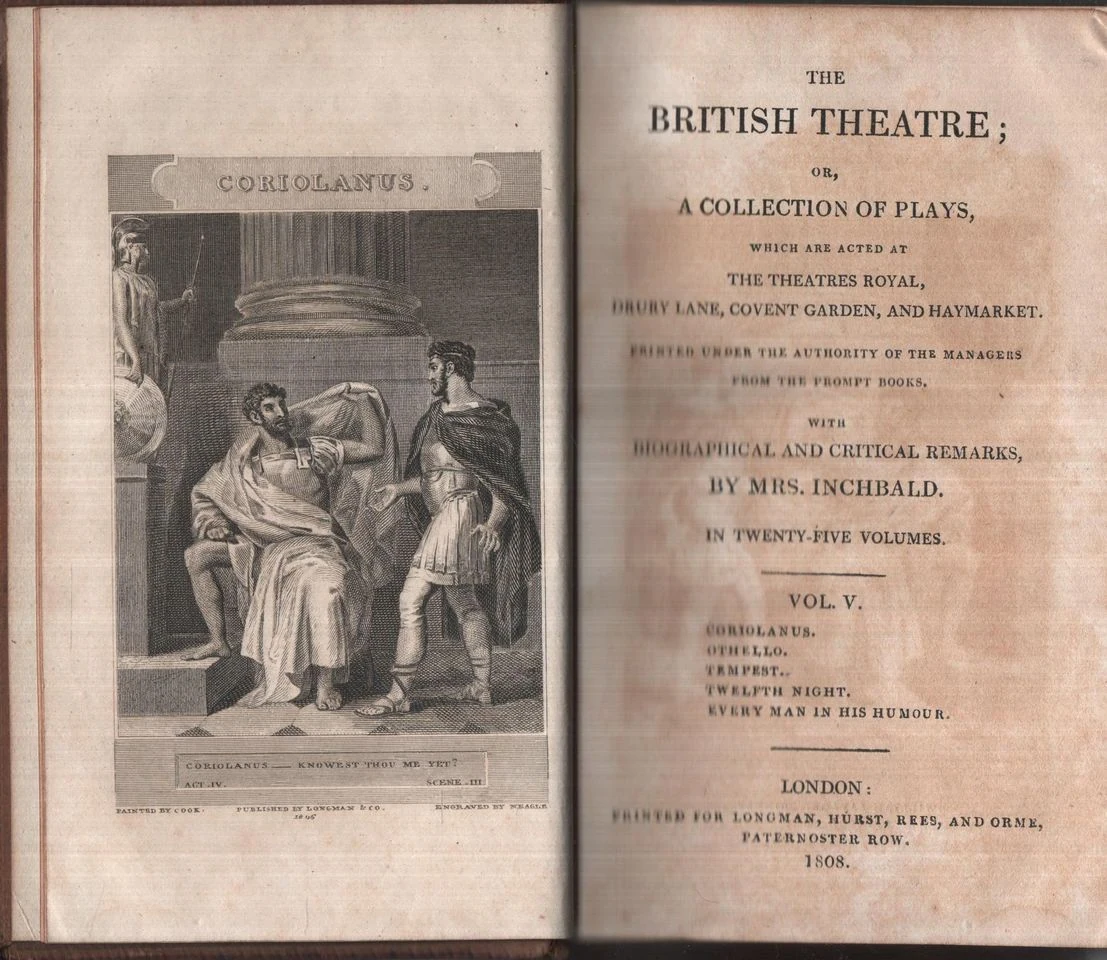
In Coriolanus, military success cannot protect a Roman general from the political consequences of his contempt for the people he serves. Shakespeare follows Caius Marcius from the siege of Corioli to a campaign against Rome itself, tracing how pride and loyalty collide when a celebrated soldier is asked to become a public leader. The tragedy is set in ancient Rome, but its conflict is concentrated in recognisable questions: who deserves political authority, how public opinion is shaped, and what a person owes to a community after it has rejected him.
A soldier asked to enter public life
The play opens amid unrest over a shortage of grain. The citizens’ anger is directed at Marcius, a formidable general who makes no effort to conceal his low opinion of them. His sense of worth is grounded in service on the battlefield and the esteem of fellow soldiers and patricians, not in winning popular approval. That disposition gives the play its central political tension: the qualities that make Marcius a celebrated warrior do not equip him to persuade the people whose support public office requires.
In the war against the Volscians, Marcius distinguishes himself at Corioli. He fights his way into the besieged city, and his military achievement earns him the name Coriolanus. His success brings the prospect of high office, encouraged by his mother, Volumnia. She wants him to pursue political power; he is reluctant, but agrees. To become consul, however, he must present his achievements to the citizens and seek their consent. The request exposes the gap between his belief that deeds should speak for themselves and the political necessity of addressing an audience.
Two tribunes, Brutus and Sicinius, oppose his advancement and help turn public feeling against him. When Coriolanus speaks with open hostility about popular rule and the citizens, his enemies can present that contempt as evidence against his fitness to govern. He is banished. His response is to declare that he will banish Rome from his presence, a defiant reversal that cannot undo the rupture between the city and its former defender.
Exile, revenge and a mother’s appeal
After his expulsion, Coriolanus goes to Antium, the Volscian capital, and seeks out Tullus Aufidius, the enemy commander he has fought repeatedly. The two men’s relationship is shaped by rivalry, but Aufidius receives him and allows him to join a new assault on Rome. Coriolanus now leads the force threatening the city that cast him out. His military ability remains formidable; what has changed is the cause for which he uses it.
Rome tries to stop the attack through negotiation. General Titus and then the senator Menenius fail to persuade Coriolanus to relent. Volumnia then comes with Coriolanus’s wife Virgilia and their son. Her appeal succeeds where the men’s missions have failed: Coriolanus agrees to spare Rome and makes peace between the Romans and the Volscians. His decision protects the city but turns his Volscian allies against him. Aufidius and his men accuse him of betrayal and kill him.
The conclusion does not offer a simple choice between loyalty and treachery. Coriolanus has been banished by Rome, accepted by its enemy and finally moved by his family to save the city he set out to destroy. Each allegiance has a claim on him, and his attempt to honour one is treated as betrayal by another. Volumnia’s influence, present earlier in her encouragement of his political ambitions, becomes decisive in the appeal that stops his campaign. The tragedy places private relationships inside public conflict rather than allowing them to remain separate.
Plutarch, pride and the politics of performance
Shakespeare drew on Plutarch’s Lives of the Noble Grecians and Romans for the play’s historical narrative. The ancient Roman setting lets him examine military honour and the struggle for political authority through a figure who understands reputation chiefly as something earned by action. Yet in the contest for office, reputation must also be spoken, displayed and judged. Coriolanus’s reluctance to perform humility before the citizens is not a minor social failing: it makes the difference between battlefield acclaim and political consent.
The play’s conflict is not only between one proud man and a crowd. The tribunes use public discontent to obstruct Coriolanus, while he treats the citizens’ participation in government as a threat to the authority he believes he deserves. The result is a drama in which public opinion can be manipulated, but cannot simply be dismissed. Coriolanus’s contempt helps his opponents; his military record cannot settle the argument about how Rome should be governed.
Composition is generally placed around 1608, and the play belongs to Shakespeare’s early-seventeenth-century work. Its continuing theatrical life also shows how a drama rooted in a Roman story can be reinterpreted for different audiences. A notable London production at the Donmar Warehouse in 2013–14 starred Tom Hiddleston. The play’s staging and running time can vary by production, so no single duration defines the experience. What remains central is the confrontation between a soldier’s idea of honour and the demands of public life.
From the stage to Ralph Fiennes’s film
Ralph Fiennes brought the tragedy to the screen in Coriolanus, a 2011 film adaptation in which he directed and played the title character. John Logan adapted Shakespeare’s text, retaining its language while placing the action in a contemporary, pseudo-Balkan setting. The film was shot in Serbia, Montenegro and the United Kingdom, using the region’s landscapes to evoke a country at war. Its 123-minute running time turns the play into a compact screen drama, while its modern setting makes the political and military conflict visible in terms of contemporary warfare.
Fiennes’s cast included Gerard Butler as Aufidius, Vanessa Redgrave as Volumnia, Brian Cox as Menenius and Jessica Chastain as Virgilia. Barry Ackroyd was the cinematographer; Ilan Eshkeri composed the music. The film premiered in competition at the 61st Berlin International Film Festival in February 2011, where it was nominated for the Golden Bear. Its full UK cinema release followed on 20 January 2012. Fiennes was later nominated for the BAFTA Award for Outstanding Debut by a British Writer, Director or Producer.
The film’s reworking preserves the basic movement of the tragedy: a general becomes a political danger, is expelled, joins the enemy and finally spares his former city. It also makes the work’s civic conflict immediate by relocating it to a recognisably modern landscape. This is one route by which Coriolanus has travelled beyond the stage: the story can be reframed without losing its central question about the price of pride when private conviction meets public power.
Why Coriolanus deserves a place in British Legacy
Coriolanus deserves a place in British Legacy as a work of Shakespearean drama that turns a Roman story into a sustained examination of political authority, public consent and personal loyalty. Its British connection is specific: it is part of the theatrical writing of William Shakespeare, and its continuing performance and adaptation demonstrate the reach of that work. The tragedy does not offer a comfortable lesson in which military achievement automatically makes a leader fit to govern. Coriolanus’s courage at Corioli earns him a name, but his contempt for citizens undermines his attempt to gain office. The play makes the distinction between service and authority part of its action.
Its legacy also lies in the way the story can be made present without being stripped of its original tensions. The Donmar Warehouse production brought the play to a London stage with Tom Hiddleston in the lead; Ralph Fiennes’s film carried Shakespeare’s language into a modern Balkan setting and reached cinemas in the United Kingdom. Those examples show a British dramatic text being sustained through performance and adaptation, rather than preserved only as a literary artefact. For audiences, the work offers a vivid study of how political systems depend on persuasion as well as force, and how loyalty can change when a community rejects one of its defenders. That combination of theatrical endurance and continuing civic relevance makes Coriolanus a meaningful part of Britain’s dramatic inheritance.
Sources
Coriolanus (film), revision 1378630638 · Coriolanus (film)
Adapted in part from Coriolanus (film) by Wikipedia contributors, under CC BY-SA 4.0. Text has been edited and combined with the existing article; this adapted text is shared under the same licence. Contributor history.