
Emmeline Pankhurst’s political career moved from local reform in Manchester to a national campaign that brought the demand for women’s votes into direct confrontation with Parliament. In 1903 she founded the Women’s Social and Political Union (WSPU), whose motto, “Deeds, not words”, expressed its preference for direct action over further promises. The organisation’s militancy made it prominent and controversial; Pankhurst’s own politics changed over time, and historians have disagreed about whether its tactics advanced or hindered the cause. The votes women first gained in 1918 were limited. Equal voting terms with men came in 1928, shortly after her death.
A political education in Manchester
Born Emmeline Goulden in Moss Side, Manchester, on 15 July 1858, she grew up in a politically active family. Her father, Robert Goulden, was involved in local politics; her mother, Sophia, read and followed arguments about women’s suffrage. Emmeline later remembered being taken to a public meeting on women’s voting rights at 14. She also attended school in Paris, where her studies included chemistry and bookkeeping as well as embroidery.
In 1879 she married Richard Pankhurst, a barrister who had advocated women’s suffrage and other reforms. They had five children. Their home became a meeting place for activists and political visitors, while Emmeline combined family responsibilities with organising. She helped establish the Women’s Franchise League in 1889, which sought votes for married as well as unmarried women and linked suffrage with other questions of women’s rights. The league also supported trade unionism and alliances with socialist organisations, but it lasted only about a year.
After the family returned to Manchester, Pankhurst worked with political groups including the Independent Labour Party (ILP). In 1894 she became a Poor Law Guardian in Chorlton-on-Medlock, a role that brought her into contact with the conditions of people in the workhouse. She also served on the Manchester School Board. These local responsibilities connected her demand for political rights to the effects of poverty and unequal treatment in people’s daily lives. After Richard died in 1898, she had to support the family while continuing her public work.
Building the WSPU
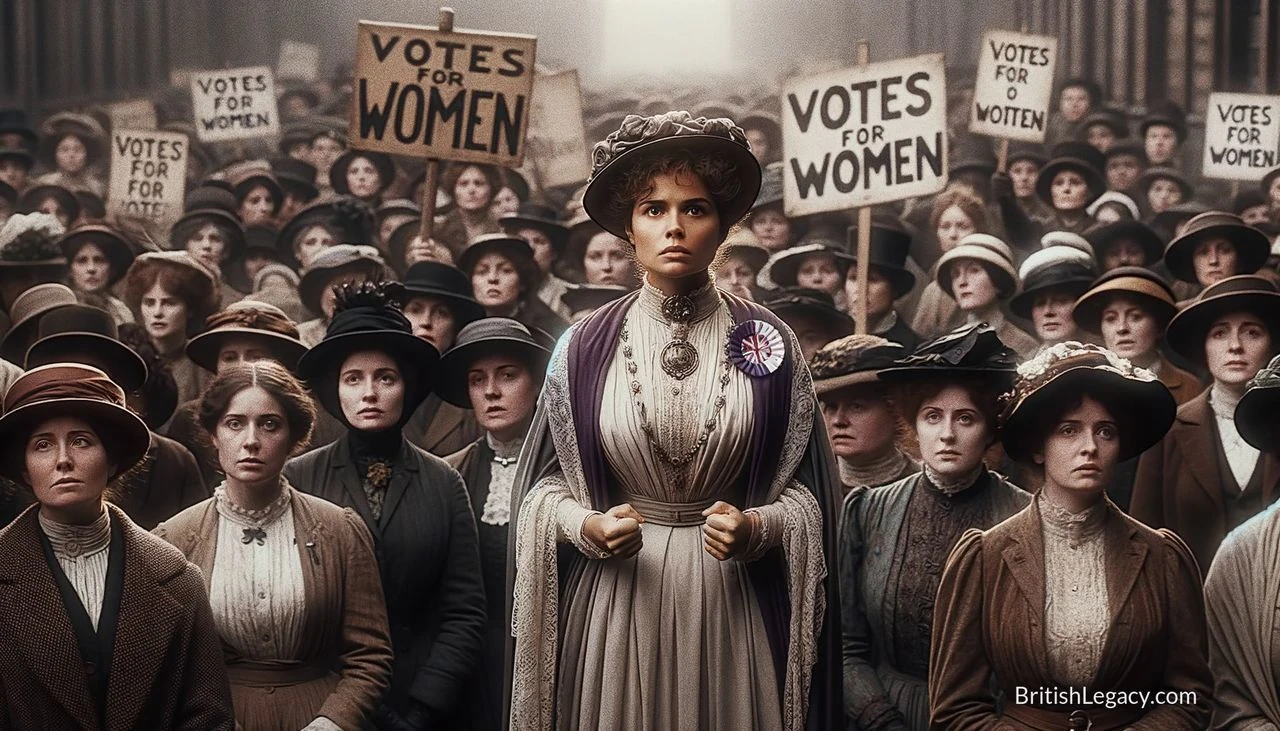
Pankhurst came to believe that years of speeches and unsuccessful parliamentary bills had not secured progress. She broke with the ILP when it would not make women’s suffrage its priority. On 10 October 1903, she and several colleagues established the WSPU, an organisation open only to women and committed to winning the vote through direct action. Early activity included public meetings, demonstrations, petitions and a newsletter, Votes for Women. Pankhurst’s choice to keep the union independent of political parties was central to its strategy: the WSPU opposed parties that failed to act on suffrage, even when individual members supported it.
The organisation’s confrontations with the authorities intensified. Pankhurst was arrested repeatedly, including after trying to deliver a protest to Prime Minister H. H. Asquith in 1908. Imprisonment became part of the campaign: women in prison staged hunger strikes, and prison authorities force-fed some of them. In 1913, the government passed the Prisoners (Temporary Discharge for Ill Health) Act, commonly called the Cat and Mouse Act. It allowed authorities to release hunger-striking prisoners weakened by illness and re-arrest them after their health recovered.
WSPU tactics did not remain non-violent. Some members broke windows and later adopted arson and other forms of property destruction. Pankhurst supported a turn towards more militant action, but the organisation’s approach also produced disagreement and departures. More moderate suffrage campaigners criticised the damage to property and refused to join some actions. In 1913, Pankhurst’s daughters Adela and Sylvia also broke with the WSPU: Adela opposed property destruction and left for Australia, while Sylvia’s socialist organising brought her into conflict with the organisation’s leadership. The disagreements show that the suffrage movement was not a single unified campaign.
War, votes and a changing political course
When the First World War began in 1914, Emmeline and her daughter Christabel backed the British government’s war effort and suspended the WSPU’s militant suffrage activity. Pankhurst organised and spoke at events encouraging women to enter work as men served overseas. Her position was sharply contested: Sylvia and Adela opposed the war, and some WSPU members objected to the organisation’s new direction. Pankhurst’s wartime politics therefore widened existing divisions in both her family and the movement.
The Representation of the People Act 1918 gave the vote to women aged 30 and over who met specified property qualifications; it did not establish equal voting terms. The same year, Pankhurst and Christabel turned the WSPU into the Women’s Party, which advocated women’s equality in public life while remaining separate from the men’s party organisations. Its electoral hopes included Christabel’s unsuccessful candidacy at Smethwick in 1918. The party soon closed.
Pankhurst’s later political commitments differed markedly from her earlier work with the ILP. Increasingly concerned about Bolshevism, she joined the Conservative Party in 1926 and was selected as its candidate for Whitechapel and St George’s in 1927. She did not contest the election: ill health intervened. She died in Hampstead on 14 June 1928, aged 69. On 2 July, 18 days later, the Representation of the People (Equal Franchise) Act extended the vote to women on the same age terms as men, including women aged 21 and over.
Commemoration and contested memory
Pankhurst’s reputation has never depended on an uncontested account of her methods. Her daughters offered sharply different views of her political choices, and later historians have debated the effects of WSPU militancy. The organisation drew attention to women’s exclusion from political power, but property destruction and the leadership’s treatment of dissent attracted criticism, including from within the wider movement. Her public life also included advocacy for the British Empire and, in later years, support for eugenic ideas. Those positions belong in any account that recognises both her role in the suffrage campaign and the limits of her politics.
After her death, former WSPU colleagues raised funds for a memorial. A statue was unveiled in Victoria Tower Gardens, near Parliament, in 1930. Manchester’s Pankhurst Centre opened in 1987 as a museum and women’s gathering space. In 2018, a statue of Pankhurst by Hazel Reeves was unveiled in Manchester, and her name and image were included among those of women’s suffrage campaigners on the Millicent Fawcett statue in Parliament Square. These memorials place her within the cities and political institutions where the campaign’s history unfolded.
Why Emmeline Pankhurst deserves a place in British Legacy
Pankhurst’s place in British history rests on a specific achievement: she helped build an organisation that made women’s suffrage a sustained and conspicuous political demand. The WSPU gave that campaign a distinctive structure, public language and national presence. Its direct-action strategy challenged the assumption that women could be indefinitely put off with promises of future reform. The results cannot be reduced to the work of one leader or one organisation, and the effectiveness of militancy remains disputed. But the scale of public attention the WSPU attracted, and the persistence of its demand, form an important part of the history of how women’s political exclusion was challenged.
Her British legacy also includes the difficult questions her career leaves behind. Pankhurst’s advocacy of votes for women existed alongside a willingness to accept authoritarian leadership within the WSPU, support for wartime nationalism and later conservative politics. Remembering those tensions makes her story more useful, not less: it shows how political movements can broaden public debate while remaining divided over methods, priorities and the society they want to build. The 1918 Act gave some women the vote but retained age and property restrictions; equal voting terms followed in 1928, after her death. Pankhurst’s life belongs in British Legacy both for her central role in forcing that unfinished question into national politics and for the contested choices through which she pursued it.
Sources
Emmeline Pankhurst — revision 1378722742
Adapted in part from Emmeline Pankhurst by Wikipedia contributors, under CC BY-SA 4.0. Text has been edited and combined with the existing article; this adapted text is shared under the same licence. Contributor history.
.jpg)