
Vivienne Westwood helped turn the clothes sold in a King’s Road boutique into a language for punk: confrontational, handmade-looking and designed to unsettle. But her career did not stop at safety pins and torn T-shirts. She went on to build a fashion house whose collections reworked historical dress, brought British textiles to international attention and gave visible form to her arguments about politics and the environment.
From Hollingworth to the King’s Road
Vivienne Isabel Swire was born on 8 April 1941 in Hollingworth, Cheshire, and grew up in nearby Tintwistle. Her family moved to Harrow in 1958. She took a jewellery and silversmithing course at Harrow Art School, then left after one term. After working in a factory and studying at Trent Park Teacher Training College, she became a primary-school teacher. She also made jewellery, selling it from a stall on Portobello Road.
In 1962 she married Derek Westwood; their son, Benjamin, was born the following year. She met Malcolm McLaren after the marriage ended. Their son, Joseph Corré, was born in 1967. Westwood continued teaching until 1971, while making clothes that McLaren designed. The partnership joined two activities that would become closely associated with her early career: fashion and music.
In 1971, Westwood and McLaren opened Let It Rock at 430 King’s Road in Chelsea. The shop drew on the clothing, music and interiors of the post-war years, including the Teddy Boy style. It changed name and direction as the pair’s ideas developed: first to Too Fast To Live Too Young To Die, then Sex in 1974, and Seditionaries in 1976. Each incarnation offered a different visual vocabulary, and the boutique became a meeting place for the developing London punk scene.
Making punk visible
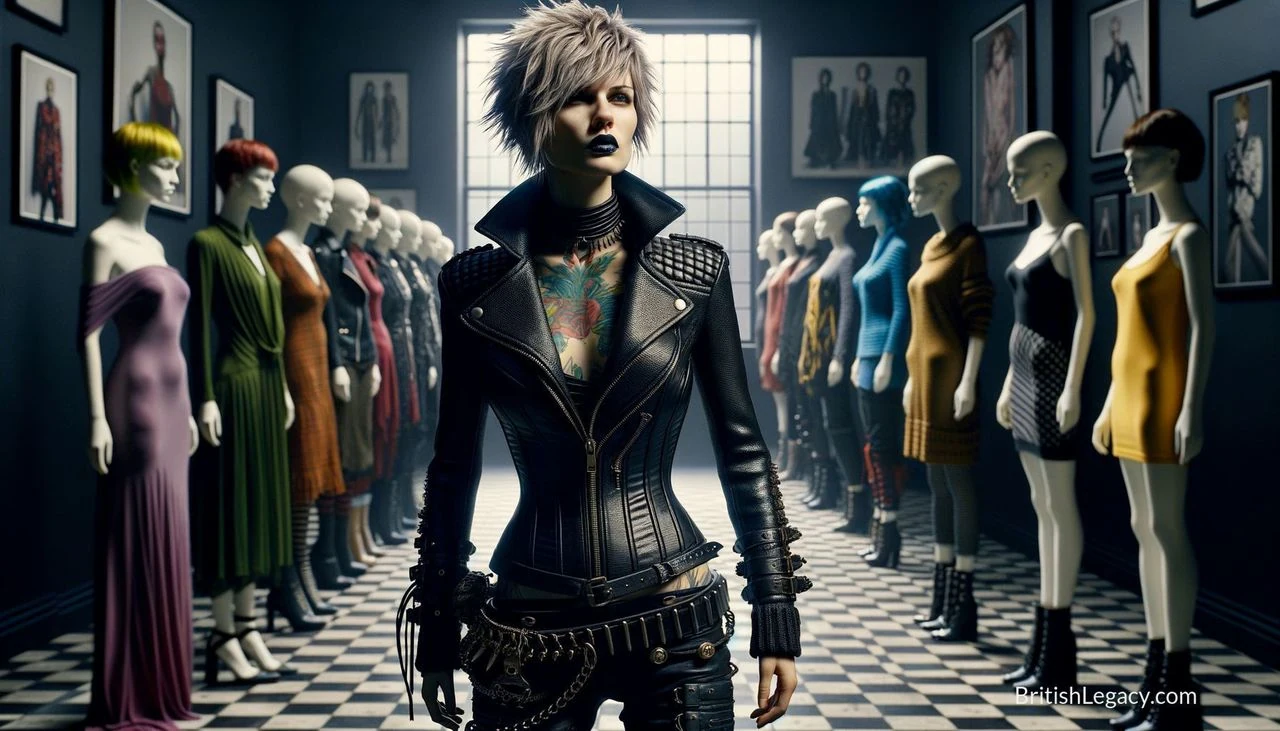
The clothes sold through Sex and Seditionaries were meant to provoke. Designs used torn fabric, prominent zips and slogans; some drew on fetish wear. Westwood and McLaren’s work challenged conventions of dress and gender, and their designs became closely connected with the punk movement. McLaren managed the Sex Pistols, whose members wore their clothes. The connection between music, shop and street style helped make the look immediately recognisable.
Westwood later described punk as a way to “put a spoke in the system”. That idea mattered as much as the clothes themselves. Her early designs were not simply a uniform for a new subculture: they questioned who set the rules of taste and respectability, and whether clothing could make that questioning public. Her work also drew on historical references from the outset, a method that would remain central when she moved beyond the punk scene.
By the mid-1970s, Westwood was dissatisfied with the direction some people had taken punk, treating its style as a marketable look rather than a means of radical change. As the Sex Pistols broke up, she shifted her inspiration towards the eighteenth century. Her approach to fashion would continue to combine historical research with a present-day argument, rather than treating the past as a source of fixed rules.
History transformed into fashion
Pirate, the first Westwood and McLaren collection shown to the media and international buyers, combined eighteenth- and nineteenth-century dress, British history and textiles with African prints. Later collections included Savages, Buffalo/Nostalgia of Mud, Punkature and Witches. Their titles and references signalled that each collection was built around a particular set of ideas, not simply a new season’s shapes.
After the partnership ended, Westwood continued to develop her own label. In the 1980s she explored historical silhouettes, including the mini-crini: a short, bouffant version of the Victorian crinoline. The contrast between the restrictive associations of the crinoline and the miniskirt’s claim to freedom captured the questions her work often posed about beauty, convention and women’s clothing. Corsets, ruffs, bustles and other historical forms appeared in her collections, reshaped rather than reproduced.
Her 1987 Harris Tweed collection brought a traditional Scottish cloth into her fashion vocabulary and established a lasting relationship with the Harris Tweed Authority. The collection is credited with helping revive the fabric’s use in fashion. Westwood’s work with the cloth illustrates how her British references operated: not as decorative shorthand, but as materials and traditions she could study, adapt and put before new audiences.
That practice also informed commissions beyond the runway. In 2008, King’s College London unveiled academic gowns and hoods designed by Westwood after the college gained the right to award degrees. She said her reworking of the traditional robe sought to link “the past, the present and the future”. She also worked with Richard Branson on uniforms for Virgin Atlantic crew; the designs used recycled polyester as part of an effort to reduce environmental impact.
Fashion as public argument
Westwood used clothing and public appearances to make political positions visible. In 1989 she appeared on the cover of Tatler wearing a suit ordered for Margaret Thatcher, accompanied by the caption “This woman was once a punk”. In 2005, she worked with the civil-rights group Liberty on T-shirts bearing the words “I AM NOT A TERRORIST, please don’t arrest me”, with proceeds supporting the organisation’s campaign on civil liberties.
Her environmental campaigning became another sustained part of her public life. She spoke against consumerism and urged people to buy less and choose carefully. Her activism included campaigning for nuclear disarmament and speaking about climate change. In 2009, she cut off her hair to draw attention to the dangers of climate change. She also promoted vegetarianism and awareness of the meat industry’s water use in a campaign for PETA.
Westwood’s fashion business and environmental principles did not always sit comfortably together. In 2013, Eluxe Magazine criticised the sustainability of some products and questioned the gap between her public message and the company’s practices. The tension between campaigning against overconsumption and operating a fashion label is part of the record, rather than something to smooth over. In 2015, Westwood announced she would stop expanding her business as a way of addressing environmental and sustainability concerns.
Her political interventions were not confined to a single party or campaign. She supported the Green Party in 2015, later backed Jeremy Corbyn for the 2017 general election and endorsed him again in 2019. She also supported Julian Assange and WikiLeaks, dedicating a collection to Chelsea Manning in 2013 and campaigning against Assange’s extradition. These positions brought her fashion and activism together in public, sometimes through slogans, sometimes through the staging of a collection or protest.
Recognition and remembrance
Westwood received the OBE in 1992 for services to fashion design and was made a Dame Commander of the Order of the British Empire in 2006 for services to British fashion. She won British Designer of the Year three times. Her other recognition included a fellowship at King’s College London and an honorary degree from Heriot-Watt University, which recognised her contribution to the industry and use of Scottish textiles.
She died in Clapham, London, on 29 December 2022, aged 81. A private funeral was held at Christ Church in Tintwistle, where she had grown up, and a memorial service followed at Southwark Cathedral in London. Her career left a record not only in clothing and collections but also in the institutions, campaigns and public debates she engaged with.
Why Dame Vivienne Westwood deserves a place in British Legacy
Westwood’s place in British Legacy rests on a specific achievement: she helped make fashion an active part of British cultural life, connecting the clothes of the King’s Road with the music and street culture of punk. Her early work with McLaren gave a new movement a striking visual language, but she did not remain defined by that moment. Through collections such as Pirate and her later use of historical silhouettes, she showed how research into dress could be turned into contemporary design. Her reinterpretation of Harris Tweed also brought a traditional Scottish textile into a new fashion context, with the collection credited with helping revive its use.
Her influence also came from treating clothing as a means of communication. Westwood used designs, slogans and public appearances to address civil liberties, nuclear disarmament and climate change. The tensions between her activism and the operation of a fashion business deserve acknowledgement, as does her decision to halt business expansion on sustainability grounds. This combination of design achievement, engagement with British materials and visible political argument makes her story more than a tale of individual style. It records how one designer helped shape the image of punk, carried British fashion references to international audiences and used a creative career to take part in public debate.
Sources
Vivienne Westwood — Wikipedia revision 1379274637
Adapted in part from Vivienne Westwood by Wikipedia contributors, under CC BY-SA 4.0. Text has been edited and combined with the existing article; this adapted text is shared under the same licence. Contributor history.
.jpg)