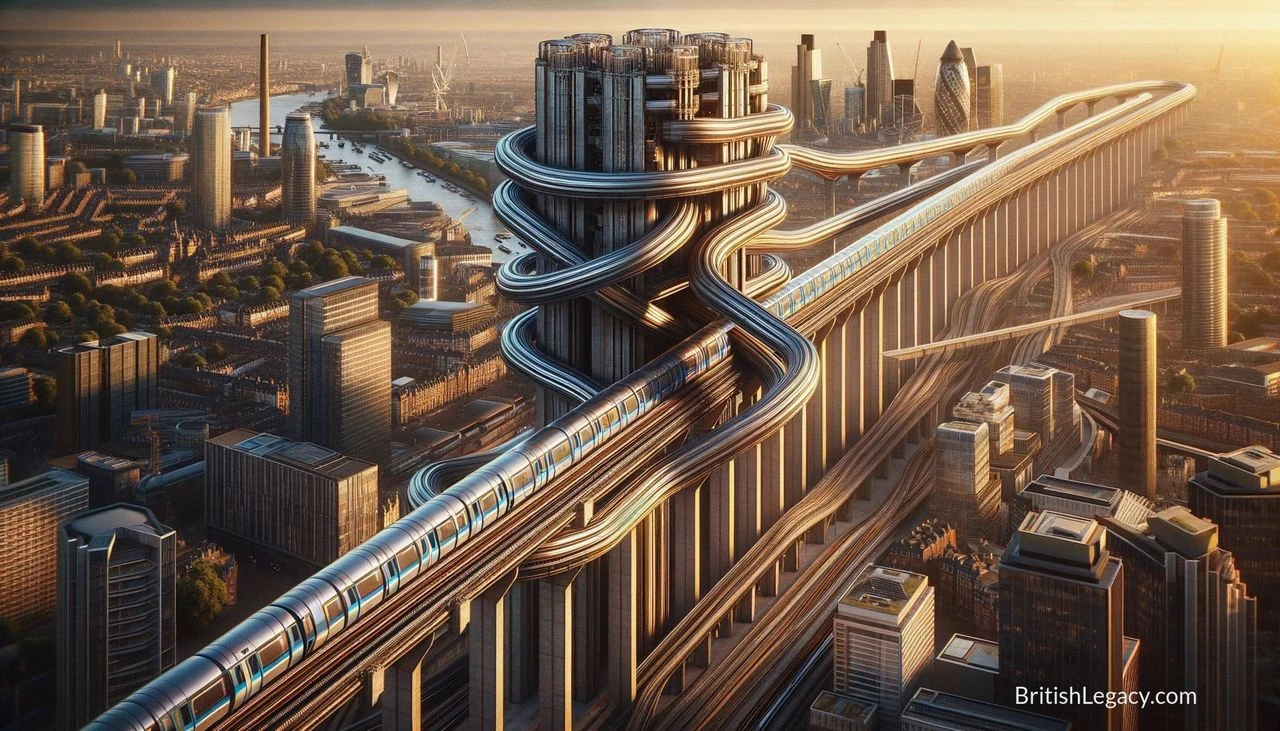
Crossrail was conceived as a way to improve movement through London’s crowded transport network. Its outcome, the Elizabeth Line, provides a high-capacity railway route across the capital, linking Reading and Heathrow in the west with Shenfield and Abbey Wood in the east. Beneath central London, new tunnels carry trains through a route that connects places and services that were previously less directly joined.
A route across the capital
The project took shape against concerns about London’s growing population and the demands on its ageing transport network. The Crossrail Act received parliamentary approval in 2008, providing the basis for a major new railway scheme. The line was later named the Elizabeth Line in honour of Queen Elizabeth II.
Its scale is apparent in the route and its stations. The railway extends for more than 100 kilometres, serving 41 stations: ten newly built and 31 extensively upgraded. Rather than simply adding a central section, the scheme brings together a west-to-east corridor that reaches beyond central London at both ends. The result is a direct connection between areas including Heathrow, Reading, Canary Wharf, Shenfield and Abbey Wood.
That through-route changes how passengers can travel across the city. Journeys that once involved several changes can be made more directly, and the line’s high capacity adds another option for people moving between London’s principal centres. The original account gives Paddington to Canary Wharf as an example: a journey of about 17 minutes, compared with an earlier estimate of 30 to 40 minutes. Travel-time savings vary by journey, but the example conveys the practical appeal of a railway designed to cross the capital rather than terminate at its centre.
Building beneath a historic city
One of the project’s defining tasks was creating new tunnels beneath London’s historic core. More than 42 kilometres of tunnels were excavated using tunnel-boring machines, including machines named Ada and Phyllis. The tunnelling allowed a new railway to pass below the existing city and its transport infrastructure, while the wider project also involved building stations and upgrading others.
The scheme’s station design sought to balance new construction with London’s established character. The original account describes contemporary designs alongside traditional architecture, with public art incorporated into stations. These elements make the stations part of the experience of using the line, as well as points of access to it. They also show how a large transport project can affect the public realm, not just the time spent on a train.
That combination of underground engineering, station construction and network connections helps explain why Crossrail was more than a tunnel project. Its works had to serve a railway operating across a broad area, with new and upgraded stations forming part of one route. The line’s scale is therefore measured not only by the kilometres of tunnel but by the connections the finished network makes possible.
Access, regeneration and the limits of prediction
Improved access is the clearest intended benefit described for the Elizabeth Line. Direct links between major business centres, including Canary Wharf, can make cross-city journeys simpler. Places that were less accessible by direct rail connections may become easier to reach, potentially supporting closer economic links and development around stations.
The project’s economic case has included an estimate that it could generate £42 billion for the UK economy. That figure is a forecast, not a measurement of a result already achieved. The original account also associates Crossrail stations with commercial and residential development, regeneration and job creation. These are potential or reported wider effects of improved transport access; they should not be confused with the railway’s direct, readily described function of carrying passengers across London.
The same care is needed with environmental claims. An efficient alternative to road travel may help reduce road journeys, congestion and emissions, but the scale of any such effect depends on passenger choices and wider transport conditions. The line adds capacity and choice to London’s public transport network; its environmental contribution is best understood in that context, rather than as a guarantee of particular reductions.
Why Crossrail deserves a place in British Legacy
Crossrail deserves a place in British Legacy because it is a substantial public work built to address a recognisable urban problem: moving people across a growing capital whose existing transport network faced increasing pressure. The Elizabeth Line links western and eastern destinations through a new central route, joining Reading and Heathrow with Shenfield and Abbey Wood. Its 41 stations combine new construction with extensive upgrades, while more than 42 kilometres of tunnels carry the route beneath London. These are specific achievements of planning and engineering, not abstract claims about national ingenuity.
The line’s importance also lies in the everyday benefits its design seeks to provide. A direct, high-capacity route can reduce the need for changes and make journeys between major centres more convenient; the Paddington–Canary Wharf example illustrates the difference this can make. Better connections can also support access to employment and development around stations, although economic and environmental forecasts should remain distinct from proven outcomes. Named for Queen Elizabeth II, the railway joins a practical transport purpose with a lasting alteration to London’s infrastructure. Its legacy will be judged through the connections it enables and the city’s ability to make good use of them.