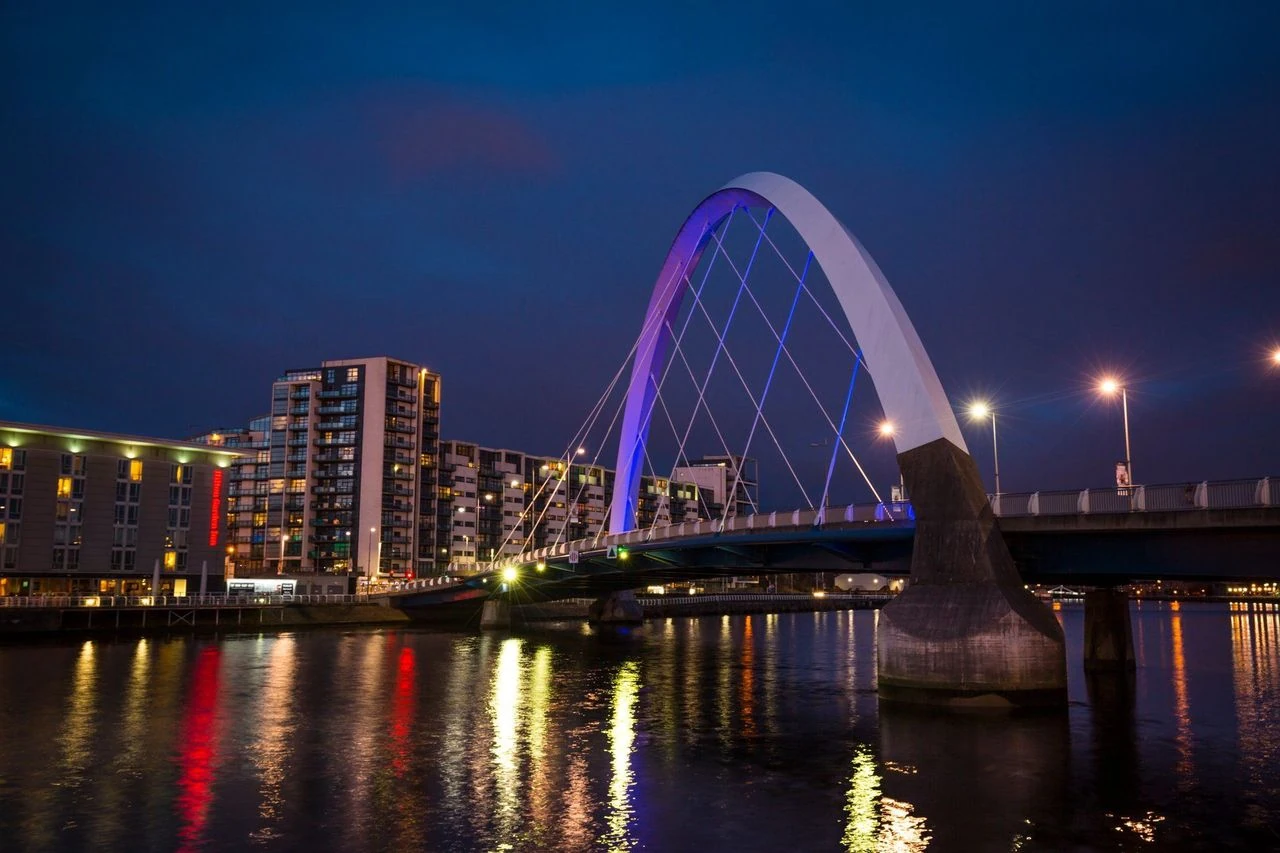
Glasgow’s Clyde Arc is both a working road bridge and a defining feature of the modern riverside. Its diagonal line across the River Clyde gives it the local nickname “the Squinty Bridge”; its purpose is more direct, linking Finnieston on the north bank with Pacific Quay on the south. Opened in 2006, the crossing joined a practical transport link to a striking silhouette on the city’s skyline.
A new crossing over the Clyde
The bridge was designed by the Halcrow Group and built by Edmund Nuttall Ltd. It officially opened on 18 September 2006. Its position, spanning the river at an angle, distinguishes it from a conventional straight crossing and explains the nickname by which it is widely known locally.
The Clyde Arc carries road traffic, and its design also provides lanes for cyclists and pedestrians. It therefore serves different kinds of journeys between the river’s north and south banks. The connection reaches from Finnieston to Pacific Quay, where the Glasgow Science Centre is located. The bridge’s transport role is closely tied to the places it joins: it offers a direct route across the river for people travelling between these parts of Glasgow.
The original account describes the bridge as easing congestion on other bridges and roads and shortening journey times. Those benefits reflect the central function of a new crossing: adding a route across a river that can otherwise channel movement towards existing crossings. The bridge’s provision for walking and cycling also means that the connection is not limited to motor vehicles.
Form and construction
The Clyde Arc’s bowstring arch curves over the river while the crossing takes a diagonal course between its banks. The account gives the span as 96 metres and the arch height as 27 metres, with suspension cables supporting the structure. Its steel form makes the bridge conspicuous in the Glasgow skyline while carrying its transport function.
Construction involved assembling the bridge in a north–south position before pivoting it into its final diagonal alignment. That sequence made the positioning of the crossing a notable part of the project. The finished bridge is not simply a straight span between opposite banks: its final angle is central to both its appearance and the name “Squinty Bridge”.
A Glasgow landmark
The bridge has become a recognisable element of Glasgow’s riverside, appearing in depictions of the city and providing a setting for civic events. Its illuminated structure is another part of its public presence: at night, lights in a range of colours give the crossing a different appearance from the steel profile seen by day.
These visual qualities sit alongside the bridge’s everyday use. It joins two parts of the city, carries traffic and accommodates people walking and cycling. Its contribution is therefore both practical and civic: the crossing forms part of the transport network, while its unusual outline has given Glasgow a modern landmark on the Clyde.
Why the Clyde Arc deserves a place in British Legacy
The Clyde Arc deserves a place in British Legacy because it represents a clear, local achievement in contemporary public works. Designed by the Halcrow Group and built by Edmund Nuttall Ltd, it was opened in Glasgow in 2006 as a new crossing between Finnieston and Pacific Quay. Its combination of a road route with provision for pedestrians and cyclists makes its purpose tangible: it connects places and supports more than one way of travelling across the Clyde.
Its significance is also visible in the form of the bridge itself. The angled alignment, bowstring arch and pivoting construction give the crossing a distinctive identity, while its illumination and place in views of the city have made it a recognisable part of Glasgow’s riverside. The Clyde Arc’s British connection is specific rather than abstract: it is a Scottish city’s transport link and landmark, designed and constructed by named engineering firms. It shows how public infrastructure can shape daily movement and contribute to the character of a place at the same time.