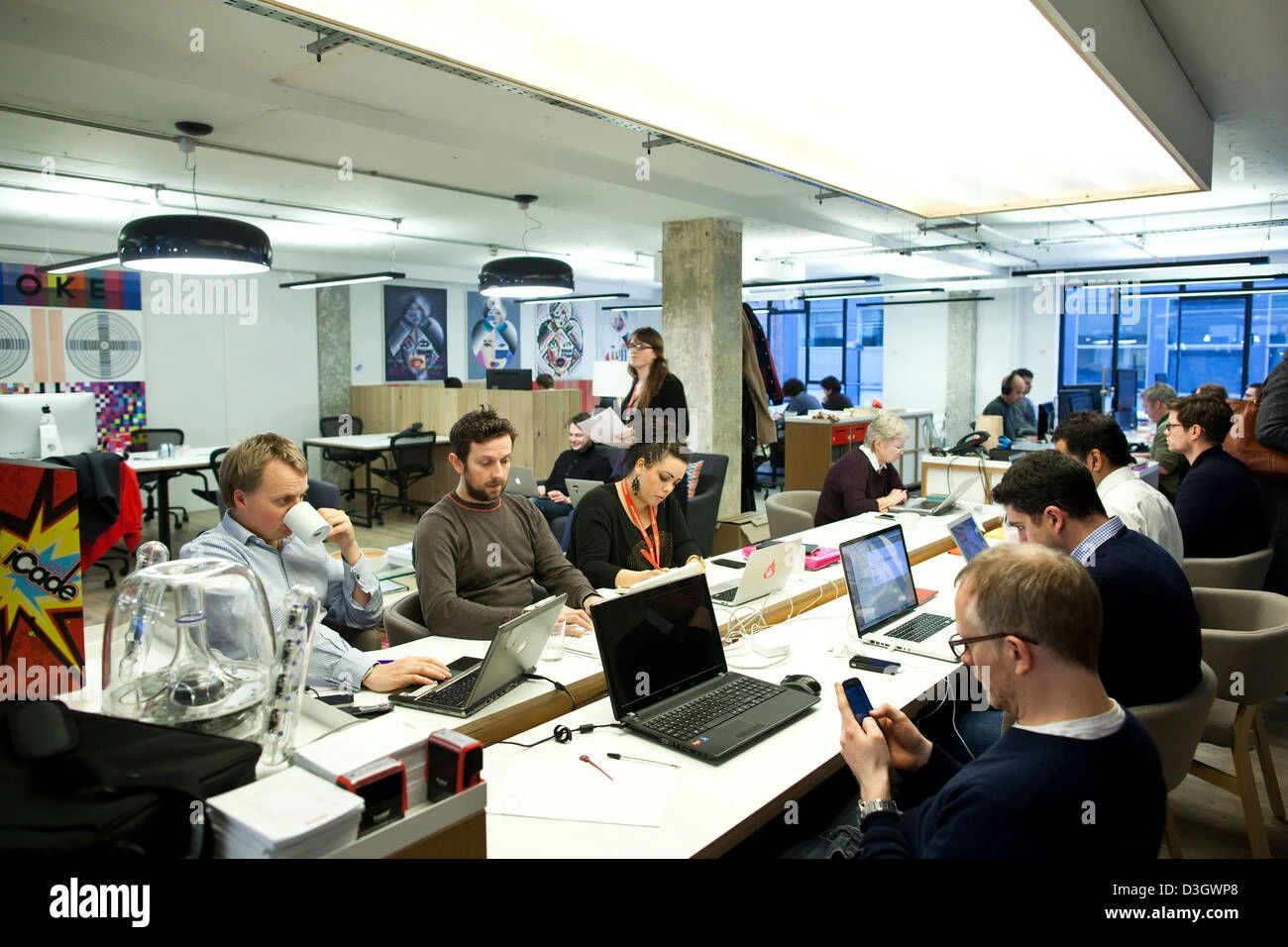
East London Tech City grew from a gathering of web businesses around Old Street into a technology cluster spanning parts of Hackney and Islington. Known also as Tech City and Silicon Roundabout, it was not created in a single act of planning: start-ups were already moving into the area before the government announced a growth initiative in 2010. Its story is therefore one of local conditions, entrepreneurial activity and efforts by public bodies, universities and larger companies to build a wider technology ecosystem.
Why businesses gathered around Old Street
The cluster’s main area lies broadly between St Luke’s and Hackney Road, with an accelerator space for spin-out companies at Queen Elizabeth Olympic Park. Its location on the City Fringe mattered, but so did the circumstances of the late 2000s. The area had historically been relatively poor compared with the City of London. The 2008 financial crisis contributed to lower rents as firms closed, while redundancies in financial services released experienced workers who were interested in starting businesses.
Web companies had begun to establish a presence around Old Street by 2008. Among those named as early arrivals were Last.fm, Dopplr, Songkick, MOO, TweetDeck and Trampoline Systems. The nickname “Silicon Roundabout” began as a tongue-in-cheek suggestion by Matt Biddulph. It captured the concentration of digital businesses around the junction, though the cluster itself extended beyond the roundabout.
These beginnings differ from the idea of a technology district deliberately founded in the late 1990s. The evidence points instead to a cluster that formed around Old Street by 2008, with changing rents and a pool of entrepreneurial talent helping to make the area attractive. That distinction matters: public policy later sought to accelerate an existing concentration rather than create it from nothing.
From an emerging cluster to a public initiative
On 4 November 2010, Prime Minister David Cameron announced plans to help accelerate the cluster’s growth. The stated ambition was to create a technology centre comparable with Silicon Valley. A year later, Cameron said entrepreneur Eric van der Kleij would lead the initiative. Support came from local as well as national government, and the area attracted investment from companies including Cisco Systems, Facebook, Google, Intel, McKinsey & Company and Microsoft.
The pace of growth was reflected in changing estimates. There were 85 start-up companies in the area in 2010 and about 200 firms in 2011. A 2012 estimate cited by Wired put the number of technology companies in the wider area centred on Old Street at around 5,000. The figure describes a much broader geography than the roundabout itself, and the different counts should not be treated as a like-for-like measure.
Google’s involvement provided a visible example of the support infrastructure taking shape. In 2011 it announced the acquisition of a seven-storey building in Bonhill Street, intended for work space and activities including talks, hackathons, workshops and product demonstrations. The building opened as Campus London in March 2012. Alongside such spaces, accelerators and business networks offered routes for start-ups to meet mentors, investors and potential collaborators.
Companies, institutions and a wider network
The cluster brought together businesses at different stages and in different fields. The companies associated with it include Wise, previously known as TransferWise, as well as Songkick, Last.fm and TweetDeck. The earlier group of web businesses included firms working across music, social platforms, online services and software. The mix is more telling than a claim that every company shared a single model: East London Tech City was a concentration of businesses and support organisations, not one firm or a narrowly defined industry.
Universities and other educational partners formed another part of that network. City, University of London, London Metropolitan University, Imperial College London, Queen Mary University of London and University College London have all been involved in projects associated with the cluster. At the Olympic Park, plans for links between universities and enterprise included support for spin-out companies. These relationships connected research and graduate talent with commercial activity, while the city’s wider collection of investors, professional advisers and technology firms supplied other kinds of support.
Community organisations also helped give the area a shared identity. Independent Shoreditch brought businesses together, while Digital Shoreditch organised monthly meet-ups and an annual festival. A separate Silicon Roundabout meet-up community had been organising events since 2011. The cluster’s identity was thus built not only through property, companies and government policy, but also through recurring opportunities for people working in the area to meet.
Investment, criticism and the costs of growth
London’s technology sector attracted substantial investment during this period. Investment in the sector reached $2.28 billion in 2015, up from $1.3 billion in 2014; London-based technology companies had raised a collective $5.2 billion in venture capital since 2010. These figures concern London’s technology sector as a whole, rather than East London Tech City alone. They indicate the wider financial environment in which the cluster developed, not a sum that can be attributed solely to Old Street.
Growth also drew criticism. A Centre for London report in 2012 questioned whether development had a sufficiently clear focus and raised concerns about skills shortages, connectivity, mentoring and rising costs. James Dyson criticised government spending on attracting international companies, arguing that this could push up rents rather than help start-ups and hardware businesses. Such objections complicate a simple success narrative: attracting firms and investment did not automatically answer questions about who benefited, which businesses received support or whether the area remained accessible to new entrants.
Transport and the surrounding neighbourhood were part of the practical context. Old Street is served by the Northern line’s City branch and the National Rail Northern City Line, operated by Great Northern. As passenger numbers rose, Transport for London announced in 2014 that it would offer pop-up retail space at the station as part of an effort to increase revenue. Housing developments were also built or planned as the cluster expanded. The area’s development therefore touched not only technology businesses, but also the everyday questions of movement, workspace and housing.
Why East London Tech City deserves a place in British Legacy
East London Tech City deserves a place in British Legacy as a documented example of how a technology cluster can emerge from local conditions and then become the focus of deliberate public policy. Web businesses had gathered around Old Street by 2008, amid lower rents and a changing labour market. The 2010 initiative sought to accelerate that growth; subsequent investment, work spaces and university partnerships helped establish a wider network. The sequence matters because it shows the interaction between private enterprise and public support, rather than presenting innovation as the result of a single plan or a handful of celebrated companies.
The cluster’s legacy is also visible in the range of relationships it brought together: start-ups, larger technology firms, universities, investors, professional services and community organisations. Campus London, university-linked projects and local meet-ups each represent different ways of making a business environment more useful to people trying to develop ideas. At the same time, concerns about rising costs, skills, mentoring and access belong in the account. They show that economic growth does not settle questions about inclusion or long-term benefit. For British Legacy, East London Tech City is significant not as a simple emblem of national technological supremacy, but as a specific London case study in how enterprise, institutions and public choices shaped a changing urban district.
Sources
Adapted in part from East London Tech City by Wikipedia contributors, under CC BY-SA 4.0. Text has been edited and combined with the existing article; this adapted text is shared under the same licence. Contributor history.