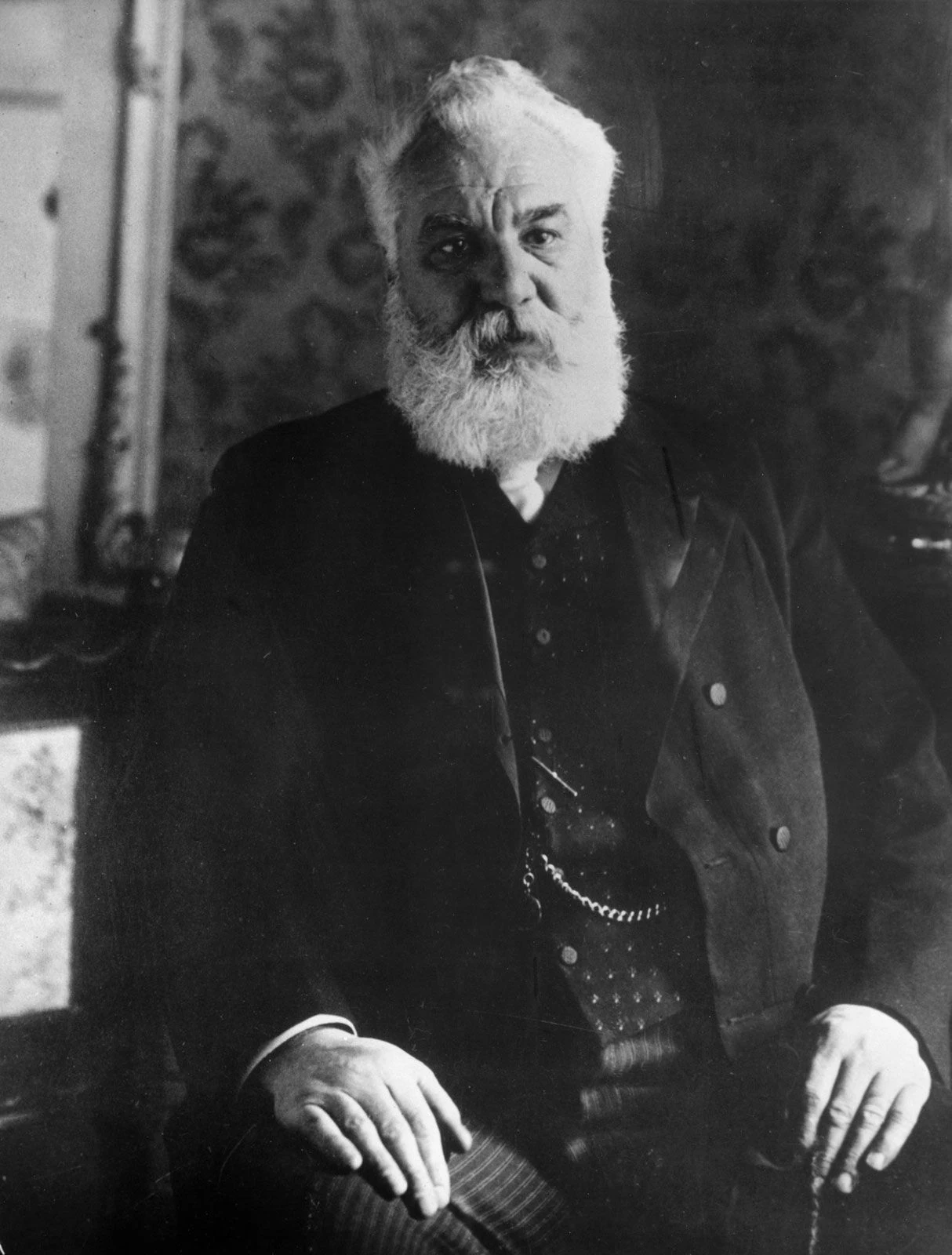
Alexander Graham Bell is usually remembered for the telephone. Yet the invention was the culmination of a much longer interest in how people speak, how sound can be studied and how communication might cross distance. Bell’s story began in a family devoted to speech and phonetics, continued through education in Edinburgh and London, and reached its decisive experimental stage in North America. Holding those parts together gives a fuller account than the familiar picture of a lone inventor with a single sudden idea.
A Scottish education in speech
Bell was born in Edinburgh on 3 March 1847. He grew up in a household where speech was both a subject of study and part of family life. His father, Alexander Melville Bell, was an authority on elocution and developed Visible Speech, a system of symbols designed to represent how speech sounds are produced. His mother, Eliza Grace Bell, became deaf. Bell’s interest in communicating with her formed part of a broader engagement with sound, articulation and hearing.
His education included study at the University of Edinburgh and University College London. These were formative years, not the setting for the invention of the telephone. They gave Bell grounding in the study and teaching of speech, building on his father’s work and his own developing interest in how the voice could be represented and understood. London was one part of that intellectual formation; it should not be mistaken for the place where Bell developed the practical telephone.
The distinction matters. Bell’s British connection is substantial without needing to exaggerate it. He was born in Scotland, studied in Edinburgh and London, and grew up within a family shaped by the sciences and arts of speech. But the practical telephone emerged later, after the family moved to Canada. The story is not of an invention completed in London, but of ideas and training carried from Britain into a new setting.
Bell’s family experience helps explain why the voice remained a central subject for him. His father’s system sought to make the physical production of sounds visible and teachable; his mother’s deafness made communication an intimate concern as well as an intellectual one. The work that followed was not simply a matter of electrical apparatus. It involved asking what speech consists of, how its sounds are formed and whether the qualities that distinguish a spoken voice could be represented and conveyed. That starting point separates Bell’s career from a narrower story of mechanical invention.
From sound to electrical transmission
In 1870, after the deaths of his brothers and concerns about the family’s health, the Bells moved to Canada. At the family home near Brantford, Ontario, Bell continued to explore questions about sound and transmission. The move changed the setting, not the subject of his attention. He was still interested in what sound consisted of and whether it could be reproduced at a distance.
Bell’s route to the telephone ran through the harmonic telegraph. He was trying to find a way to send several telegraph messages along one wire, using different pitches to distinguish them. This work made him consider the relationship between vibration, frequency and electrical signals. It also helped turn his attention from the transmission of coded clicks towards the possibility of transmitting the human voice.
In 1875 Bell sought advice from Joseph Henry of the Smithsonian Institution, who encouraged him to pursue research into transmitting vocal sounds. Bell also worked with Thomas Watson, a mechanic and electrical designer. Bell brought ideas and an experimental drive; Watson helped turn them into working apparatus. Their collaboration is an important part of the history. The telephone was not simply the product of an isolated flash of inspiration, but of thinking, practical work and repeated attempts to make a system function.
That progression gives the invention its context. Bell’s earlier work on phonetics and speech did not itself produce an electrical telephone. His work on the harmonic telegraph did not immediately yield a finished device either. But each stage brought him closer to a practical question: whether a changing electrical current could carry the changing patterns of spoken sound, and whether those patterns could be heard again at the other end.
The Bell family home near Brantford became an important setting for that development. The work there linked earlier interests in speech and vibration with trials of transmission at a distance. It is useful to distinguish conception, experiment and public demonstration rather than collapse them into a single moment. Bell’s move to Canada did not erase his British intellectual formation, but the practical invention took shape beyond Britain, through a combination of theory, equipment and collaboration.
The telephone becomes practical
In 1876 Bell applied for a United States patent for the telephone. The application reached the Patent Office on 14 February, and the patent was issued on 7 March. On 10 March, an experiment in Boston produced the sentence most closely associated with the invention: “Mr Watson, come here – I want to see you”. Its significance was not its eloquence. The words were ordinary speech, successfully sent through a wire and understood at a distance.
The experiment was followed by public demonstrations. At the Centennial Exposition in Philadelphia later that year, the telephone attracted international attention. Bell also demonstrated the instrument’s reach in Brantford. A long-distance call to Paris, Ontario, on 10 August 1876, is recorded among the early demonstrations of the telephone’s capabilities. A device that could carry speech beyond a room suggested new possibilities for business, public administration and everyday contact.
Bell’s contribution is best understood through the telephone’s practical development as well as the question of priority. Related ideas were pursued by others, and disputes over claims to telephone invention remained part of its history. Bell’s patent, experiments and demonstrations helped establish a system that could be improved and commercialised. In 1877 he co-founded the Bell Telephone Company; in 1885 he co-founded the American Telephone and Telegraph Company, later known as AT&T. Those were distinct steps in the growth of a telecommunications industry, not a single company founded under one name.
The change was not merely technical. The telephone allowed people to speak directly across distance rather than rely only on written messages. Offices could exchange information more quickly; families could hear one another when they were apart. Bell did not create every later use or form of telecommunications, but his work helped make voice transmission a practical technology and placed it at the centre of modern communication.
The public demonstration mattered because it made a new kind of communication intelligible to people who had not seen the experiments. A spoken sentence could be heard at the other end of a wire, retaining the immediacy of a voice rather than arriving as a sequence of written words or coded clicks. The Philadelphia exhibition helped bring the instrument before a wider audience, while the Brantford demonstrations made distance itself part of the proof. The telephone’s future applications were not all present at once, but its practical promise was becoming apparent.
Beyond the telephone
Bell continued to experiment after the telephone made him famous. At the Volta Laboratory he worked on sound recording and helped improve the phonograph’s recording medium. In 1880 he and Charles Sumner Tainter developed the photophone, which transmitted sound using a beam of light. Bell later described it as his greatest invention. Its approach anticipated a principle associated with fibre-optic communication, though the technology needed to make that principle widely useful came much later.
His interests extended to movement through water and air. In Nova Scotia, Bell worked on hydrofoils; the HD-4 set a world marine speed record in 1919. He also supported early aviation research through the Aerial Experiment Association, organised at Baddeck with strong support from his wife, Mabel. The association’s work helped lead to the Silver Dart’s Canadian flight in 1909. These projects were different in subject from the telephone, but shared an emphasis on experiment and on turning difficult technical ideas into working machines.
Bell also took part in the development of institutions concerned with knowledge and public communication. He held a leading role in the National Geographic Society around the turn of the century and influenced the magazine’s development towards more visual presentation. That work is less famous than the telephone, but it belongs to the wider record of a person interested not only in devices but in how information could reach people.
The range of these later projects makes the telephone a starting point for understanding Bell, not a complete account of his work. The photophone explored the transmission of sound by light; sound recording concerned how voices might be captured and reproduced; hydrofoil and aviation experiments addressed movement through water and air. The settings and problems differed, but the common thread was practical investigation: developing an idea far enough to test what it could do.
Deaf education and a contested legacy
Bell’s work with deaf pupils and teachers was a significant part of his life. He taught and lectured, supported educational institutions and studied ways to teach articulation and lip-reading. His family experience and his interest in speech were closely connected to that work. It would be misleading to treat deaf education as a minor footnote to the story of the telephone.
It is equally important to recognise that Bell’s educational views remain contested. He was a prominent advocate of oralism, which favoured speech and lip-reading rather than sign language. Many Deaf people and historians have criticised oralism for devaluing sign languages and Deaf culture. Bell’s interest in heredity and his concern about the formation of a separate deaf community also sit uneasily with modern readers. These are not complications to be brushed aside in an account of his achievements. They show the limits of his thinking about communication and the people he hoped to help.
Bell’s legacy therefore requires both acknowledgement and criticism. His work on speech and education was sustained and influential; some of his views have caused lasting concern. Neither fact cancels the other. A clear account can recognise the scale of his technical achievements while also taking seriously the consequences of ideas that many Deaf people have experienced as restrictive or harmful.
This tension is especially relevant because communication was not an abstract topic in Bell’s life. He worked on speech, taught deaf pupils and considered how people might communicate, but his preference for oralism placed spoken language above signing. That position reflects a real historical disagreement over educational methods and the status of sign languages. Acknowledging his efforts in education without repeating a celebratory account of them as uncomplicated benevolence makes the record more accurate and more respectful of those affected by the debate.
Why Alexander Graham Bell deserves a place in British Legacy
Bell deserves a place in British Legacy because his life connects a British education in speech and sound with a technological change that reached far beyond Britain. Edinburgh and London formed part of his intellectual background; his family’s work on elocution and phonetics helped make the voice an object of close study. The telephone itself was developed and demonstrated in North America. That distinction strengthens rather than weakens the British connection: Bell’s British formation was one part of a wider history in which knowledge travelled, was tested and became useful across national boundaries.
The benefits associated with Bell’s work are tangible. By helping make electrical speech transmission practical, he contributed to a technology that allowed people to talk across distances without waiting for letters. The telephone changed the pace of communication in business and public life, and made immediate conversation possible for people separated by geography. His later work on the photophone, sound recording, hydrofoils and aviation shows an inventive career broader than one celebrated object. His efforts in deaf education, alongside the criticism of his oralist views, also make the story more than a simple tale of progress.
His British significance lies in a specific formation, not in a claim that Britain alone produced the telephone. Bell was born in Edinburgh and studied in Scotland and London; he developed his practical work after moving to Canada and working in North America. That chronology allows British Legacy to recognise the part played by British institutions and a family tradition of speech study without claiming an invention that belongs to a broader, international history. It also illustrates how education and ideas can cross borders and acquire new practical force in a different place.
Remembering Bell means recognising both the British roots of his formation and the international reach of what followed, while keeping the history candid about its contested parts. His telephone helped make direct speech at a distance an everyday possibility; his other experiments extended his work into light, recording, water and flight. The legacy is therefore not a single device or an uncomplicated verdict on its inventor. It is a consequential body of work, shaped in part by British study, whose benefits and limitations deserve to be understood together.