
Barbara Hepworth made sculpture in which an opening could matter as much as the material around it. Her pierced forms, carved first in stone and wood and later cast in bronze, brought mass and space into direct relation. Born in Wakefield, she became one of the leading figures in British modernism, helping to connect artistic experiments in London with the community of artists that gathered in St Ives during the Second World War.
Yorkshire beginnings and a new kind of sculpture
Jocelyn Barbara Hepworth was born in Wakefield on 10 January 1903, the eldest child of Gertrude and Herbert Hepworth. She attended Wakefield Girls’ High School and won a scholarship to Leeds School of Art in 1920. There she met Henry Moore. The two Yorkshire artists became friends and maintained a professional rivalry over many years.
In 1921 Hepworth won a county scholarship to study at the Royal College of Art in London. She completed her studies in 1924, then travelled to Florence on a West Riding travel scholarship. There she learned to carve marble from the sculptor Giovanni Ardini. Her training in direct carving informed a practice that increasingly moved away from conventional representation towards abstraction.
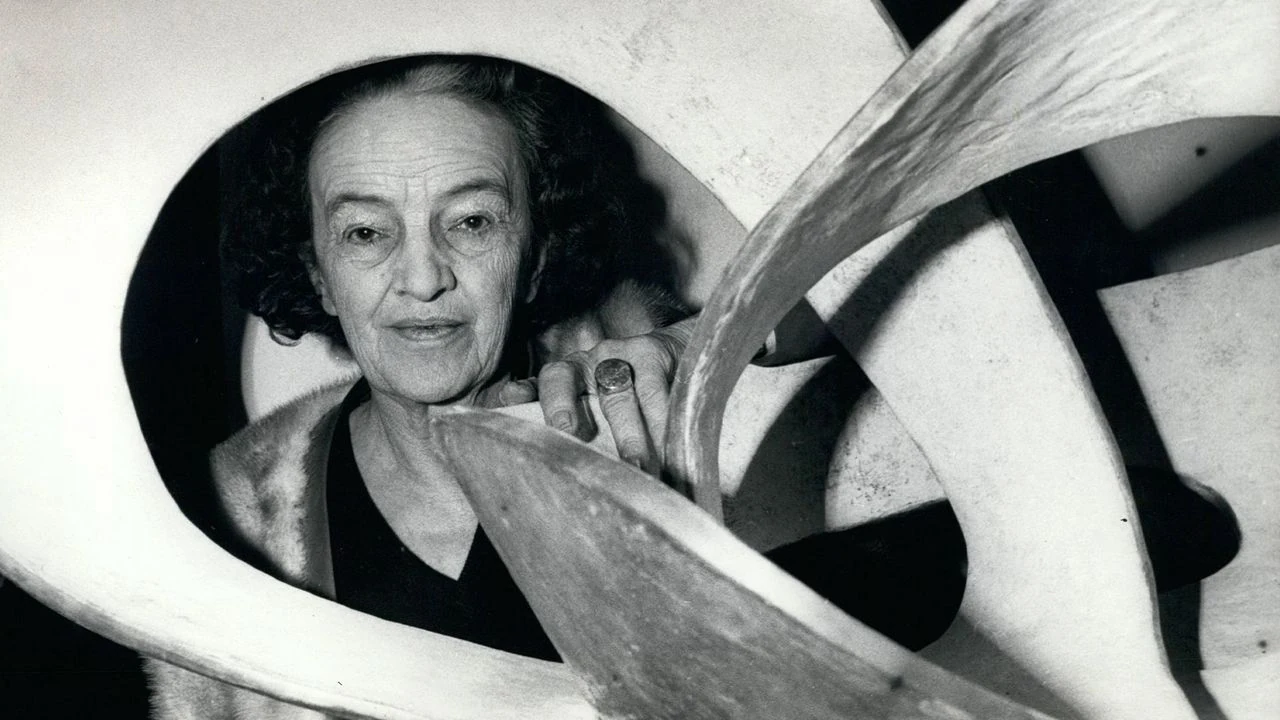
Hepworth was among the first sculptors to make pierced figures, introducing openings that became a recognisable feature of her work and influenced the development of modern sculpture. In 1933 she co-founded Unit One with the painter Ben Nicholson, Paul Nash, the critic Herbert Read and the architect Wells Coates. The group sought to bring abstraction and Surrealism together in British art. Hepworth also helped introduce British audiences to continental artists: in 1937 she designed the layout of Circle: An International Survey of Constructivist Art, a book edited by Nicholson, Naum Gabo and Leslie Martin.
St Ives: a home, a studio and an artistic community
At the outbreak of the Second World War in 1939, Hepworth and her family moved to Cornwall. She remained in St Ives for the rest of her life. In 1949 she moved into Trewyn Studios, a place with a yard and garden where she could work outdoors. Its setting gave her room to make and consider sculpture on a large scale, while the Cornish landscape became an important context for her work.
Hepworth and Nicholson were among the founders of the Penwith Society of Arts, established in St Ives in 1949. The society brought together artists including Peter Lanyon and Bernard Leach. St Ives had already become a refuge for artists during the war; the Penwith Society gave them a local organisation through which to exhibit and exchange ideas.
Her output extended beyond sculpture. After her daughter Sarah was hospitalised in 1944, Hepworth became interested in the work of surgeons. At the invitation of surgeon Norman Capener, she observed operations and made nearly 80 drawings of operating rooms between 1947 and 1949, using chalk, ink and pencil. She also made lithographs, including two suites produced in 1969 and 1971. The latter, The Aegean Suite, drew on a journey she had made to Greece with Margaret Gardiner in 1954.
From public commissions to international recognition
Hepworth’s public work brought modern sculpture into civic and everyday settings. In 1951, the Arts Council commissioned her to make a work for the Festival of Britain. Contrapuntal Forms, carved from Irish limestone, was displayed on London’s South Bank before being given to Harlow, where it remains at Glebelands. She hired her first assistants to help complete the large-scale work; over the course of her career she worked with 16 assistants.
Her sculpture also reached beyond Britain. Single Form, a bronze memorial to her friend and collector Dag Hammarskjöld, stands in the plaza outside the United Nations building in New York. Commissioned after Hammarskjöld’s death, it was completed in 1964. Hepworth’s work appeared in the British Pavilion at the Venice Biennale in 1950, and in 1959 she received the Grand Prix at the São Paulo Art Biennial.
She continued to expand her working space as her commissions grew, buying the Palais de Danse, a former cinema and dance hall across the street from Trewyn, in 1960. At the same time, she remained connected to the town where she had made her home. St Ives awarded her its freedom in 1968. She was also a founder member of Cornwall County Council’s Art in Schools programme and gave several sculptures to the town. That year she was inducted into Gorsedh Kernow, the Cornish cultural organisation, with the bardic name Gravyor, meaning “Sculptor”.
Recognition, loss and a lasting presence
Hepworth was appointed a Commander of the Order of the British Empire in 1958 and a Dame Commander in 1965. She received honorary degrees from universities including Birmingham, Leeds, Exeter, Oxford, London and Manchester. She died in an accidental fire at Trewyn Studios on 20 May 1975, aged 72.
Her home and studio later became the Barbara Hepworth Museum, and the site came under Tate’s control in 1980. In 2011, The Hepworth Wakefield opened in her home town, giving Yorkshire a major public institution named for one of its most influential artists. Her work remains visible in public places as well as museum collections: Winged Figure, for example, is mounted on the John Lewis building on Oxford Street in London. These sites make her sculpture part of the lived environment, not solely the history of galleries and exhibitions.
Why Dame Barbara Hepworth deserves a place in British Legacy
Hepworth’s place in British Legacy rests on the way she helped alter what sculpture could be and where it could belong. Her pierced forms made the space inside a sculpture an active part of its design, while her move from carved stone and wood to bronze and clay widened the possibilities of material and scale. Through Unit One and the Penwith Society of Arts, she also helped build communities in which modern art could be made, discussed and seen. Those were practical contributions to British cultural life as well as individual artistic achievements.
Her story is rooted in places that still connect audiences with that work. In St Ives, the former Trewyn Studios preserve the setting in which she lived and worked; in Wakefield, a major gallery bears her name. Meanwhile, works such as Contrapuntal Forms and Single Form show how her sculpture entered public life in Britain and internationally. Her drawings of operating rooms and her work in lithography also reveal an artist who did not confine herself to one medium or subject. Remembering Hepworth means recognising both the force of her own art and the institutions, public works and artistic networks through which modern sculpture became part of Britain’s shared cultural landscape.
Sources
Adapted in part from Barbara Hepworth by Wikipedia contributors, under CC BY-SA 4.0. Text has been edited and combined with the existing article; this adapted text is shared under the same licence. Contributor history.
_by_Erling_Mandelmann.jpg)